We compared eleven shadcn/ui registries and block packs on price, licence and what they actually install. shadcn/ui itself for primitives, Kibo UI for app components, Magic UI and Aceternity for animation, Shadcnblocks and Tailark for marketing sections, Shadcn UI Kit for dashboards.
Get a dedicated SEO review articlefor your product or service and start ranking for “your brand + review” in search results.
Get Your Review Article
We compared six AI voice to text tools on price, privacy and what they actually do. Wispr Flow wins for everyday dictation, Superwhisper for offline work, MacWhisper for a one-time licence and Otter for meetings.
We compared eight screen recorders on price, licence model and platform. Loom wins for team messages, Screen Studio for polished demos, OBS for free long recordings and CleanShot X for quick Mac clips.
The best shadcn/ui component libraries in 2026 are shadcn/ui itself for primitives, Kibo UI for application components, Magic UI and Aceternity UI for animation, Shadcnblocks and Tailark for marketing sections, and Shadcn UI Kit for admin dashboards.
Calling any of these a "library" is slightly wrong, and the mistake costs people money. You do not install shadcn/ui as a dependency. The CLI copies source files into your repository, you own them, and nothing updates behind your back. Everything in this list follows the same model, which means you are not choosing a package to depend on. You are choosing a registry to copy from, and the real differences are licence, who maintains the code afterwards, and whether the catalog is free or a one time purchase.
That splits the category in two. On one side sit the free, MIT licensed registries: shadcn/ui, Magic UI, Kibo UI, Cult UI, coss ui (the project Origin UI became) and the free kits from Tailark and Hairline UI. On the other sit the commercial block packs that sell the thing nobody enjoys building, which is 40 finished marketing sections or 16 admin dashboards, for a one time fee. One tool here, shadcn.io, breaks the pattern and sells a subscription instead.
Two things changed in 2026 and both matter when you pick. The shadcn CLI reached v4 in March, and in July Base UI became the default primitive layer in place of Radix, so some registries are now on Base UI, some are still on Radix, and a few support both. The other change is MCP. Almost every library in this list now ships an MCP server, which means Claude Code, Cursor or Codex can search the registry and run the install for you instead of you pasting a command.
Prices were checked on November 20, 2026, on each vendor's own pricing page. Several were running Black Friday discounts that day, so both the regular and the sale price are quoted where one applied, and the figure at your checkout may differ.
| Library | Best for | Free tier | Starts at |
|---|---|---|---|
| shadcn/ui | The primitives every other library builds on | Yes, all of it, MIT | $0 |
| Kibo UI | Application components like kanban, gantt and editors | Yes, all of it, MIT | $0 |
| Magic UI | Animated components for landing pages | Yes, 150+ components, MIT | $199 one time for Pro |
| Aceternity UI | Premium looking effects and motion | Yes, 100+ components | $249 for a year, $169 on sale |
| coss ui (was Origin UI) | Clean application components and form inputs | Yes, all of it, MIT | $0 |
| Cult UI | Creative, animated, slightly strange components |
The headline price tells you little here, because these products are sold three different ways and install in two. This is the shape of each deal.
| Library | What you install | How it is sold | The limit to check first |
|---|---|---|---|
| shadcn/ui | 75+ components, blocks, charts, AI Elements | Free, MIT, by Vercel | It gives you primitives, not a finished design |
| Kibo UI | 41 components and 28 blocks | Free, MIT | Niche by design, it assumes you have shadcn/ui already |
| Magic UI | 150+ animated components | Free, MIT, Pro sold separately | Pro is landing page sections, not app UI |
| Aceternity UI | 100+ free components, 200+ premium blocks | Free tier plus a one time licence | The $249 tier is one year of updates, not lifetime |
| coss ui |
Every price, licence term and component count here comes from the vendor's own site, read on November 20, 2026. Where a number is a marketing claim rather than something we counted, it is quoted as the vendor states it.
We judged five things: what you actually get on the free tier, whether the licence covers client work, whether the code installs through the standard shadcn CLI and registry rather than a bespoke setup, which primitive layer it sits on now that Base UI is the shadcn default, and the two year cost for a small team rather than the headline figure.
We did not audit accessibility, bundle size or code quality across all eleven. Claims about counts, performance and AI features are what each vendor publishes, not measurements of our own.
Pros
npx shadcn add works against third party registries and private GitHub ones tooCons
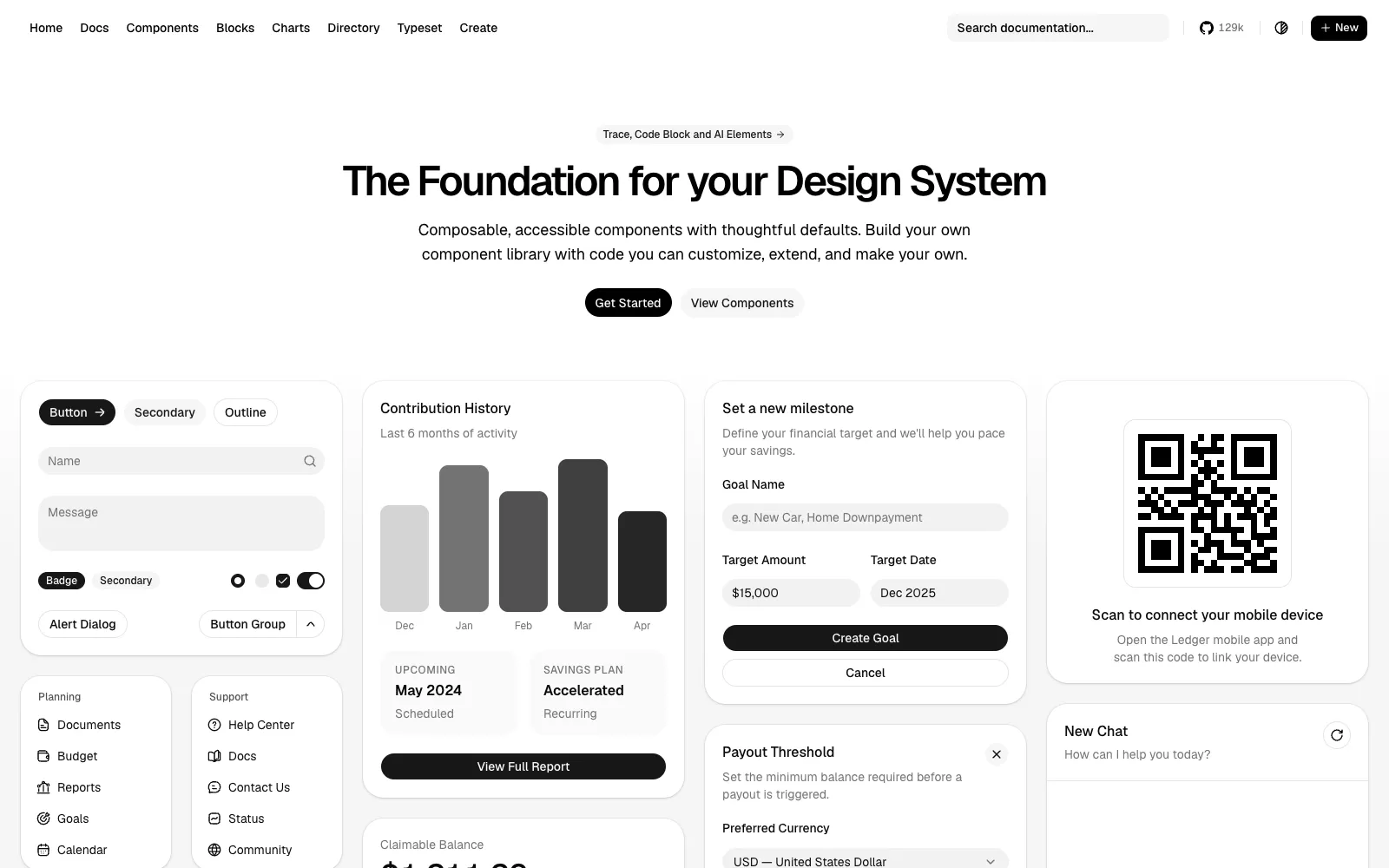
Everything else on this page is a layer on top of this one, so the question is never whether to use shadcn/ui. It is what you add to it. Start here, get the tokens, the theme and the primitives right, then decide whether you are buying sections or building them.
The 2026 releases moved it well past a component collection. The registry now supports namespaces and private GitHub registries, the CLI reached v4 in March, and AI Elements landed in October with ready patterns for agent interfaces: traces, code blocks, streamed messages. If you are building anything that talks to a model, that alone is worth the look.
The honest limitation is unchanged. shadcn/ui hands you a well built, deliberately plain foundation. A landing page that converts still needs sections, motion and art direction, and that is exactly the gap the other ten products in this list sell into.
Who it is for: every React and Next.js project that wants to own its component code. The docs are at ui.shadcn.com.
Pros
npx kibo-ui add, and ships an MCP server for coding agentsCons
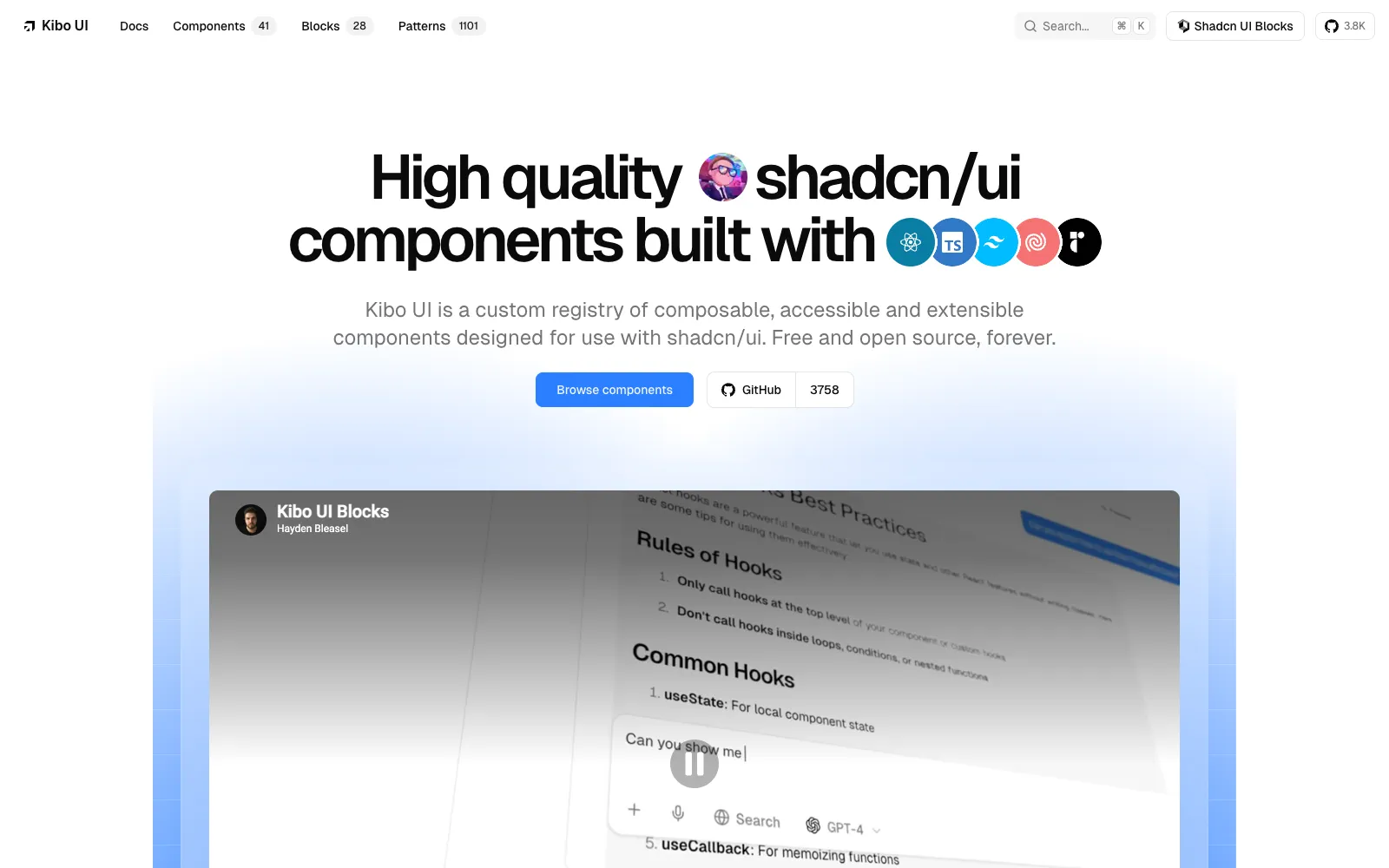
Kibo UI solves the part of a SaaS build that quietly eats weeks. A kanban board with sane drag and drop, a gantt chart that does not need a commercial licence, a file dropzone that handles the edge cases, an editor that is not a six month project. These are the components people copy from Stack Overflow at 1am and regret.
Because it follows the shadcn registry format and reuses your CSS variables, adding it is a one line install rather than an integration. Nothing about it asks you to adopt a second design system, which is why it sits comfortably next to anything else here.
It is a supplement, and it says so. You will not build a landing page from Kibo UI, and the catalog is intentionally short. What is there is the hard part of an application, given away under MIT.
Who it is for: teams building dashboards, project tools and internal apps who need the complicated widgets rather than more buttons. The docs are at kibo-ui.com.
Pros
Cons
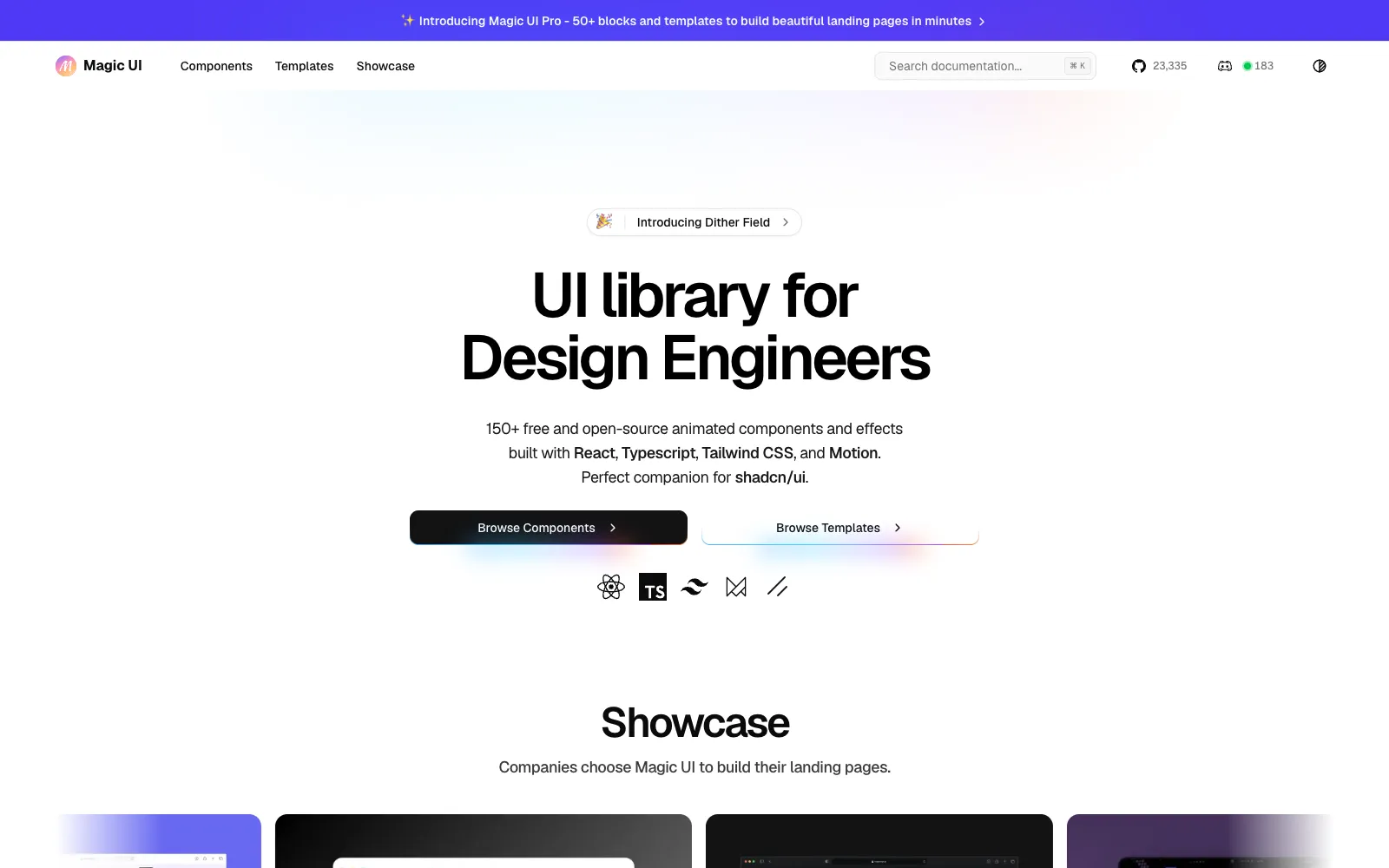
Magic UI is the shortest path from a plain shadcn/ui page to one that looks like a funded startup's. The components are the specific effects the current landing page aesthetic is built from, and they are free under MIT, which is a better deal than most paid packs manage.
The Pro offer is one of the cleanest here. $199, once, for the sections and templates, a perpetual licence, lifetime updates and no seat maths. Next to a $389 per year subscription, the comparison makes itself.
Treat the animation budget seriously. Every beam, particle field and scroll reveal has a cost, and a hero that stutters on a three year old Android does more damage than a static one ever would. Pick three effects, not thirteen.
Who it is for: founders and design engineers building marketing pages who want motion without writing it. The library is at magicui.design.
Pros
Cons
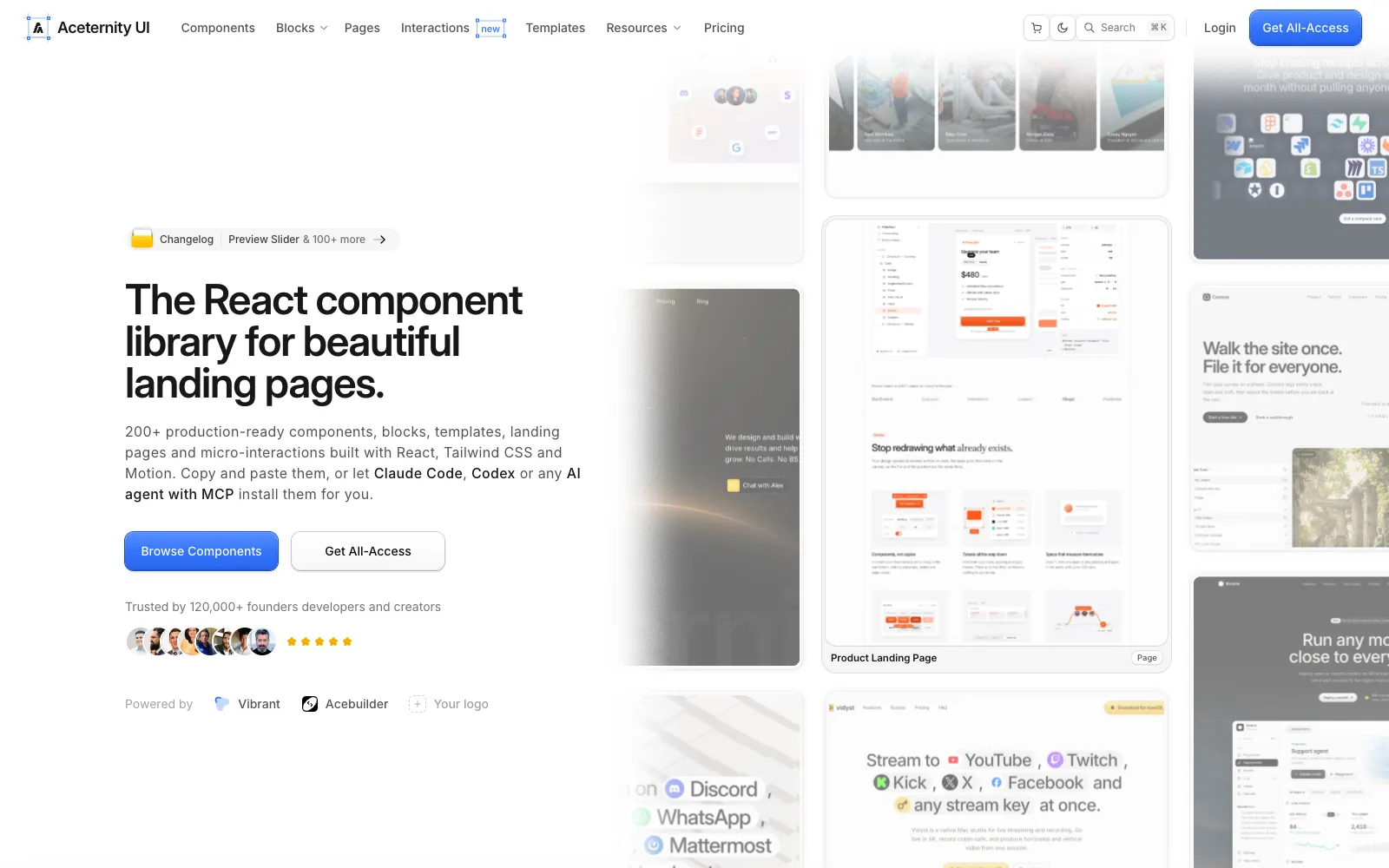
Aceternity sells polish. The free components alone put effects on a page that would take a competent developer days to build, and the paid blocks turn that into whole sections and landing pages. For a product page that has to look expensive by Friday, this is the fastest route in the list.
Putting MCP on the free tier is the smart move of 2026. If your workflow is an agent in the terminal, a registry the agent can search and install from is worth more than a slightly larger catalog it cannot reach.
The licence choice is where people pay too much. The cheaper tier stops receiving updates after a year while the lifetime tier is $50 more at list price and $30 more on sale. Unless you are certain this is a one project purchase, the lifetime tier is the one that makes sense.
Who it is for: teams that need a visually striking marketing site quickly and are comfortable tuning animation performance afterwards. Pricing is at ui.aceternity.com/pricing.
Pros
Cons
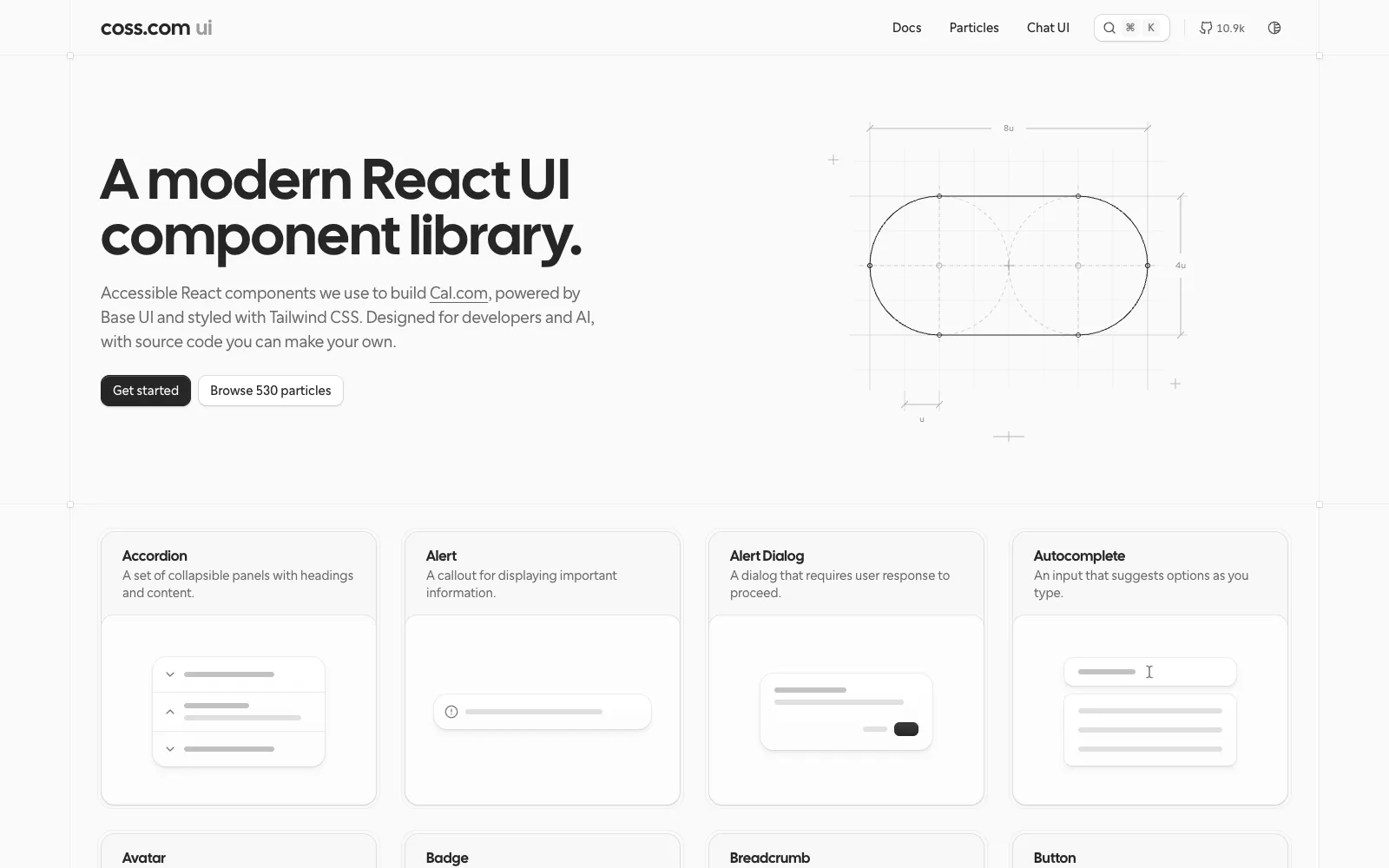
This is the entry most likely to catch people out, which is why it is worth the space. Origin UI was the go to free collection for form controls, and in October 2026 it was absorbed into Cal.com and became coss ui, built on Base UI. The announcement came from its creator, and originui.com has redirected ever since.
The practical news is good. The 626 component Origin collection remains online and free at coss.com/origin, so nothing you copied has stopped working, and the new library has Cal.com paying for its upkeep. The thing you are really getting is input variants: dozens of each control, with states, icons and validation already handled.
The caution is the seam. One project now holds a Radix era legacy snapshot and a Base UI successor, and the two are not interchangeable. Pick a side per project, note which one your components came from, and do not assume a future Origin component will arrive to match the ones you already have.
Who it is for: anyone building forms, settings screens or admin UI who wants variety for free. The new library is at coss.com/ui and the legacy collection at coss.com/origin.
Pros
Cons
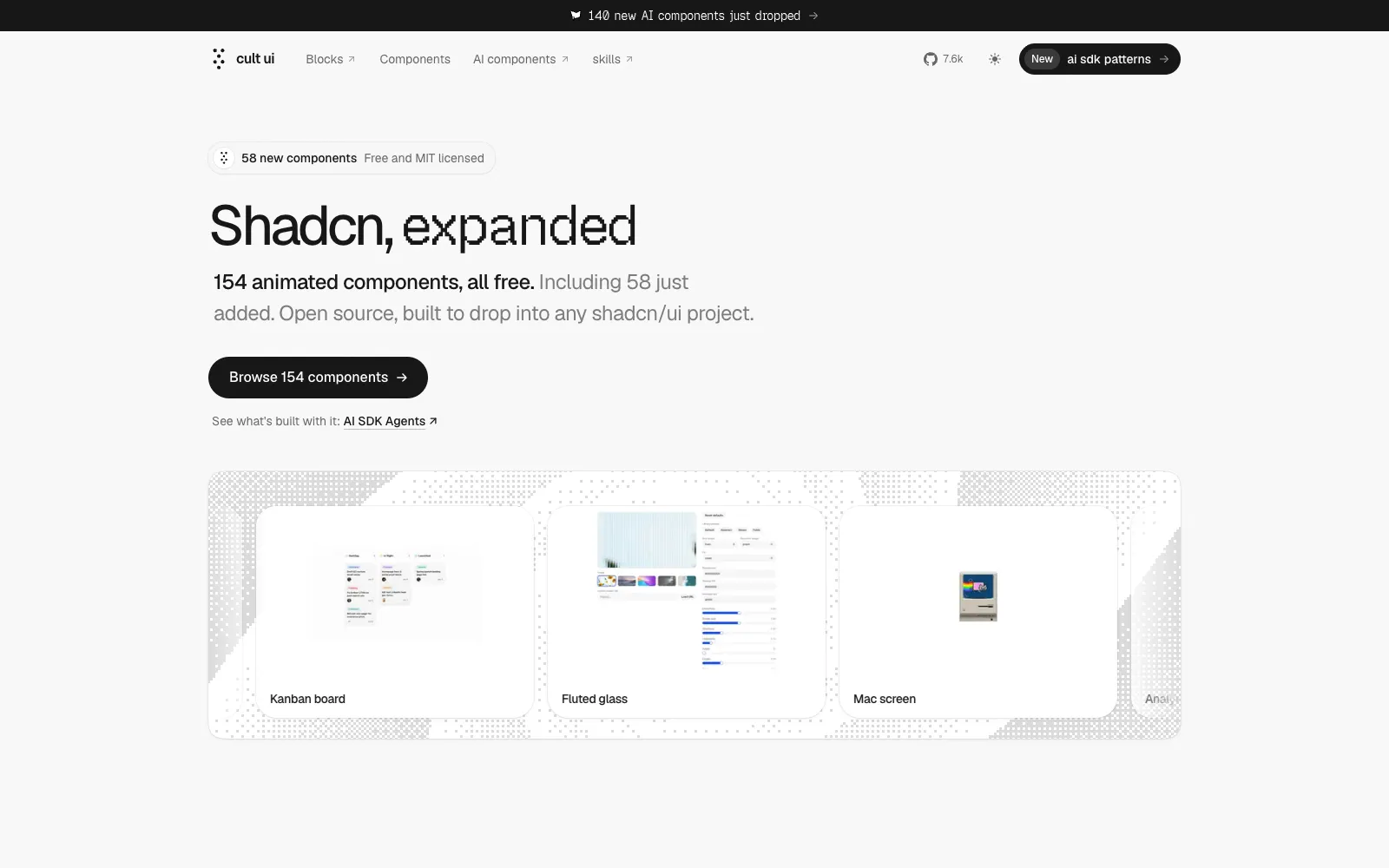
Cult UI is the library you reach for when a page needs one memorable thing. Device mockups that look designed rather than stock, texture and gradient cards, interactions that read as craft. Those pieces are usually behind a paywall, and here they are MIT.
September 2026 made it more interesting. Cult Pro stopped being sold, its 58 components were open sourced into the free library, and the project's income moved to AI SDK Agents, a set of full stack blocks for the Vercel AI SDK that ship the UI, the API route and the tools together. The components are now genuinely a free library rather than a demo for a paid one.
Expect personality over coverage. This is not where you get your table, your form or your dashboard. It is where you get the three components a visitor remembers, and at MIT that is a straightforward yes.
Who it is for: design engineers adding character to a site that already has its basics covered. The components are at cult-ui.com.
Pros
Cons
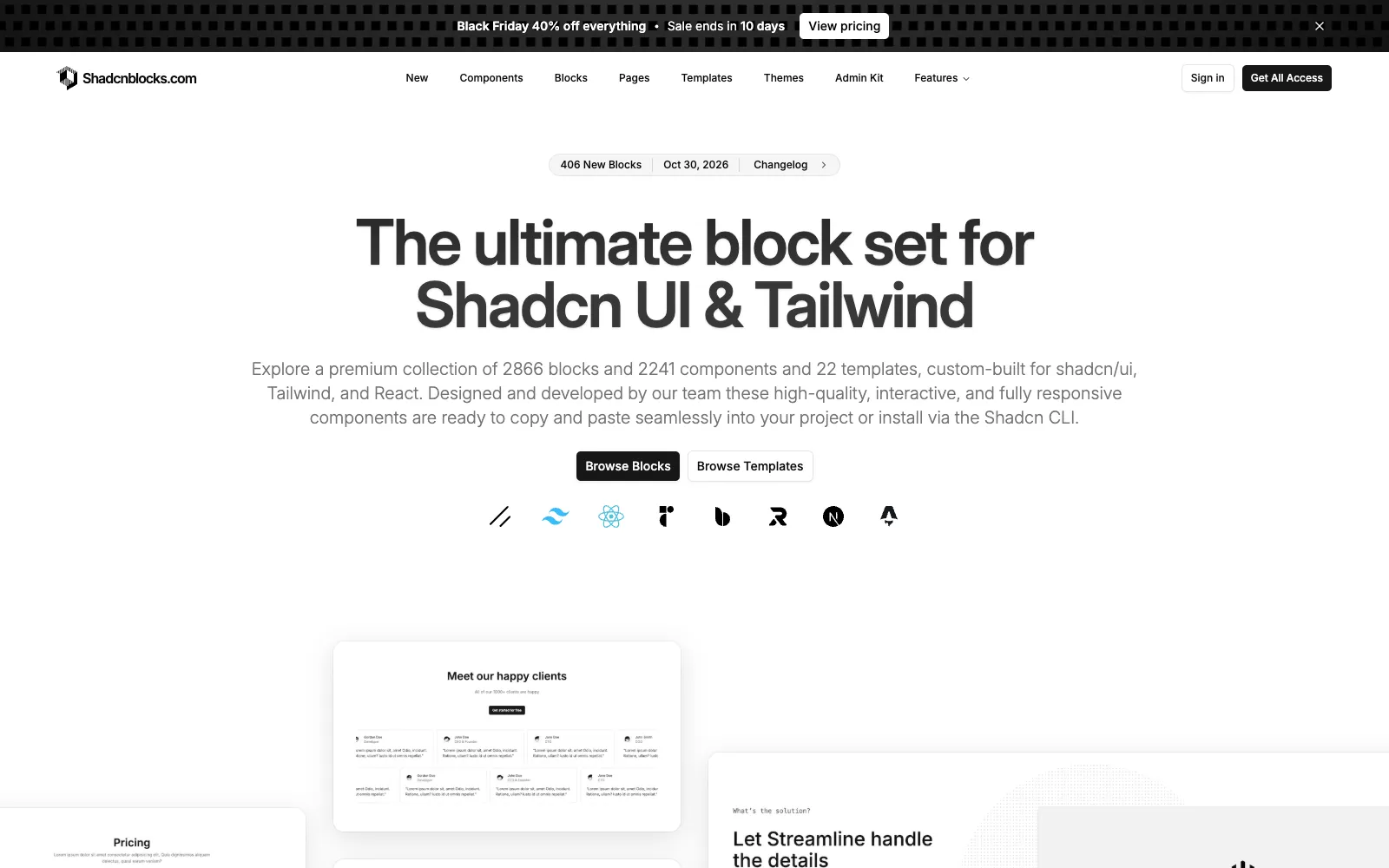
If the job is a marketing site and the bottleneck is sections, this is the most complete answer in the list. Hero, pricing, feature, testimonial, FAQ, footer and CTA blocks in volume, written in the same style, so a page assembled from twelve of them looks deliberate rather than stitched.
The install story is better than anyone else's. The shadcn CLI for the usual route, MCP when an agent is doing the work, an IDE extension when you want to browse without leaving Cursor, and a web app when you want to see the thing first. In practice that is the difference between a catalog you use and one you forget you bought.
Read the tier list before paying. The things people assume are included, the Figma file and the pre built pages, are the $299 and $399 tiers. At $149 for Pro, or $89 on sale, the block catalog alone still beats building forty sections yourself.
Who it is for: agencies and founders shipping marketing sites repeatedly, who would rather assemble than design. Pricing is at shadcnblocks.com/pricing.
Pros
Cons
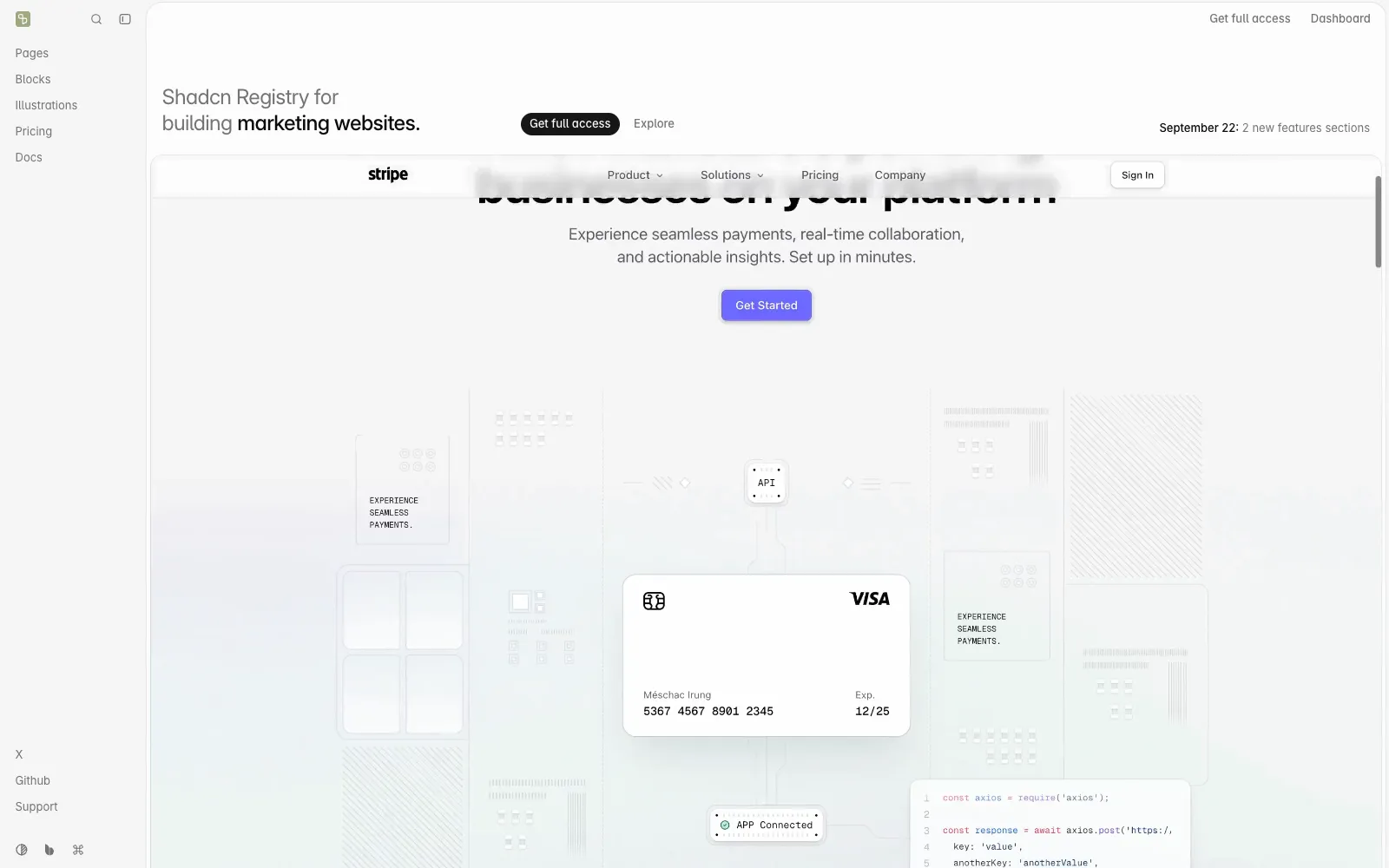
Tailark thinks in pages, not parts. Instead of a hero here and a pricing table there, the Complete tier ships the full set a SaaS marketing site needs, built from one visual system. Assembling a site from it feels like filling in a design rather than negotiating between twelve different ones.
The free kits are a real test. Mist, Dusk and Veil are MIT, installable from the open source registry with no account, and enough to see whether the code style suits you before any money moves.
The pricing ladder is the awkward part. Essentials at $249 gives blocks, Complete at $299 gives blocks and the page templates that are the actual reason to buy, so there is little reason to choose the cheaper one. Budget $299 or stay on the free kits.
Who it is for: teams that want a finished marketing site from one coherent system rather than a pile of sections. Pricing is at tailark.com/pricing.
Pros
Cons
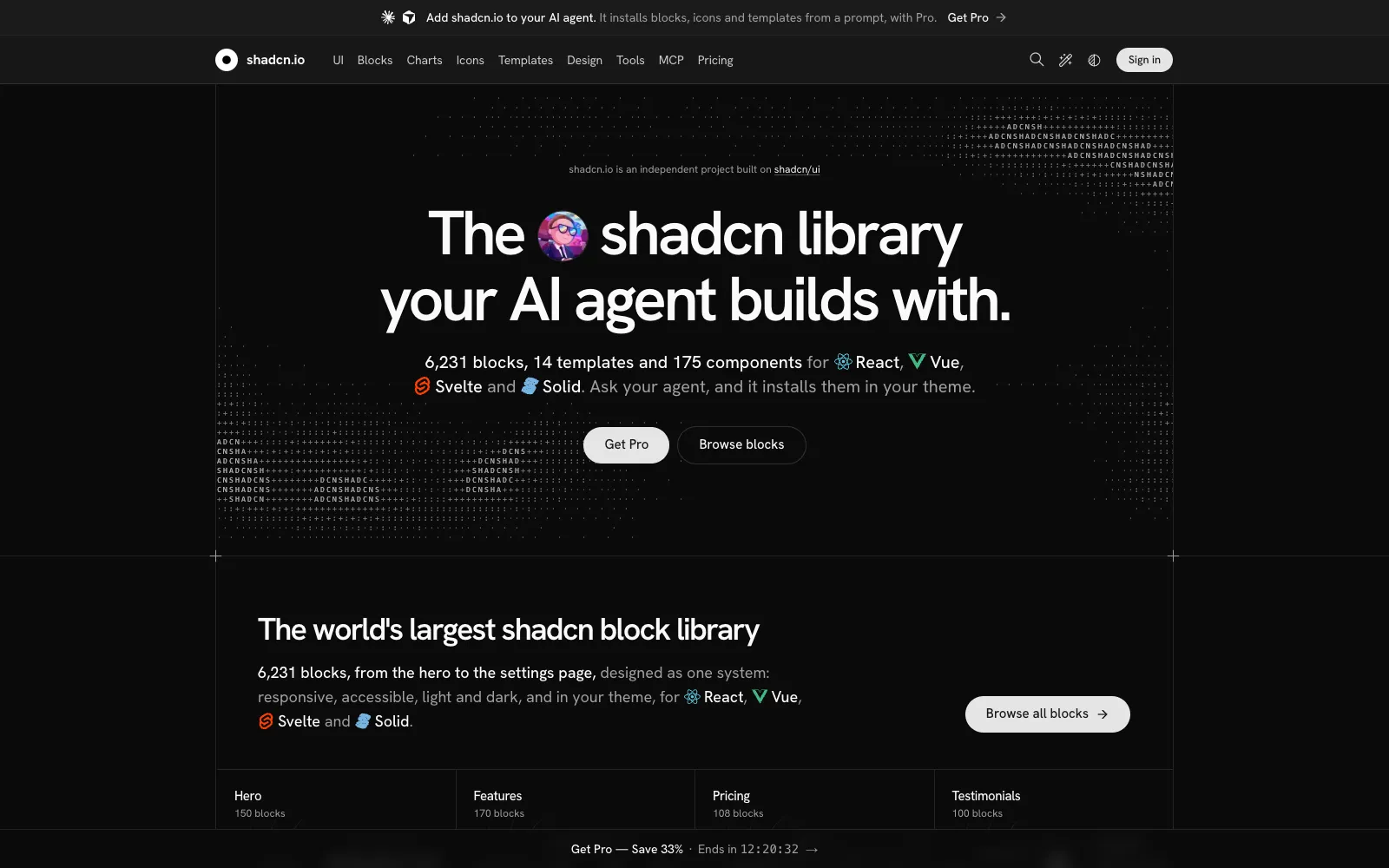
Judged on catalog alone, nothing else is close. Six thousand blocks, charts in 45 types, components for four frameworks and an MCP server that plugs into nearly every agent on the market. If your team works across React and Vue, this is the only entry that serves both.
It deserves one clear statement, though: this is not shadcn/ui. The official project lives at ui.shadcn.com and is free and MIT. shadcn.io is an independent site built on the same conventions and the same CLI, and the similarity of the names does a lot of work for it.
Then there is the licence. The $389 Individual plan covers personal and open source projects only, so the realistic price for professional work is the $789 a year Team plan. In a category where Shadcnblocks sells 2,697 blocks for $149 once, a recurring four figure bill over two years needs the multi framework support to be genuinely load bearing for you.
Who it is for: teams working across React, Vue, Svelte and Solid who will use the volume, and who have checked which tier their use case actually requires. Pricing is at shadcn.io/pricing.
Pros
Cons
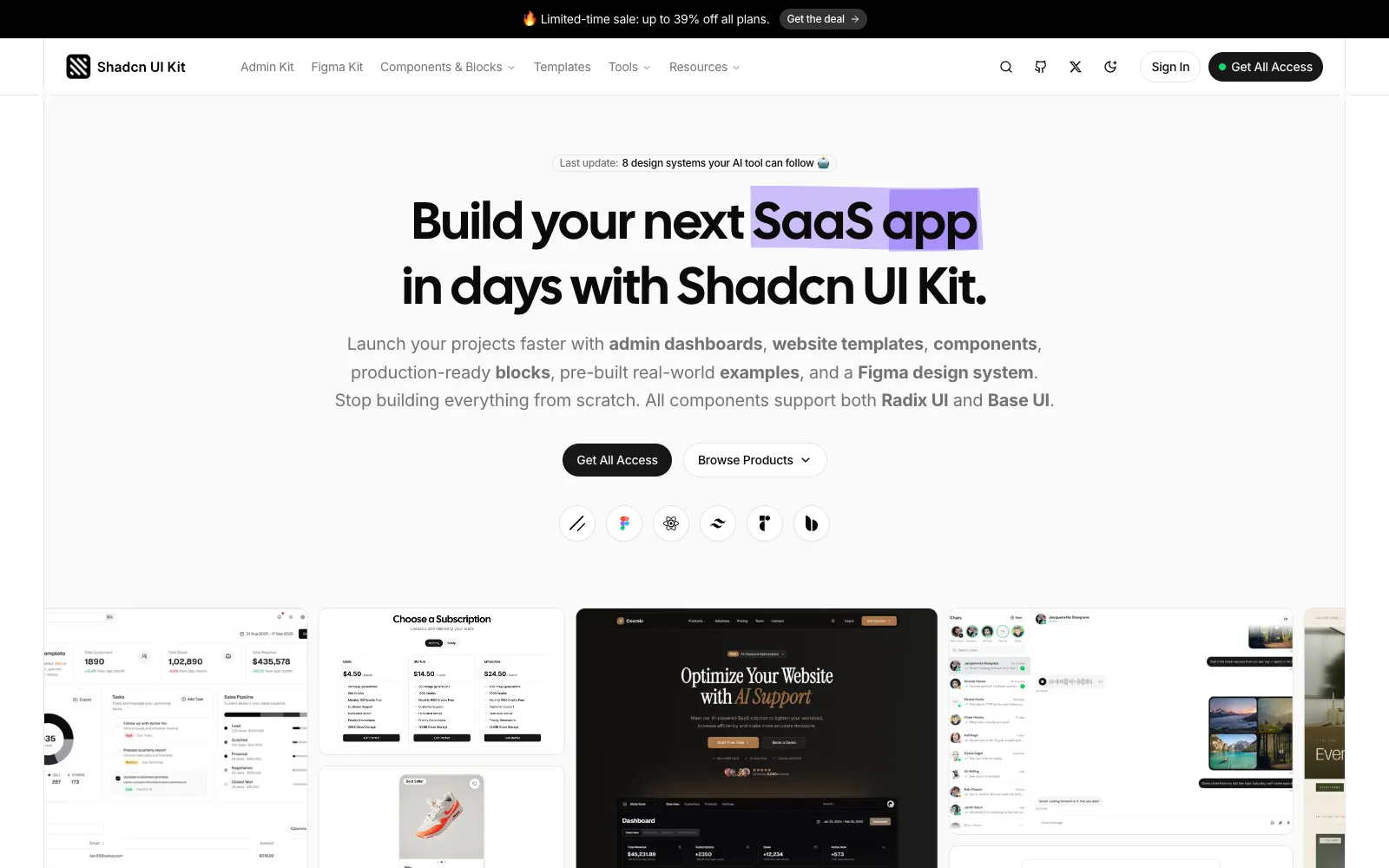
Dashboards are where this ecosystem is thinnest. Free registries hand you a table and a card and wish you luck, and most paid packs chase landing pages. Shadcn UI Kit sells the CRM, the analytics view, the e-commerce admin and the project management screens as finished, wired templates.
The stack is current, which matters more than it sounds. Next.js 16, React 19 and Tailwind v4 means you are not inheriting a migration on day one, and that is a real risk with dashboard kits, which tend to age badly.
Price it by seats. $129 once, or $79 on sale, for one developer with lifetime updates is good value against a week of building an admin shell. A five person team needs the $299 Team tier, and that is still one payment rather than a subscription. It is listed in our directory at Shadcn UI Kit, with the closest Shadcn UI Kit alternatives next to it, and we reviewed it in full in our Shadcn UI Kit review.
Who it is for: teams building an internal tool or SaaS admin who want the shell finished and the screens already laid out.
Pros
Cons
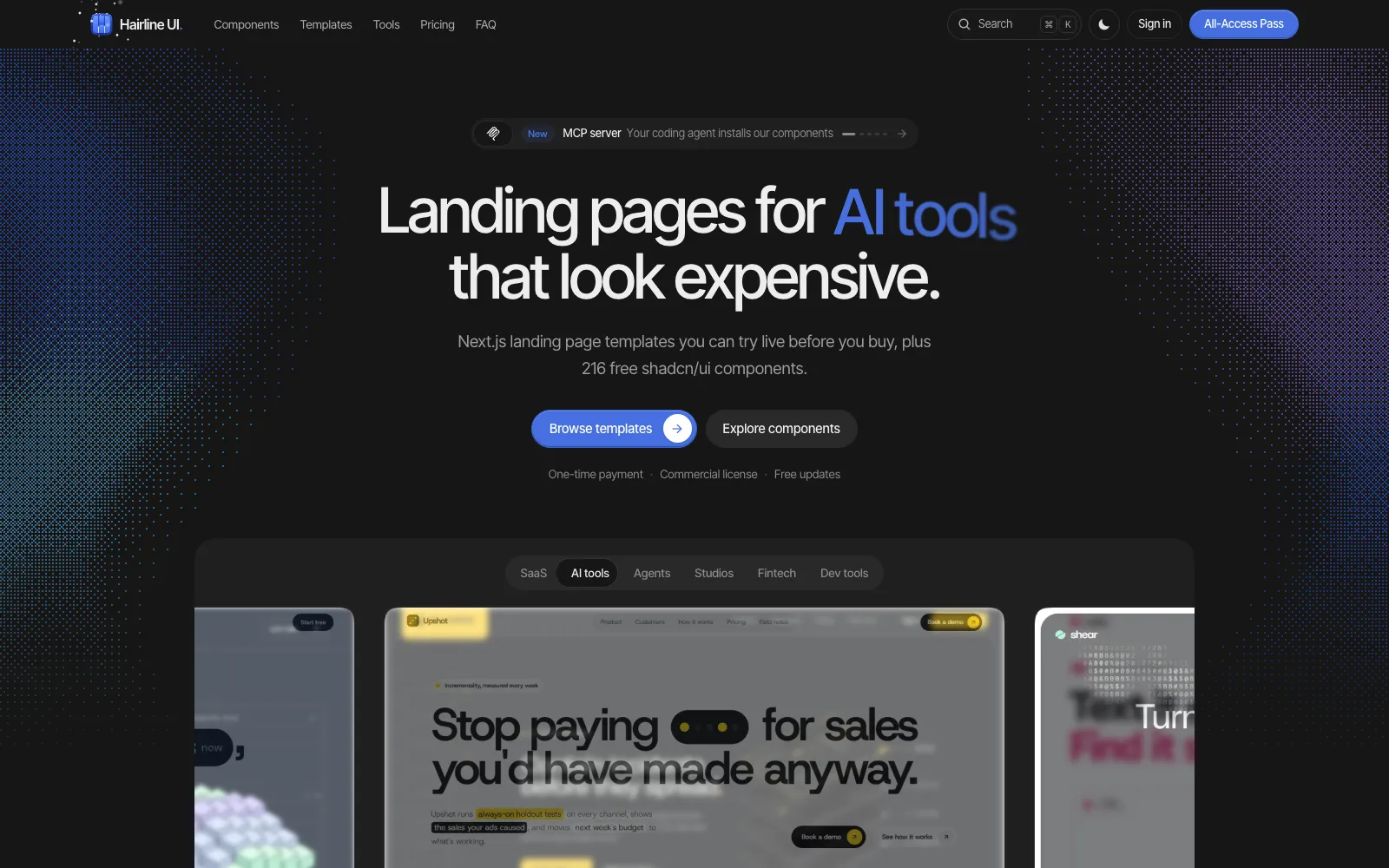
Hairline sits in the gap between a block pack and a boilerplate. You are not assembling a page from sections, you are picking a finished site and changing the words. For a launch that needs to be live this week, that is the shortest path on this page.
The free side is unusually generous. 216 components install from the registry without an account, and eight full templates are downloadable free with one, which is a real evaluation rather than a teaser.
The pricing mechanic is worth understanding before you buy. All access is one payment that includes future templates, and the price steps up as the catalog grows, so it rewards buying early. Buying a single template at $39 makes sense only if you are certain you need exactly one. It is listed in our directory at Hairline UI, alongside the nearest Hairline UI alternatives.
Who it is for: founders and freelancers shipping marketing sites on Next.js who want a finished design rather than parts.
Three neighbouring categories keep coming up in the same conversation. v0 from Vercel generates components and pages from a prompt and exports to shadcn/ui, which is a different trade: you get something bespoke and then own the quality problem. 21st.dev is a community catalog in the shadcn registry format, free to browse with a couple of free component copies a day and a membership for more, and it is the best place to find a component nobody has packaged into a paid kit. Theme editors solve the third problem, which is that every library here inherits your CSS variables and so a half hour spent on tokens improves all of them at once.
Two tools in our directory sit next to this work. Export to Figma pulls a live page back into editable Figma layers, which is useful when a client's feedback arrives as a design rather than a ticket. The wider developer tools category and the design category list the rest.
For most teams the honest answer is two purchases and three free registries: shadcn/ui as the base, one free registry for the components you keep rebuilding, and one paid pack for whichever of marketing sections or dashboards your product actually needs.
Once the product is built, the demo matters nearly as much as the UI: our comparison of the best screen recording tools covers what to record it with.
shadcn/ui itself, then Magic UI for animation, Kibo UI for application components such as kanban and gantt, Cult UI for creative pieces and coss ui, formerly Origin UI, for form controls. All five are MIT licensed and free for commercial work, which covers most of what a product needs before you pay for anything.
No. The official project is shadcn/ui at ui.shadcn.com, built by shadcn at Vercel, and it is free and MIT licensed. shadcn.io is an independent site that uses the same CLI and conventions, sells access by subscription and says so on its own pages. Check which one a tutorial means before you sign up for anything.
It became part of Cal.com and was renamed coss ui in October 2026, and originui.com now redirects to coss.com/ui. The original 626 component collection is still free at coss.com/origin as a legacy snapshot, while the new library is built on Base UI. Nothing you already copied stops working, but the two sets are different foundations.
Usually yes, because they all copy source into your project and read your shadcn/ui CSS variables. The friction is in the primitives and the animation dependency: a Radix based component and a Base UI based one can both work while duplicating behaviour, and three libraries can drag in two motion libraries. Pick one primitive layer per project and check what each install adds.
Over two years, almost always. Shadcnblocks Pro is $149 once, Magic UI Pro is $199 once, Shadcn UI Kit Pro is $129 once, and all three include lifetime updates. shadcn.io's commercial Team tier is $789 a year, which is more than all three combined before the second year starts. The subscription earns its place only if the multi framework catalog is something you use weekly.
Yes, and that is the big change of 2026. shadcn/ui, Aceternity UI, Kibo UI, Cult UI, Shadcnblocks, Shadcn UI Kit and Hairline UI all publish MCP servers, so Claude Code, Cursor or Codex can search the registry and run the install itself. If an agent writes most of your UI code, the presence of an MCP server matters more than a thousand extra blocks.
| Yes, 154 components, MIT |
| $0 for the library |
| Shadcnblocks | Ready made website sections, at volume | Some blocks, with a login | $149 one time, $89 on sale |
| Tailark | Complete marketing pages and blocks | Yes, three MIT kits | $249 one time |
| shadcn.io | A very large multi framework catalog | Yes, with an account | $389 per year |
| Shadcn UI Kit | Admin dashboards and web app templates | Starter, limited | $129 one time, $79 on sale |
| Hairline UI | Finished Next.js landing page templates | Yes, 216 components, 8 templates | $39 per template |
| The new Base UI set, plus 626 legacy Origin components |
| Free, MIT, now Cal.com's design system |
| The Origin collection is a legacy snapshot, lightly maintained |
| Cult UI | 154 components, MIT | Free, funded by a separate paid product | The paid part is AI SDK Agents, not the components |
| Shadcnblocks | 2,241 components and 2,697 blocks | One time, three tiers, lifetime updates | Figma kit and admin kit need the $299 tier |
| Tailark | Free kits plus hundreds of premium blocks | One time, four tiers | Page templates need the $299 Complete tier |
| shadcn.io | 175 components, 6,231 blocks, 14 templates | Subscription, or a lifetime price | The $389 Individual tier excludes commercial work |
| Shadcn UI Kit | 16 dashboards, 17 web apps, 550+ blocks | One time, lifetime updates | Seats: Pro is one user, Team is ten |
| Hairline UI | 216 free components, 63 paid templates | Free registry plus per template pricing | All access is $159 now and rises as templates land |