A curated guide to 30+ platforms for launching and promoting products beyond Product Hunt.
Get a dedicated SEO review articlefor your product or service and start ranking for “your brand + review” in search results.
Get Your Review Article
AI pixel art generator that turns text prompts and photos into finished sprites, scenes, tiles, and looping animations in seconds.

All-in-one AI creative studio with 500+ models and 85+ tools for image and video generation, AI photoshoots, photo editing and audio, under one subscription.
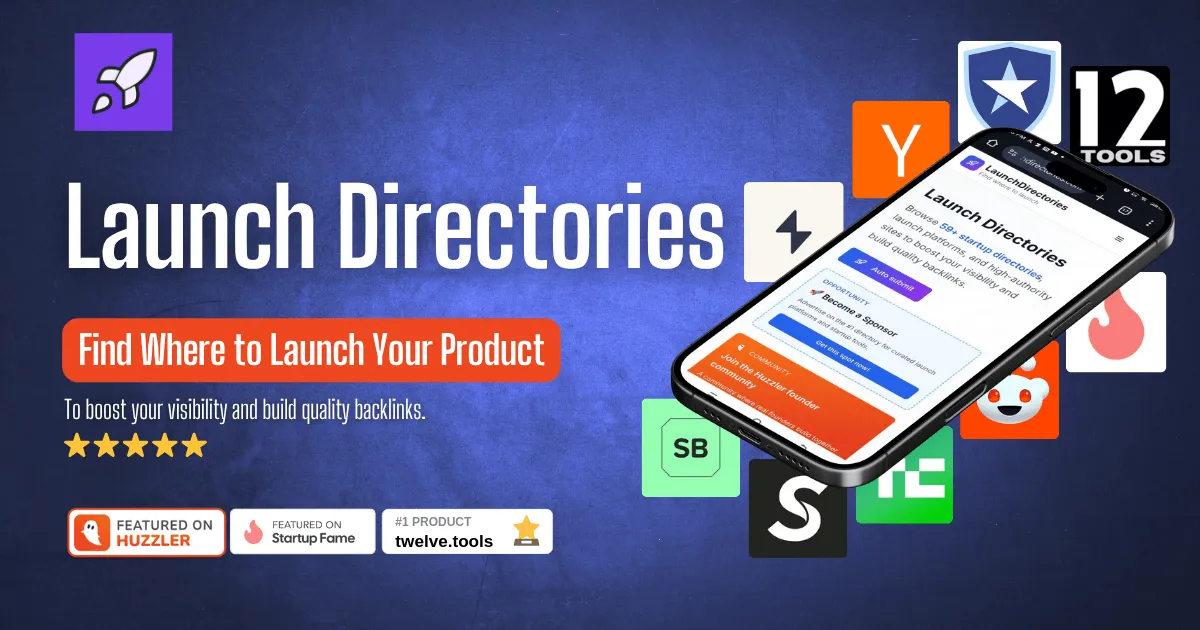
LaunchDirectories.com
Browse 100+ startup directories to build quality backlinks.
Product Hunt Alternatives is a curated directory and strategic guide designed to solve a specific, painful problem for founders and indie hackers: the diminishing returns of relying solely on Product Hunt for product launches. The platform addresses the reality that Product Hunt has become increasingly competitive, algorithm-driven, and often requires a pre-existing audience or paid promotion to achieve meaningful visibility. Even when a launch succeeds, the traffic spike is notoriously short-lived—a single day of attention that rarely translates into sustained growth.
The target audience is clear: solo founders bootstrapping a SaaS product, small teams with limited marketing budgets, indie hackers building side projects, and even marketing professionals at agencies who need to promote multiple products without depending on a single distribution channel. These users share a common frustration—they have built something valuable but lack the audience or budget to break through the noise on mainstream launch platforms.
The competitive landscape includes resources like LaunchDirectories.com, which offers a broader but less curated list of directories, and various blog posts that compile platform lists without strategic context. Product Hunt Alternatives differentiates itself through editorial depth. It does not simply list 30+ platforms; it organizes them into five strategic categories—Launch Platforms, Communities, Directories & Review Sites, AI-Specific Directories, and Other Platforms—each with introductory paragraphs explaining when and how to use that category effectively. The site also provides actionable advice, such as staggering launches across platforms over weeks rather than launching everywhere simultaneously. This transforms a simple directory into a tactical playbook for multi-channel distribution.
The thesis of this review is that Product Hunt Alternatives succeeds as a practical, well-organized resource for founders seeking to diversify their launch strategy. Its strength lies in the combination of curated listings and actionable advice, which helps users avoid the common pitfall of relying solely on Product Hunt. However, its static nature and lack of user-generated content or regular update signals raise questions about long-term relevance. For indie hackers and small teams launching a product, this guide is a must-bookmark starting point—but it should be complemented with ongoing research as the launch platform landscape evolves.
Visitors land on the homepage, which immediately presents the core value proposition: "A curated guide to platforms where you can launch and promote your product beyond Product Hunt." There is no signup process, no onboarding flow, and no account creation required—the site is entirely open and accessible from the first click. The page is structured as a long-form article with a table of contents displayed in a sticky sidebar on desktop or a hamburger menu on mobile.
The user journey begins with scanning the table of contents, which lists the five categories: Launch Platforms, Communities, Directories & Review Sites, AI-Specific Directories, and Other Platforms. Each category heading is a clickable anchor link that scrolls the page to the relevant section. Users can either scroll through the entire guide sequentially or jump directly to the category most relevant to their product type.
Within each category, users encounter an introductory paragraph that explains the strategic value of that platform type. For example, the Communities section explains that these platforms are best for building relationships and getting feedback rather than driving immediate traffic. Below the introduction, platform cards are displayed in a grid layout. Each card contains a screenshot thumbnail, the platform name (linked to its website), a pricing tag (e.g., "Free/Paid" for BetaList, "Freemium" for G2), and a one-sentence description.
The day-to-day workflow for a founder using this guide is straightforward: read the strategic advice for each category, browse the listed platforms, click through to explore promising ones, and then incorporate them into a launch plan. The guide recommends staggering launches across platforms over weeks rather than launching everywhere on the same day. For instance, a founder might submit to BetaList in week one, post on Hacker News in week two, engage with Indie Hackers in week three, and create a G2 listing in week four.
The site includes a footer link to a GitHub issues page for suggesting new platforms, and a cross-reference to LaunchDirectories.com for discovering even more directories. There are no integrations with other tools—the site is a standalone resource. The entire experience is read-only and static, which makes it fast and reliable but also means there is no way to save favorites, track progress, or receive notifications about new platforms.
The design of Product Hunt Alternatives is clean, modern, and professional, with a clear focus on readability and navigation. The color palette is restrained—primarily white backgrounds with dark text and subtle accent colors for headings and links. The typography is well-chosen, with clear hierarchy between section titles, platform names, and descriptions. The overall aesthetic is minimalist, which is appropriate for a resource that aims to be a practical tool rather than a visual showcase.
Navigation is the standout feature of the user experience. On desktop, the sticky sidebar table of contents remains visible as users scroll, providing constant orientation within the long-form article. Each category heading is a clickable anchor link, allowing users to jump directly to the most relevant section. On mobile, the table of contents collapses into a hamburger menu, which is a standard and effective pattern. The platform cards are displayed in a responsive grid that adapts to screen size—three columns on desktop, two on tablet, and one on mobile.
The learning curve is essentially zero. The site is a static resource with no interactive features, no account creation, and no configuration required. Users simply scroll and click. The only potential friction point is that the site does not provide any way to filter or sort platforms beyond the categorical organization. Users looking for, say, only free platforms or only AI-specific directories must scan through the entire category to find what they need.
One notable design decision is the use of lazy-loaded screenshot thumbnails. This improves page load performance, especially on mobile connections, but it means that screenshots appear as gray placeholders briefly before loading. This is a minor trade-off that most users will not notice. The site could benefit from hover states on platform cards that provide additional information, such as traffic estimates or user reviews, but this is not currently implemented.
Mobile responsiveness is well-executed. The hamburger menu works smoothly, the platform cards stack vertically without overlapping, and the text remains readable without zooming. The site loads quickly on both desktop and mobile, thanks to the static Next.js build and optimized images.
Product Hunt Alternatives is completely free to access—no subscription, no hidden costs, no email gate, and no paywall. The entire guide, including all 30+ platform listings, strategic advice, and category introductions, is available from the first click without any signup or account creation. This is a deliberate choice that aligns with the indie hacker audience's values around accessibility and transparency.
The value proposition is straightforward: the curated list and strategic advice save founders hours of research. Without this guide, a founder would need to search Google for "product launch platforms," read multiple blog posts, cross-reference recommendations, and evaluate each platform's relevance manually. Product Hunt Alternatives compresses this process into a single page that can be read in 15-20 minutes.
The platforms listed within the guide range from free to paid, with pricing noted for each. For example, BetaList is listed as "Free/Paid" (offering both free and paid listing options), G2 is "Freemium" (free basic listing with paid upgrades), and Hacker News is "Free." The guide does not include affiliate links or sponsored placements, so the recommendations are unbiased. This is a significant trust signal—users can be confident that the platforms are listed based on merit rather than commercial relationships.
Compared to similar resources like LaunchDirectories.com, Product Hunt Alternatives provides more editorial depth and strategic context. LaunchDirectories.com offers a broader list of directories but lacks the introductory paragraphs and tactical advice that make this guide actionable. For founders who are new to product launches, the strategic guidance is likely worth more than the platform list itself.
The only cost to users is the time spent reading and evaluating the recommendations. There is no clear upgrade path or premium tier—the site is a one-time resource rather than a recurring service. This makes it an excellent starting point for launch planning, but users will need to supplement it with ongoing research as new platforms emerge and existing ones change their policies.
Product Hunt Alternatives is best suited for three primary user segments. First, solo founders bootstrapping a B2B SaaS product who have limited marketing budgets and cannot afford paid promotion on Product Hunt. These users benefit most from the strategic advice on staggering launches and building long-term SEO through directory listings. The guide provides a clear, actionable framework that replaces expensive marketing consultants.
Second, indie hackers building side projects who are new to product launches and need a structured approach to distribution. The guide's categorical organization and introductory paragraphs provide context that helps these users understand not just what platforms exist, but why each type matters. The emphasis on genuine community participation is particularly valuable for this group, as it prevents them from making common mistakes like spamming communities with self-promotional posts.
Third, marketing professionals at small agencies who manage multiple client accounts and need scalable distribution strategies. The Directories & Review Sites section is especially relevant for this group, as it explains how to create permanent listings that drive long-term organic traffic. The guide saves these professionals hours of research that would otherwise be spent evaluating platforms for each client individually.
Users who might want to look elsewhere include enterprise marketing teams with large budgets and dedicated launch teams. These users likely already have established relationships with launch platforms and may find the guide too basic. They would be better served by specialized launch agencies or enterprise-grade distribution tools. Additionally, founders of consumer apps may find the guide less relevant, as many of the listed platforms cater to B2B SaaS and developer tools. Consumer app founders should look for app store optimization guides or social media launch strategies instead.
Product Hunt Alternatives succeeds as a practical, well-organized resource for founders seeking to diversify their launch strategy. Its three biggest strengths are the curated platform selection, the strategic advice embedded in each category, and the clean, accessible design that makes navigation effortless. The guide saves hours of research and provides a clear framework for building a multi-channel launch plan that compounds over time rather than relying on a single day of visibility.
The most notable limitation is the static nature of the resource. Without regular updates, the platform list may become outdated as new platforms emerge and existing ones change their policies or pricing. The GitHub issues page provides a mechanism for community-driven updates, but it relies on the maintainer's responsiveness. Additionally, the lack of user reviews or ratings for each platform means that users must evaluate platform quality on their own by clicking through to each site.
Overall, Product Hunt Alternatives is worth trying if you are a solo founder, indie hacker, or small team launching a product for the first time. It is particularly valuable for those new to product launches, as it provides a clear framework for building a multi-channel approach. Consider Product Hunt Alternatives when you need a structured starting point for launch planning—but plan to supplement it with ongoing research as the platform landscape evolves. For experienced founders who already have established launch processes, the guide may serve as a useful checklist rather than a primary resource.