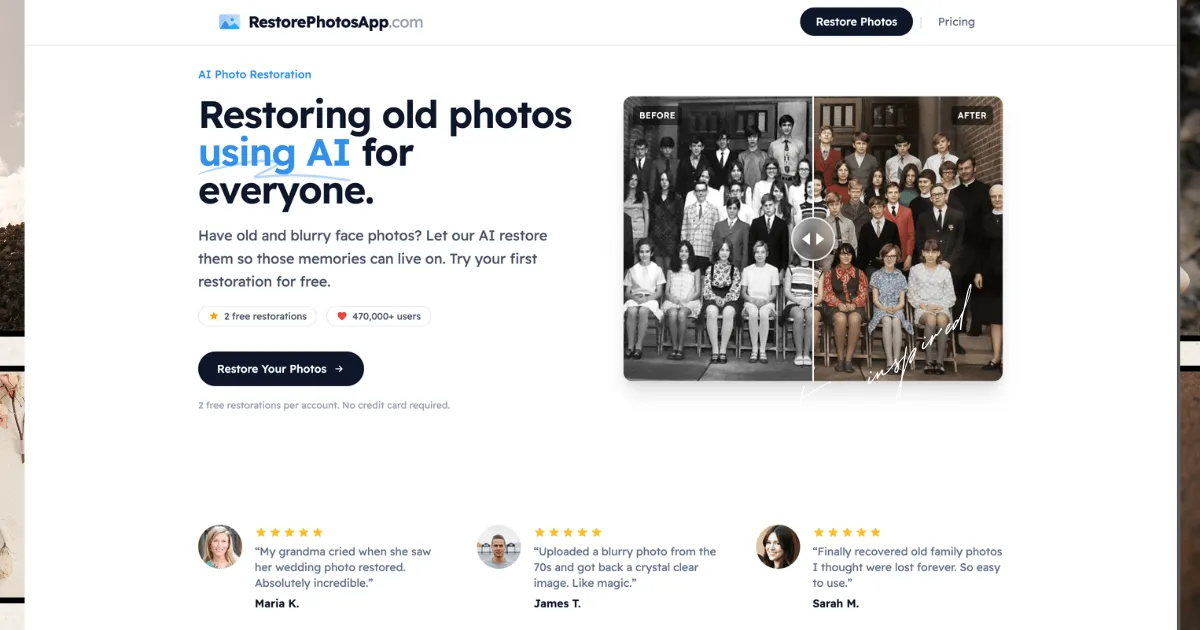
AI-powered photo restoration service that repairs blur, scratches, and damage, and colorizes black & white photos, starting at $6.99.
Get a dedicated SEO review articlefor your product or service and start ranking for “your brand + review” in search results.
Get Your Review Article
Get your business featured on 500+ news and media sites to boost SEO, credibility, and AI visibility.
68+ honest, score-anchored audiophile reviews, buying guides, comparison tools, and free audio utilities. No sponsored verdicts.
Get video and text reviews on autopilot.
RestorePhotos is an AI-powered photo restoration service that repairs blur, scratches, and damage, and colorizes black & white photos, starting at $6.99. It solves a deeply personal problem: the shoebox of faded family portraits, the scratched wedding photo, the grainy baby picture that deserves a second chance. The service uses advanced machine learning models, including Google Gemini AI, to analyze and reconstruct missing details, remove scratches and noise, sharpen out-of-focus images, and colorize monochrome photographs. With over 470,000 users and 2 million photos restored, it positions itself as an affordable alternative to professional photo restoration studios, which typically charge $50 or more per image.
The target audience is broad but specific: individuals digitizing family archives, genealogists piecing together ancestral records, small business owners selling vintage or restored imagery, and anyone who has inherited a collection of damaged photographs. The competitive landscape includes both professional restoration services and other AI tools like Remini, MyHeritage Photo Enhancer, and Topaz Photo AI. RestorePhotos is a solid alternative to Remini, MyHeritage Photo Enhancer, and Topaz Photo AI. What sets it apart is its transparent one-time pricing, its focus on face restoration, and its commitment to privacy, with photos stored securely on Cloudflare R2 and automatically deleted after 30 days. The thesis of this review is straightforward: RestorePhotos delivers professional-grade restoration results at a consumer-friendly price point, making it the most accessible option for everyday users who want to preserve their memories without learning complex editing software or paying studio rates.
Using RestorePhotos is refreshingly straightforward. First, users create an account, which includes 2 free restorations with no credit card required. This allows them to test the service on their own photos before committing to a paid plan. The signup process is quick, requiring only basic information, and the free credits are immediately available. After signing up, users navigate to the restore page, where they can upload an image from their device. The upload process is simple and works in the browser on any device, whether desktop, tablet, or mobile.
Once the photo is uploaded, users choose a restoration style: Restore, Colorize, Enhance, Cleanup, or Sharpen. Each style is tailored to a specific need, and users can experiment with different styles on the same photo using their credits. The AI processing takes under 30 seconds, and the result is displayed with a before-and-after slider so users can see the improvement. If satisfied, they can download the restored image in full resolution. If not, they can try a different style or adjust the original photo. This iterative workflow is intuitive and encourages experimentation without wasting credits.
For bulk restoration, users can upload multiple photos at once and process them in a single session. The service handles the queue, and users can download each restored image as it's ready. There's no need to install any software, and the entire workflow is designed to be intuitive even for non-technical users. The learning curve is minimal, and the free credits provide a risk-free way to get started. The service does not currently offer integrations with cloud storage platforms like Google Photos or Dropbox, so users need to upload files directly from their devices, but this is a minor inconvenience given the simplicity of the process.
The RestorePhotos website presents a clean, modern, and professional design that immediately communicates its purpose. The landing page features a prominent before-and-after slider that demonstrates the service's capabilities right away, which is both visually compelling and informative. The navigation is intuitive, with clear links to the restore page, pricing, FAQ, and comparison pages. The overall aesthetic is warm and inviting, using soft colors and human imagery that aligns with the emotional nature of photo restoration.
The user interface for the restoration workflow is minimal and focused. The upload process is a simple drag-and-drop or file selection, and the style selection is presented as clear, labeled options. The before-and-after slider on the results page is a standout design decision, as it allows users to immediately appreciate the transformation. The learning curve is essentially zero, which is a significant advantage for a tool aimed at non-technical users, including older individuals who may be digitizing family archives.
One minor criticism is that the website could benefit from more detailed documentation or tutorials for users who want to understand the technical aspects of the restoration process. However, for the vast majority of users, the simplicity is a feature, not a bug. The mobile experience appears to be responsive and functional, allowing users to upload and restore photos directly from their phones, which is a practical consideration for those who photograph old prints rather than scanning them.
RestorePhotos offers four one-time credit packs, with no subscription required. The Starter pack costs $6.99 for 10 credits, which works out to about $0.70 per credit. The Pro pack costs $16.99 for 25 credits, bringing the per-credit cost down to $0.68. The Family pack costs $29.99 for 50 credits at $0.60 per credit, and the Studio pack costs $54.99 for 100 credits at $0.55 per credit. Each credit covers one restoration, whether it's repair, colorization, or sharpening. Credits never expire, so users can buy them once and use them whenever they're ready.
Compared to professional photo restoration services, which can cost $50 or more per image, RestorePhotos is significantly cheaper. Even the Starter pack offers a fraction of the cost of a single professional restoration. The free 2 credits on signup provide a risk-free trial, and the 30-day money-back guarantee on all purchases adds further confidence. The pricing is transparent, with no hidden fees, and the per-credit cost decreases with larger packs, making the Family and Studio plans the best value for users with many photos. For occasional users, the Starter pack is a low-commitment entry point, while the Studio pack is ideal for archivists or small businesses processing large volumes.
RestorePhotos is best for three primary user segments. First, family historians and individuals digitizing personal photo collections. These users have emotional attachments to their photos and want a simple, affordable way to restore them without learning complex software. The free credits and low entry price make it a no-brainer for this group. Second, genealogists and researchers who need to process large volumes of historical photos. The bulk restoration feature and per-credit pricing make it feasible to work through entire archives, and the privacy policy ensures sensitive images are handled securely. Third, small business owners who sell vintage or restored photos. The commercial rights and cost-effective credit packs make it a viable tool for adding value to their products.
Users who might want to look elsewhere include professional photographers or digital artists who need pixel-level control over the restoration process. For them, a tool like Adobe Photoshop or Topaz Photo AI offers more granular editing capabilities, albeit with a steeper learning curve and higher cost. Additionally, users with extremely damaged photos, such as those that are torn into multiple pieces or have severe water damage, may find that the AI cannot fully reconstruct the image. In these cases, a professional restoration service with manual editing capabilities might be a better, albeit more expensive, option.
RestorePhotos is a powerful and accessible AI photo restoration tool that delivers impressive results for a fraction of the cost of professional services. Its key strengths are its ease of use, the quality of its face restoration and colorization, and its transparent, one-time pricing. The privacy policy is a standout feature, ensuring that users' personal photos are handled securely. The main limitations are the 30-day retention period for restored photos, which requires users to download their results promptly, and the fact that severely damaged or extremely low-resolution photos may not be fully recoverable. However, for the vast majority of old photos, RestorePhotos offers a practical and affordable solution.
RestorePhotos is worth trying if you have a collection of old, damaged, or black & white photos that deserve a second life. The free credits make it easy to test the service on your own images before committing to a paid plan, and the one-time pricing means there's no ongoing subscription to worry about. Consider RestorePhotos when you need to restore family portraits, colorize historical images, or process a large archive of vintage photos. It's a genuinely useful tool that delivers on its promise, and for anyone with a shoebox of memories, it's a service that can bring those moments back to life. For more details, you can explore the pricing plans or read the FAQ to learn more about the service. If you're curious about how it compares to other tools, check out the comparison page.