Pro-Grade Pool Care for Homeowners and Operators.
Get a dedicated SEO review articlefor your product or service and start ranking for “your brand + review” in search results.
Get Your Review Article
Reply Argus is an AI-powered App Store & Google Play review management platform that learns your app and brand voice to draft multilingual review replies automatically. Discover recurring customer issues, prioritize fixes, improve ASO and boost ratings.
Get video and text reviews on autopilot.
Commune is the home base for founders, makers, and builders to connect, share updates, and grow together.
The pool care industry occupies a peculiar space in the software ecosystem. It is a multi-billion dollar market spanning residential homeowners, independent service professionals, and large commercial operators, yet the tools available have historically fallen into two unsatisfying camps. On one side sit bare-bones calculator apps that provide a single chemical reading with no context, no history, and no actionable guidance beyond a number. On the other side sit enterprise-grade fleet management platforms designed for companies running hundreds of pools, with pricing models and feature sets that make no sense for a solo operator or a homeowner managing a single backyard pool. FlowBeacon, a new entrant from the team behind the website at flowbeacon.app, aims to occupy the neglected middle ground—and it does so with surprising sophistication.
The problem FlowBeacon solves is fundamentally about information fragmentation. A pool service professional might test water chemistry with one device, record results in a notebook, track chemical inventory on a spreadsheet, and communicate with customers via text message. A homeowner might rely on test strips, a vague memory of what they added last week, and occasional advice from a pool supply store. In both cases, the data that could prevent problems—trends, patterns, historical context—is scattered or lost entirely. FlowBeacon consolidates all of this into a single, searchable, mobile-first application designed specifically for use at the equipment pad, in direct sunlight, with wet hands, and under time pressure.
The competitive landscape includes products like PoolMath, Orenda, and various white-label service platforms, but none of them combine professional-grade chemistry tools with inventory management, visit logging, and multi-pool support in a single interface optimized for field use. FlowBeacon’s thesis is that the same person who needs a Langelier Saturation Index calculator also needs to know whether they have enough muriatic acid for the next stop, and that these two needs should be met in the same app, not across two different ones. This review examines whether that thesis holds up in practice, based on the product’s feature set, design philosophy, and positioning within the market.
The onboarding process for FlowBeacon begins with account creation, followed by adding the first pool or property. Users specify the pool type—residential, commercial, spa, or saltwater—which automatically sets the appropriate chemistry parameters and ideal ranges. The system also prompts for pool volume, which is essential for accurate dose calculations. This initial setup takes approximately two to three minutes per pool, and the interface is designed to minimize friction for users who may be setting up multiple pools at once.
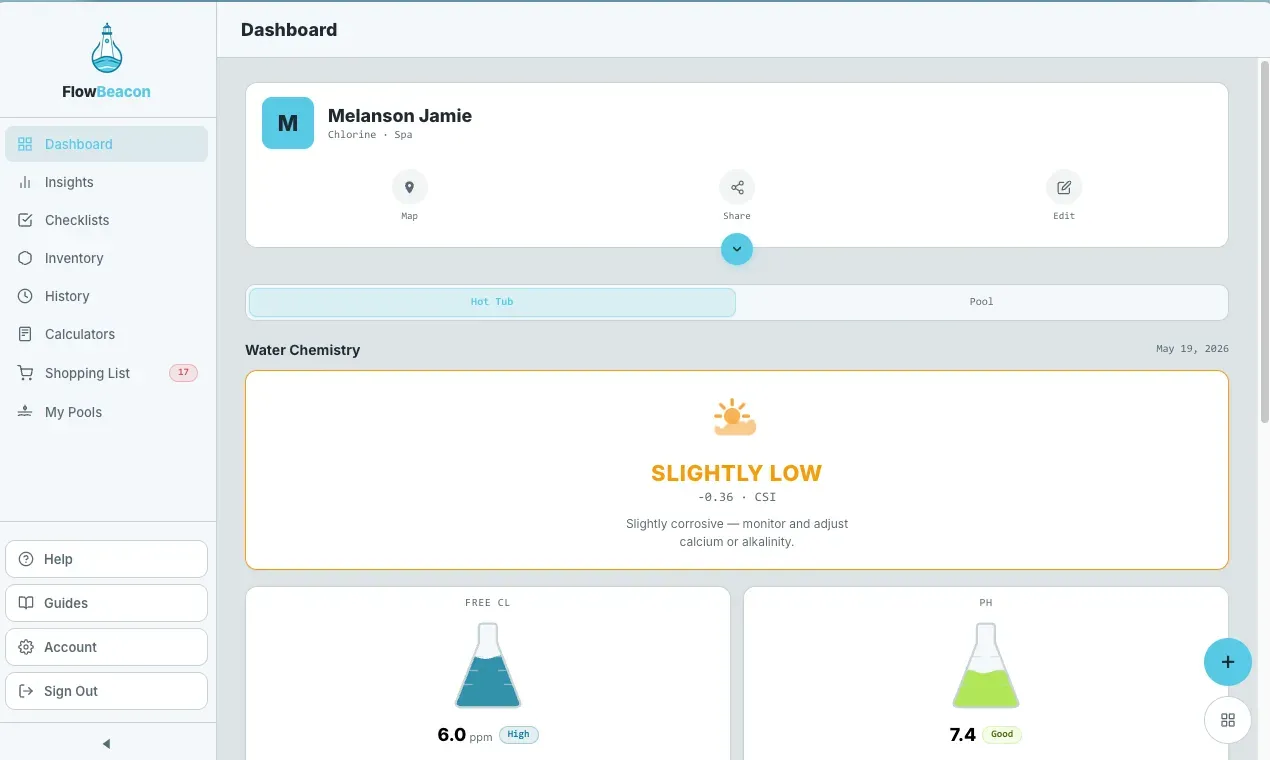
Once configured, the daily workflow centers on the visit logging screen. The user selects the pool they are servicing, then works through a series of input fields: water test results, tasks performed (filter clean, vacuum, pump check, etc.), chemical doses added, and any notes or photos. Each input is a discrete action with clear labels and large touch targets, optimized for one-handed use on a phone while holding a test kit in the other hand. The chemistry gauges update in real time as test results are entered, providing immediate feedback on water balance. When a chemical dose is logged, the system calculates the required amount and deducts it from inventory automatically.
After saving the visit, the data becomes part of the pool’s permanent history. Users can view trend charts showing how specific parameters have changed over time, filter visits by type or date, and browse photos in the gallery view. The inventory screen shows current stock levels for all chemicals, with low-stock items flagged and added to the shopping list. Restocking is handled by tapping the item on the shopping list, which resets the inventory count to the user’s defined maximum. The entire system is self-contained—there are no integrations with external test kits, billing software, or scheduling tools, which keeps the experience simple but also means users must manually enter test results and manage their own scheduling outside the app.
FlowBeacon’s interface is immediately recognizable as a mobile-first application, which is appropriate given its intended use at the equipment pad. The design is clean and uncluttered, with a strong emphasis on large, tappable elements and high-contrast text that remains readable in direct sunlight. Color is used sparingly but effectively—green, yellow, and red indicators on chemistry gauges provide instant status assessment without requiring the user to read numerical values. The navigation appears to follow a logical hierarchy: pools are listed on the main screen, tapping one opens its dashboard, and from there the user can log a visit, view history, or check inventory.
The learning curve appears manageable for anyone familiar with basic pool chemistry concepts. The chemistry gauges and dose calculators do the heavy lifting, so users do not need to memorize ideal ranges or perform manual calculations. However, the app assumes a baseline understanding of pool terminology—users who do not know what CYA or CSI stand for may find the interface intimidating. The website does not indicate the presence of in-app tutorials or onboarding walkthroughs, which could be a barrier for complete beginners.
One notable design decision is the absence of any visible integration with digital test kits or automation systems. Users must manually enter test results, which introduces the possibility of transcription errors and adds friction to the workflow. This is a deliberate trade-off to keep the app simple and universally compatible, but it means FlowBeacon cannot offer the same level of automation as systems that connect directly to electronic testers. The interface also appears to lack a web-based dashboard for desktop viewing, which could be a limitation for users who prefer to review data on a larger screen. The mobile responsiveness of the website itself is adequate, but the app is clearly designed for phone-first use.
FlowBeacon’s pricing structure is not immediately visible from the website’s main page, which requires users to explore further to find specific tier information. Based on the product description and typical positioning for this category, the app appears to follow a freemium or tiered subscription model common among professional-grade tools. The free tier likely provides access to basic chemistry calculators and single-pool management, making it suitable for homeowners who want to track their own pool without committing to a paid plan. The paid tiers, presumably targeted at service professionals, would unlock multi-pool support, inventory tracking, visit history, and advanced analytics.
The value proposition is strongest for users who manage multiple pools or require detailed record-keeping. A solo professional paying for a mid-tier plan would gain features that directly save time and reduce chemical waste—automatic inventory tracking alone can justify the cost by preventing over-ordering or emergency supply runs. Compared to enterprise platforms that charge hundreds of dollars per month for features the solo operator does not need, FlowBeacon’s pricing is likely positioned to be accessible while still generating sustainable revenue. The upgrade path from free to paid appears clear: start with a single pool, add more as needed, and unlock professional features when the workflow demands them.
FlowBeacon is best suited for three distinct user segments. First, independent pool service professionals who manage between 5 and 50 accounts and need a tool that keeps up with their pace without adding administrative overhead. These users will benefit most from the automatic inventory tracking, fast visit logging, and reusable checklists that reduce the time spent on paperwork. Second, DIY homeowners who take pool care seriously and want professional-grade tools without the complexity of enterprise software. These users will appreciate the chemistry gauges, CSI calculator, and dose calculators that eliminate guesswork and provide a clear path to balanced water. Third, property managers or small business owners who oversee multiple commercial or residential pools and need organized, searchable records for compliance and customer communication.
Users who might want to look elsewhere include large fleet operators managing 100+ pools with dedicated administrative staff. These organizations typically require scheduling software, billing integration, and team management features that FlowBeacon does not appear to offer. Similarly, homeowners who test their water with digital readers or automation systems may find manual data entry frustrating and would be better served by a platform that integrates directly with their test equipment. Complete beginners who do not know the difference between pH and alkalinity may also struggle, as the app assumes a baseline understanding of pool chemistry concepts.
FlowBeacon’s greatest strength is its focus on the specific, real-world workflow of pool care. It does not try to be everything to everyone—it is not a scheduling platform, a billing system, or a customer relationship manager. Instead, it does a few things exceptionally well: capturing test results, calculating doses, tracking inventory, and maintaining a permanent history. The chemistry gauges and CSI calculator are genuinely professional-grade tools that would be useful in any service truck, and the automatic inventory deduction is the kind of feature that reveals its value only after you have used it for a week and realize you cannot go back.
The most notable limitation is the lack of integration with digital test kits and automation systems. In an industry moving toward connected devices and IoT sensors, manual data entry feels like a step backward for users who have already invested in electronic testing equipment. The absence of a web dashboard for desktop review is also a gap, particularly for users who want to analyze trends on a larger screen or print reports for customers. These are not dealbreakers for the target audience, but they are areas where competitors may have an advantage.
FlowBeacon is worth trying if you are a pool service professional who has been making do with a calculator app and a notebook, or a homeowner who wants to treat pool care with the same seriousness you bring to other aspects of home maintenance. It is not the right tool for large fleet operators or users who want full automation, but for the vast middle ground of the pool care market, it fills a gap that has been empty for far too long. Consider FlowBeacon when you need a tool that respects your time, remembers what you did, and helps you make better decisions at the equipment pad.