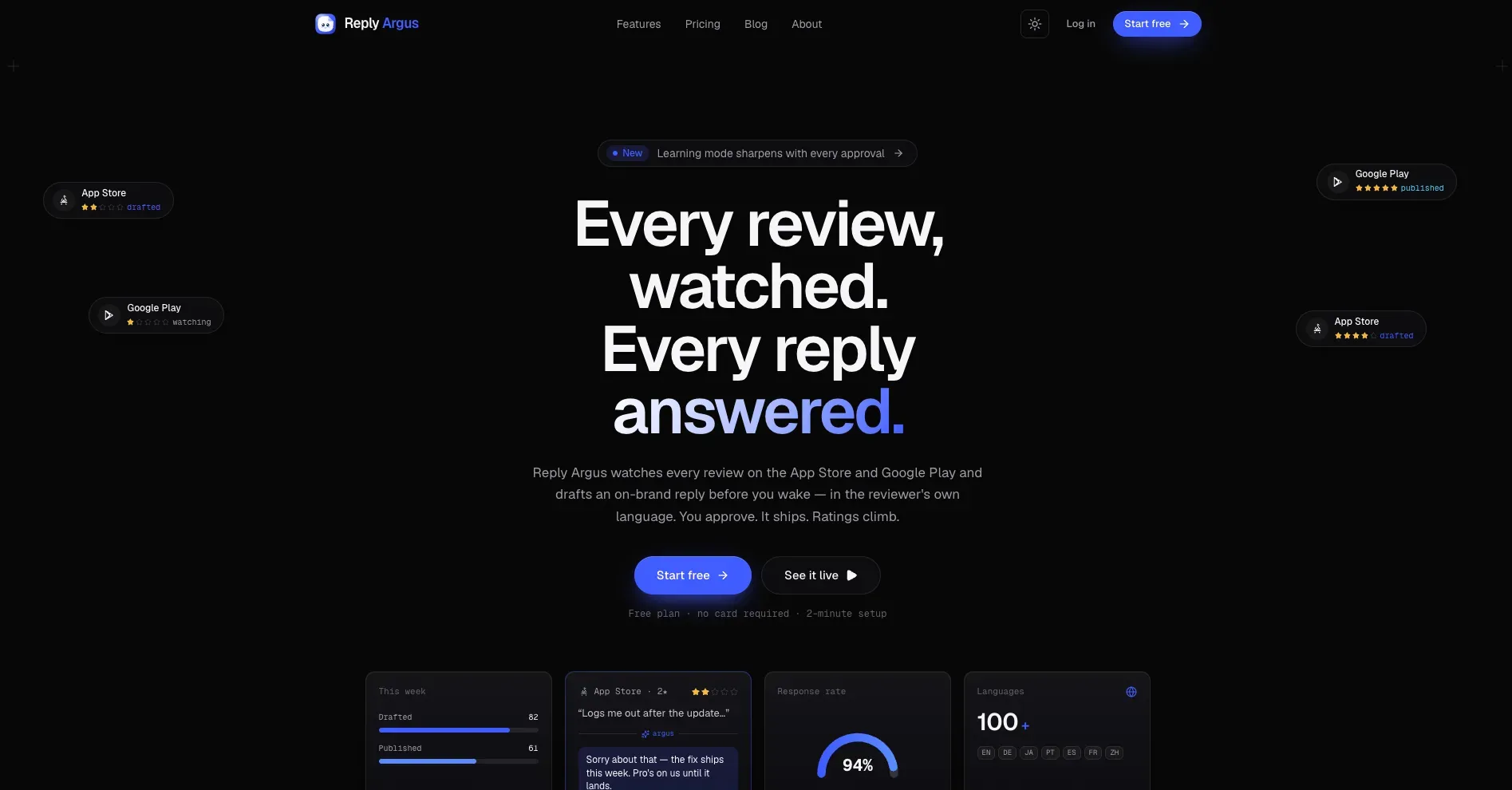
Reply Argus is an AI-powered App Store & Google Play review management platform that learns your app and brand voice to draft multilingual review replies automatically. Discover recurring customer issues, prioritize fixes, improve ASO and boost ratings.
Get a dedicated SEO review articlefor your product or service and start ranking for “your brand + review” in search results.
Get Your Review Article
Commune is the home base for founders, makers, and builders to connect, share updates, and grow together.

Research competitors, create ads, launch campaigns, and track performance yourself or through your AI agent.
Get video and text reviews on autopilot.
In the crowded ecosystem of mobile app development, customer reviews on the App Store and Google Play represent both a goldmine of actionable feedback and a persistent operational headache. ReplyArgus positions itself as a specialized solution to this dual challenge: an AI-powered review management platform that automates reply generation while simultaneously mining reviews for product intelligence. Unlike generic reputation management tools like Podium or Broadly, which cast a wide net across all review platforms, ReplyArgus focuses exclusively on the two dominant mobile app stores. This narrow focus allows it to deliver capabilities that generalist tools cannot match, such as deep integration with app metadata, multilingual reply drafting in the reviewer’s native language, and sentiment analysis tied directly to specific app features or bugs.
The target audience spans a broad spectrum: indie developers juggling a single app, startup teams scaling their first hit product, enterprise mobile teams managing portfolios of dozens of apps, and agencies handling review responses for multiple clients. The core problem ReplyArgus solves is the unsustainable manual effort required to respond to every review—especially in multiple languages—while also extracting meaningful patterns from thousands of individual comments. Competitors like AppFollow, Appbot, and TheTool offer similar review aggregation and analytics, but ReplyArgus differentiates itself through its AI’s ability to learn an app’s specific documentation, release notes, and brand voice, generating replies that feel personalized rather than templated. The thesis of this review is that ReplyArgus delivers genuine time savings and insight generation for teams that prioritize review response rates, but its value depends heavily on the quality of the app’s existing documentation and the team’s willingness to trust AI-generated responses.
The user journey begins with a straightforward signup process that requires an email address and app store credentials. During onboarding, ReplyArgus prompts the user to connect their Apple App Store Connect and Google Play Console accounts via OAuth, granting read and write access to reviews. This connection takes roughly two minutes and does not require sharing passwords. Once connected, the platform immediately begins importing the last 90 days of reviews, though users can request a full historical import.
The next step is configuring the brand voice. Users upload their app’s documentation—help center articles, FAQ pages, release notes, and any existing approved replies. ReplyArgus processes these materials to build a knowledge graph of product terminology, common issues, and preferred communication style. Users can also set tone preferences (professional, friendly, concise) and define auto-publishing rules, such as “always approve replies to five-star reviews” or “never auto-publish replies mentioning refunds.” This configuration takes 15–30 minutes for a well-documented app, longer for apps with sparse documentation.
Day-to-day usage centers on the moderation dashboard, which displays new reviews in a chronological feed. Each review card shows the original text, the AI-drafted reply, a confidence score, and suggested issue tags. Users can edit the draft, approve it, reject it, or flag it for team discussion. Approved replies are automatically posted to the respective app store within minutes. The analytics section provides a separate view for issue clusters, sentiment trends, and ASO insights, updated daily. Most teams spend 10–20 minutes per day reviewing and approving replies, compared to the 1–2 hours required for manual responses.
Integrations are limited but purposeful: the platform connects directly to App Store Connect and Google Play Console for review data and reply posting, and it supports webhook exports to Slack, email, and custom endpoints for issue tracking. There is no native integration with Jira or Asana, but the webhook system allows teams to pipe issue clusters into their project management tools with minimal setup. The platform also offers a public API for custom workflows, though this requires development effort.
Based on the visual elements visible on the ReplyArgus website, the platform adopts a clean, modern design language consistent with contemporary SaaS products. The color palette leans toward muted blues and grays, with accent colors used sparingly to highlight interactive elements and data visualizations. Typography is crisp and readable, with clear hierarchy between headings, body text, and data labels. The overall impression is professional and uncluttered, avoiding the visual noise that plagues many analytics dashboards.
Navigation appears to follow a left-sidebar pattern common in data-heavy applications, with sections for Reviews, Analytics, Settings, and Integrations. This layout is intuitive for users familiar with tools like Google Analytics or Mixpanel, though new users may need a brief orientation to understand the distinction between the review moderation queue and the analytics dashboard. The learning curve seems moderate: basic reply approval is straightforward, but mastering the issue clustering and ASO analysis features requires some exploration.
One standout design decision is the inline editing capability within the moderation queue. Users can edit AI-drafted replies directly in the feed without opening a separate modal or page, reducing friction for high-volume workflows. However, the website does not show mobile responsiveness, which is a notable gap for a platform that manages mobile app reviews—teams may want to approve replies from their phones during off-hours. The absence of visible mobile screenshots on the site suggests the desktop experience is prioritized, which could be a limitation for on-the-go support teams.
The data visualization components appear well-designed, with line charts for sentiment trends and bar charts for issue frequency, but the website does not demonstrate how these charts handle large datasets or long time ranges. Potential rough edges include the onboarding flow, which may feel lengthy for users with sparse documentation, and the lack of a visible tutorial or walkthrough for first-time users. Overall, the design is competent and professional, but not groundbreaking—it gets out of the way and lets the data speak, which is appropriate for a tool focused on efficiency.
The ReplyArgus website does not publicly display detailed pricing tiers, which is a common practice among enterprise-focused SaaS products. Based on the product description and industry norms for similar tools, the platform likely operates on a subscription model with tiers based on the number of apps managed, monthly review volume, and feature access. A typical structure might include a free tier for a single app with limited reviews (e.g., up to 500 reviews per month), a starter tier for indie developers at $29–$49 per month, a professional tier for growing teams at $99–$199 per month, and an enterprise tier with custom pricing for agencies and large portfolios.
The absence of transparent pricing is a notable friction point for potential buyers, particularly indie developers and small startups who need to budget carefully. Competitors like AppFollow and Appbot display pricing openly, giving them an advantage in the consideration phase. However, ReplyArgus’s value proposition—AI that learns your specific app documentation rather than using generic templates—justifies a premium over basic review management tools. For teams responding to more than 1,000 reviews per month across multiple languages, the time savings alone can offset the subscription cost within weeks.
The upgrade path appears clear: as an app grows in review volume or as a team adds more apps, they can move up tiers to unlock higher limits and advanced analytics. The lack of a free trial visible on the site is a concern, though many enterprise tools offer demos upon request. Overall, the pricing is likely competitive for the value delivered, but the opacity makes it difficult to recommend without a direct conversation with sales. Prospective buyers should request a demo and a custom quote to evaluate whether the ROI justifies the cost for their specific use case.
ReplyArgus is ideally suited for three user segments. First, indie developers and small startup teams with apps in multiple languages who currently ignore non-English reviews due to time constraints. The multilingual auto-reply feature alone can transform their global customer satisfaction and app store ratings, often with minimal daily effort. Second, mobile product managers at mid-size companies who need to systematically track customer feedback and prioritize bug fixes. The issue clustering and sentiment trend analytics replace manual spreadsheet tracking and gut-feeling prioritization with data-driven insights that can be presented to engineering teams and executives. Third, agencies managing 10+ client apps who need to scale their review response operations without proportional headcount growth. The workspace management, role-based access, and consolidated analytics make it feasible to deliver consistent, high-quality responses across diverse client portfolios.
Conversely, ReplyArgus may not be the best fit for two user types. Enterprise teams with highly regulated industries (e.g., banking, healthcare, legal) may find the AI-generated replies require too much human oversight to achieve meaningful time savings, especially if compliance mandates that every public response be written from scratch by a trained professional. These teams might be better served by a simpler review monitoring tool that alerts them to new reviews without attempting to automate replies. Teams with poorly documented apps—those lacking FAQs, release notes, or help center articles—will struggle to train the AI effectively, resulting in generic or inaccurate replies that undermine the platform’s core value. These teams should invest in building their documentation first, then revisit ReplyArgus once they have sufficient material for the AI to learn from.
ReplyArgus’s greatest strength is its ability to bridge the gap between customer support and product development, transforming a reactive chore into a proactive intelligence source. The brand voice learning engine and multilingual reply drafting are genuinely differentiated features that solve real pain points for global app teams. The issue clustering and sentiment analytics provide actionable insights that can directly influence product roadmaps and ASO strategy, making the platform more than just a reply automation tool—it becomes a customer feedback hub.
The most notable limitations are the lack of transparent pricing and the absence of visible mobile responsiveness, both of which create friction for potential buyers. The platform also requires a baseline level of app documentation to function optimally, which may exclude teams that have not invested in their support materials. Additionally, the reliance on AI-generated replies, even with human approval, may not satisfy compliance requirements in highly regulated industries.
ReplyArgus is worth trying if you manage a mobile app with a significant volume of reviews—especially across multiple languages—and you want to systematically improve your response rate, customer satisfaction, and product decisions. Consider ReplyArgus when you need to scale your review management without scaling your team, and when you have the documentation foundation to train the AI effectively. For indie developers and growing mobile teams, it offers a compelling return on investment through time savings and rating improvements. For enterprise teams with strict compliance needs or sparse documentation, it may require additional investment in process and content before the benefits fully materialize.