1 Beat: Hit Music Game is a free four-lane rhythm game for iPhone and Android with hit songs, hand-made charts and per-device audio offset.
Submit your website to get discovered by thousands of potential customers and boost your SEO.
Get Listed1 Beat: Hit Music Game is an in-development rhythm game for iPhone and Android that places chart-topping tracks on a four-lane note highway. The project exists to fill a gap left behind when Beatstar shut its servers down for good on 31 October 2025, taking a popular three-lane tap format with it. 1 Beat keeps the familiar vocabulary of tap, hold and swipe, then adds a single extra lane and releases the game as free to play. It is aimed squarely at mobile rhythm players who want recognisable pop, rock, hip-hop and EDM songs rather than abstract instrumental charts, and at anyone who enjoyed Beatstar and is looking for a comparable portrait-mode experience.
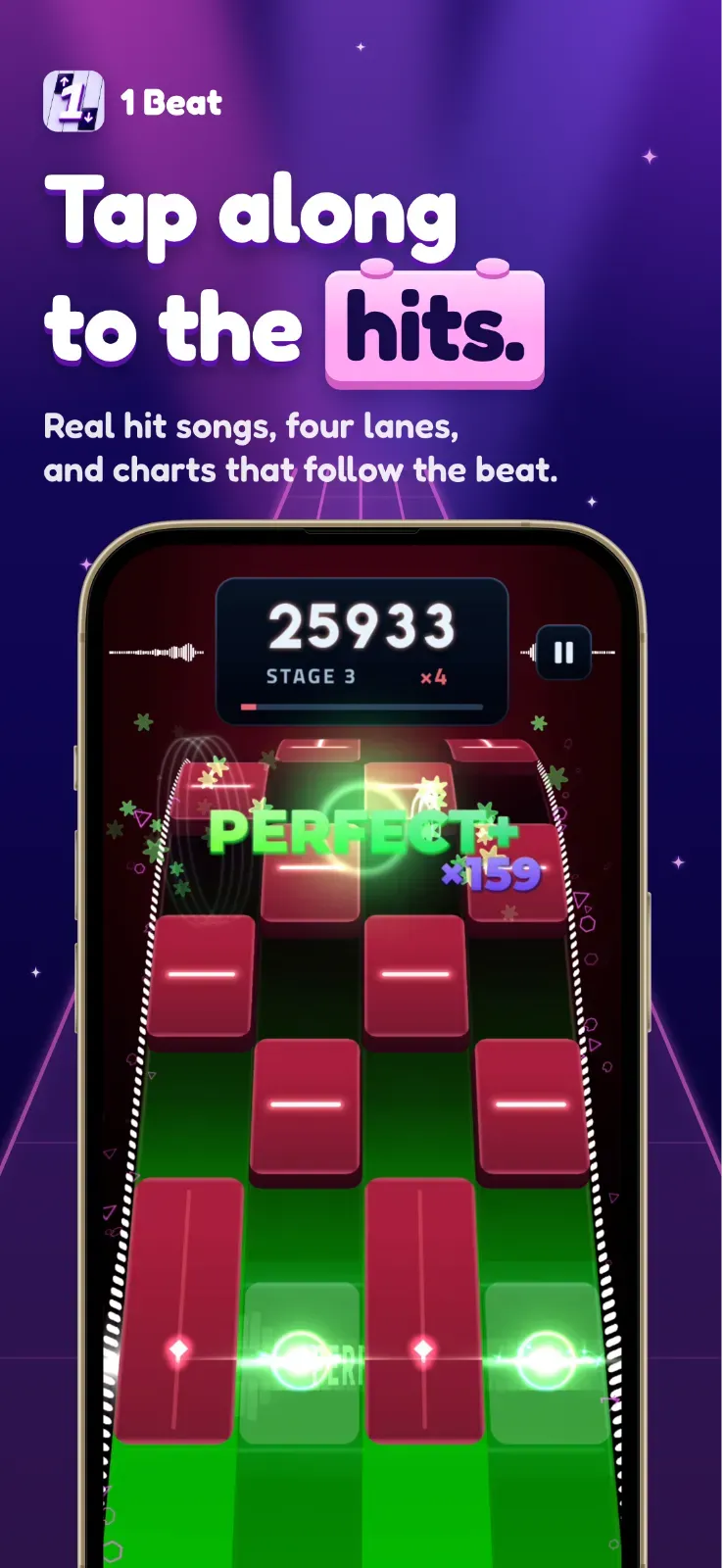
Four-lane portrait playfield. The central design decision is one more lane than Beatstar used. Three lanes produce six possible combinations of hitting one or two notes at once, while four lanes produce ten. Each thumb gets two lanes of its own, which allows patterns to cross, split and stack in ways a three-lane board cannot accommodate. The developer states the aim is charts that are harder to master rather than harder to read.
Tap pads positioned below the judgement line. Notes fall toward a white judgement line, and the touch pads sit beneath it. This keeps thumbs from covering the notes that are still travelling down the screen, a common complaint in mobile rhythm games where the input zone overlaps the reading zone.
Timing judged from the touch event. Judgement does not wait for the next render frame, so a dropped frame is not recorded as a missed note. Players see PERFECT+ style judgements on screen, and the accuracy calculation is tied to the moment the finger lands rather than the moment the frame is drawn.
Per-device audio offset memory. Calibration is stored separately for every pair of headphones rather than once per session. The site acknowledges that wireless earbuds can feel slightly out of sync because of the audio route, not the player, and treats a saved offset as the fix for the wired and calibrated cases.
No-fail by default. A poor run ends as a poor score rather than a prompt, and the site is explicit that it does not gate a retry behind an advert. The mode is designed so that mistakes cost accuracy, not access to the rest of the song.
Reduced-flashing accessibility switch. A single toggle gates every visual effect rather than a partial subset, which matters for players sensitive to strobe and rapid colour changes on a four-lane note highway.
Free browser audio offset calculator. Before any build exists, the team ships a web tool at /tools/audio-offset-calculator that lets visitors measure the latency of their own devices and headphones. It is a practical preview of the in-game calibration concept.
Weekly leaderboards and store gallery. Store screenshots show a weekly leaderboard for beating friends' scores, alongside guidance screens covering headphone tuning and hand-made charts. Six store panels are published on the homepage for advance viewing.
There is no downloadable build yet. The current journey begins on the website, where the primary call to action is a waitlist form that asks only for an email address and promises a single message when a build is ready to try. App Store and Google Play badges on the homepage are both marked coming soon, and the page states plainly that there is no app to download.
Once a build arrives, the described flow is straightforward. A player installs the game on iPhone or Android, opens a portrait-orientation session, and rests thumbs on the four pads beneath the judgement line. Notes arrive as taps, holds and swipes. Before serious play, the player calibrates once per output device using the offset setting, so the same pair of headphones keeps its timing on later sessions. Scores accumulate against a weekly leaderboard, and a bad run simply ends with a lower score. Visitors who want to prepare in advance can use the browser offset calculator to measure their own hardware today.
A lapsed Beatstar player looking for a replacement. Someone who played Beatstar on three lanes and lost access when the servers closed can join the waitlist and, in the meantime, read the site's comparison and recovery pages. The four-lane board gives that player a familiar input vocabulary with a higher ceiling.
A commuter who plays with Bluetooth earbuds. Because offsets are remembered per device, a player who switches between wired earbuds on the train and over-ear headphones at home does not recalibrate every session. The site is candid that Bluetooth drift is still unsolved by a stored offset.
A player sensitive to flashing visuals. The reduced-flashing switch gates every effect, which suits someone who enjoys rhythm games but avoids heavy strobe patterns. It is presented as a complete toggle rather than a partial compromise.
A group of friends comparing scores. Weekly leaderboards support the social loop of beating friends' scores, which gives a single-player chart a recurring reason to return each week.
A journalist or creator covering the Beatstar shutdown. The press kit, store screenshots and a set of explainer articles about Beatstar's closure, private servers and account recovery give writers citable material before launch.
1 Beat targets individual mobile players on iOS and Android, from casual commuters to mid-core rhythm fans who chase accuracy scores and leaderboard positions. No technical skill is required beyond installing an app and running a one-time calibration. The closest comparisons are Beatstar, which no longer operates, along with SuperStar, Hi Beatz, Beat Tiles and Magic Tiles 3. The differentiator is structural: a fourth lane, tap pads kept below the judgement line, frame-independent timing and per-device offset memory, all offered free to play with a no-fail default.