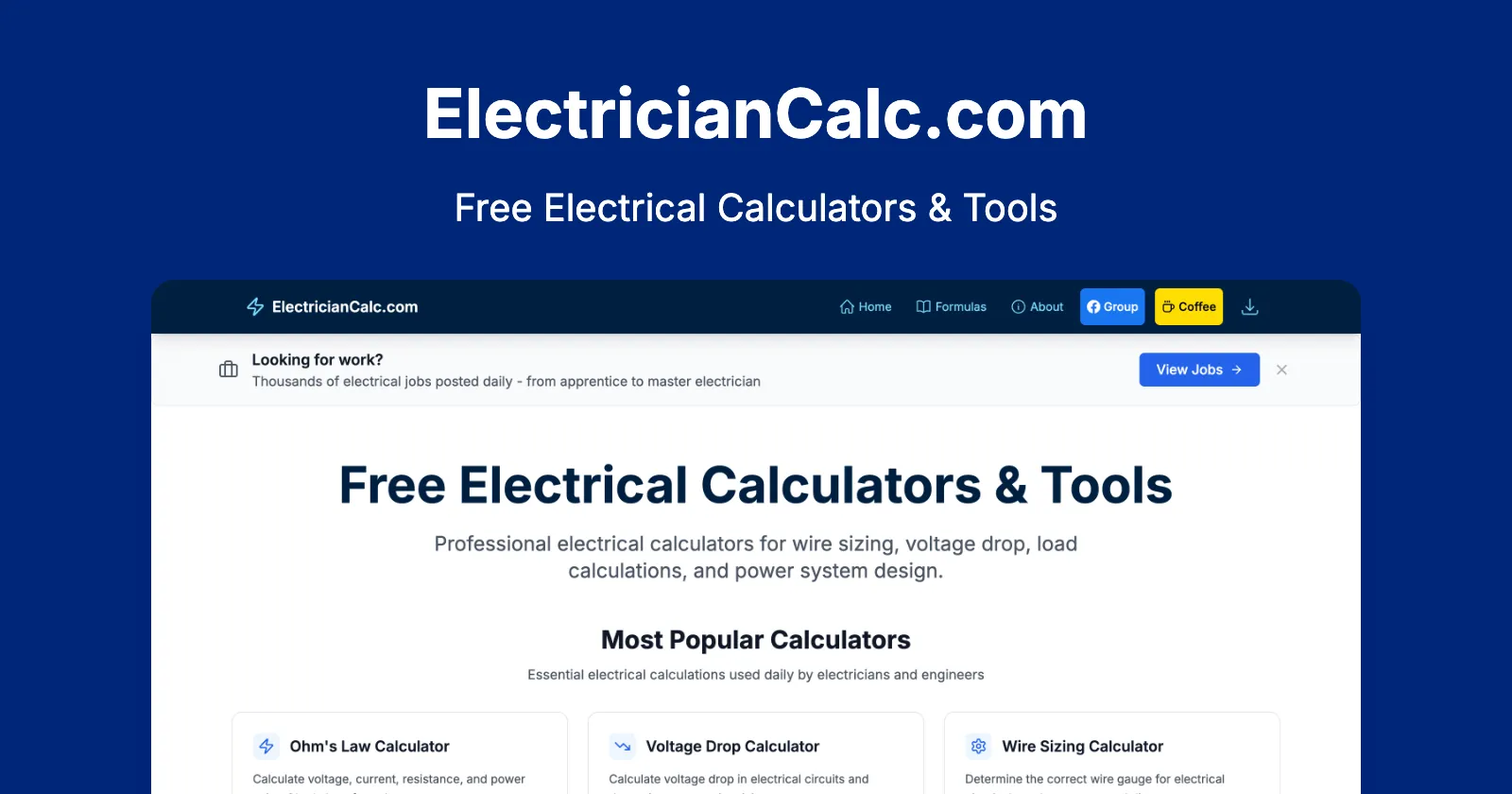
Free NEC-compliant electrical calculators for wire sizing, voltage drop, load calculations, and conduit fill, built for electricians and engineers.
Submit your website to get discovered by thousands of potential customers and boost your SEO.
Get ListedElectricianCalc.com is a specialized web application offering a comprehensive suite of free electrical calculators and tools designed primarily for electricians, electrical engineers, contractors, and students. The platform addresses a critical pain point in the electrical trade: the need for accurate, code-compliant calculations that can be performed quickly on the job site or in the office. By providing instant, NEC-compliant results for wire sizing, voltage drop, load calculations, conduit fill, and power factor, ElectricianCalc eliminates the guesswork and manual calculation errors that can lead to costly rework, safety hazards, and code violations.
Positioning itself as a practical alternative to generic calculator apps or cumbersome spreadsheets, ElectricianCalc emphasizes its adherence to National Electrical Code (NEC) standards, mobile responsiveness, and zero cost. The platform is built by an electrician, for electricians, which lends credibility and ensures the tools reflect real-world needs. While there are other electrical calculation tools available—such as desktop software like ETAP or SKM, or mobile apps like Electrical Calc—ElectricianCalc differentiates itself through its web-based accessibility, no installation required, and a growing ecosystem that includes a construction bid planner and an educational blog.
The website is clean, fast, and optimized for mobile use, making it suitable for on-the-job calculations. It also features a bookmarking system for saving frequently used calculators, a formulas reference page, and a blog covering electrical engineering topics. The platform is entirely free, supported by optional donations via Buy Me a Coffee, and has been featured on several web directories.
Wire Sizing Calculator: This tool helps users select the correct wire gauge based on load current, distance, voltage drop limits, temperature conditions, and wire type (e.g., THHN, THWN). It considers NEC ampacity tables and derating factors, providing a recommended wire size along with detailed calculations. The interface allows input of voltage (single-phase or three-phase), conductor material (copper or aluminum), and installation conditions, making it highly adaptable to real-world scenarios.
Voltage Drop Calculator: Long wire runs can cause voltage drop that impairs equipment performance. This calculator checks whether an installation meets NEC recommended limits of 3% for branch circuits and 5% for feeders. Users input the conductor size, length, current, and system voltage, and the tool outputs the voltage drop percentage and actual voltage at the load. It supports both single-phase and three-phase systems, and automatically adjusts for power factor if needed.
Load Calculation Calculator: Proper load calculations are essential for sizing panels, breakers, and feeders. ElectricianCalc provides calculators for residential, commercial, and industrial loads following NEC requirements. Users can add multiple loads, specify demand factors, and get a total load summary. This is particularly useful for permit applications and electrical inspections, as it generates a clear breakdown of general lighting, appliance, HVAC, and motor loads.
Conduit Fill Calculator: This tool helps determine the maximum number of conductors that can be installed in a given conduit size, based on NEC Chapter 9 tables. Users select conduit type (EMT, PVC, etc.), conductor size and type, and the calculator returns the fill percentage and whether the configuration is code-compliant. It supports mixed conductor sizes and includes options for different insulation types.
Power Factor Calculator: Power factor correction is important for industrial and commercial facilities to avoid utility penalties. This calculator computes the required capacitor bank size to improve the power factor from a given value to a target value. Users input the load kW, current power factor, and desired power factor, and the tool outputs the required kVAR and recommended capacitor rating.
Construction Bid & Estimate Planner: A newer addition, this is a professional spreadsheet template for contractors, electricians, and plumbers. It includes automated formulas, customizable templates, and dynamic color coding to help create accurate bids and win more projects. The tool is available as a product on the site, likely a downloadable file, and is marketed as a way to streamline the estimating process.
Formulas Reference Page: A dedicated page that lists common electrical formulas (Ohm's Law, power equations, voltage drop formulas, etc.) in a clean, easy-to-reference format. This is useful for exam preparation or quick lookups on the job.
Using ElectricianCalc is straightforward and requires no account creation. Upon visiting the homepage, users are greeted with a hero section that lists the main calculator categories. Clicking on any calculator, such as "Wire Sizing," takes the user to a dedicated page with a form interface. The user fills in the required parameters—like load current, distance, voltage, and conductor material—and the results update in real time. There is no submit button; calculations are instantaneous as values are entered or changed.
The interface is designed for mobile use, with large input fields and clear labels. Each calculator includes tooltips or helper text explaining the inputs. For example, the wire sizing calculator asks for the type of wire (THHN, THWN, etc.) and the ambient temperature, and it automatically applies the appropriate correction factors from NEC tables.
Users can bookmark calculators for quick access by clicking a bookmark icon, which stores the link in the browser's local storage. The site also offers a "Bid Planner" section that guides users through creating a construction estimate, though this appears to be a separate product rather than an interactive web tool.
For those who want to learn more, the blog covers topics like "How to Size a Wire" and "Understanding Voltage Drop," providing educational content that complements the calculators. The formulas page serves as a quick reference for common equations.
A licensed electrician on a residential service call needs to quickly determine the correct wire size for a 50-amp subpanel run 80 feet from the main panel. Using the wire sizing calculator, they input the load, distance, and voltage (240V single-phase), and the tool recommends a 6 AWG copper conductor with a voltage drop of 2.1%, well within the 3% limit. This saves time and ensures code compliance.
An electrical engineering student is studying for the NEC code exam and wants to practice load calculations. They use the load calculation calculator to simulate a small commercial building with lighting, receptacles, and HVAC loads. The tool provides a step-by-step breakdown, helping them understand demand factors and total connected load.
A project manager at a construction firm needs to prepare a bid for a new office build. They use the Construction Bid & Estimate Planner to create a detailed estimate with labor, materials, and overhead. The automated formulas and color coding help them produce a professional quote quickly, increasing their chances of winning the contract.
A facility maintenance technician notices that a large motor is running hot and suspects voltage drop. They use the voltage drop calculator to check the existing conductor size and run length, confirming a 4.5% drop that exceeds the NEC recommendation. They then use the tool to determine that upgrading to the next wire size will reduce the drop to 2.8%.
An industrial plant engineer wants to improve power factor to avoid utility penalties. They use the power factor calculator to determine that a 200 kW load with a 0.75 PF needs 100 kVAR of correction to reach 0.95 PF. The tool recommends a capacitor bank size, which they then specify for installation.
ElectricianCalc is completely free to use. There are no subscription plans, paywalls, or premium tiers. All calculators and tools are accessible without registration. The site is supported by optional donations via Buy Me a Coffee, and by displaying badges from web directories. The Construction Bid & Estimate Planner appears to be a paid product, but the core calculators remain free.
Compared to alternatives like Electrical Calc (a mobile app with a one-time purchase fee) or professional software like ETAP (which can cost thousands), ElectricianCalc offers exceptional value for its target audience. The lack of cost makes it an ideal choice for independent electricians, small contractors, and students who need reliable calculations without a financial commitment. The trade-off is that the site does not offer advanced features like project management integration, multi-user collaboration, or offline access (though it can be installed as a PWA for offline use).
ElectricianCalc is a well-executed, niche tool that fills a genuine need in the electrical trade. Its strength lies in its simplicity, accuracy, and adherence to NEC standards. The calculators are fast, mobile-friendly, and cover the most common scenarios electricians face daily. The addition of a bid planner and educational content adds value beyond just calculations.
Areas for improvement include expanding the range of calculators (e.g., transformer sizing, short-circuit current), adding more detailed output reports that can be printed or saved, and possibly offering an API for integration with other software. The site could also benefit from user accounts to save calculation history.
Who should use it: Electricians, electrical engineers, contractors, and students who need quick, reliable, code-compliant calculations for free. Who might look elsewhere: Large engineering firms requiring advanced simulation capabilities or enterprise-grade software with collaboration features.
Overall, ElectricianCalc is a highly recommended resource for anyone in the electrical field. Its commitment to being free and accurate makes it a standout in a market where many tools are either expensive or unreliable. Visit the homepage to explore the calculators, check the formulas reference for quick equations, or read the blog for educational articles.