PrivateTechShares helps founders and employees value startup equity, model exercise costs and dilution, and prepare private share sales in the US and Europe.
Submit your website to get discovered by thousands of potential customers and boost your SEO.
Get ListedPrivateTechShares is a research and tooling platform dedicated to understanding startup equity held in private companies. It addresses a problem that most cap tables quietly create: founders, employees holding vested ESOP options, and early angels often sit on paper value that is difficult to price or convert, while the knowledge required to do so normally stays with venture capitalists and professional advisers. The site moves that knowledge back to the people who earned the equity in the first place.
Aimed at founders, co-founders, current and former employees with options, and early shareholders across the United States and Europe, the platform covers three connected jobs. It explains what a grant actually represents, estimates what a stake might realistically fetch on a secondary market, and prepares the documents and conversations required to complete a small private share sale. The operation deliberately positions itself as an education and preparation resource rather than a broker, fund, or marketplace.
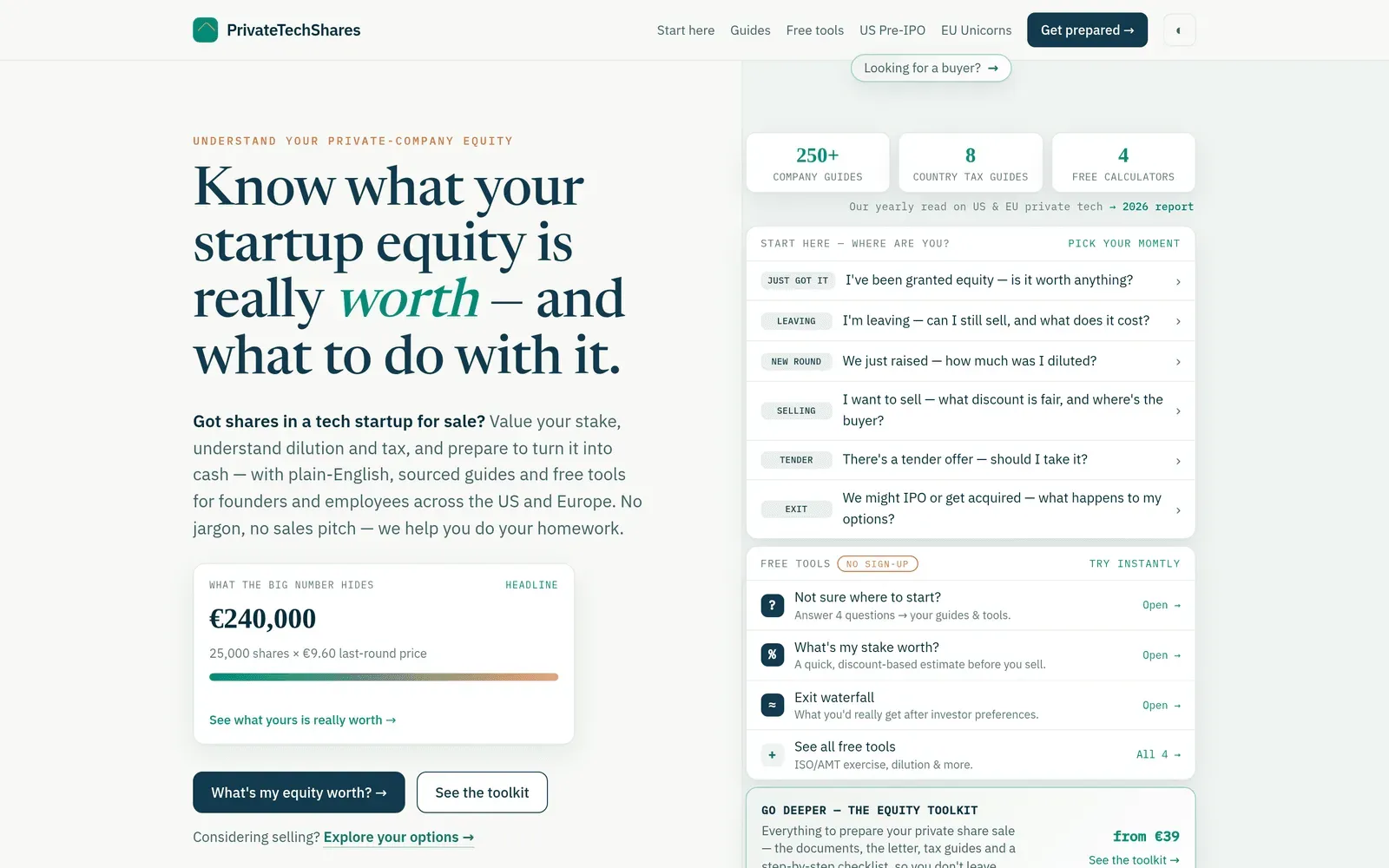
Free Stake Estimator. The homepage estimator prices a holding off the company's last round and then adjusts for the class of stock involved. Common shares, vested options, and preferred shares each receive different treatment, and a stage selector accounts for company maturity and buyer demand. The output is a realistic sale range plus an estimated net figure rather than one headline number, and the inputs cover currency, share count, last-round price, and the nature of the grant.
Exit Waterfall Calculator. A separate tool models what a holder would actually receive once investor liquidation preferences are applied to an exit. Instead of comparing a stake to a headline valuation, it walks the preference stack so the gap between gross company value and real proceeds becomes visible. It sits among four free calculators that also include the exercise tool and the dilution tool.
Option Exercise Cost Calculator with an AMT-aware US variant. The base calculator multiplies vested options by the strike price to produce the cash needed to convert options into shares, then shows the paper spread against the last-round price alongside a rough tax note for Poland, Germany, France, or the United Kingdom. A US-specific version layers in the tax exposure that ISO and NSO holders face at exercise, including AMT and ordinary income treatment.
Source-cited Country Guides. Transfer mechanics and tax treatment are documented for Germany, the United Kingdom, France, Spain, Italy, the Netherlands, and Poland, with figures dated and attributed so readers can verify the current position. The material covers capital gains treatment, notarisation where a jurisdiction demands it, and the practical difference between selling a small stake and a large one. United States coverage extends into ISO, NSO, AMT, and QSBS territory.
Equity Toolkit, US and Europe editions. The paid toolkit is organised as an eight-phase A to Z deal map with explicit STOP boxes marking where a lawyer, tax adviser, or notary takes over. Each edition bundles a PDF guide, an Excel calculator with a Deal Room control panel, and an editable Word workbook containing company-side drafts and eleven ready-to-send messages. The US edition concentrates on ISO, NSO, AMT, and QSBS questions, while the Europe edition carries seven country playbooks.
Equity Position Report. A personalised PDF produced from a holder's own grant data and governed by a published methodology. It summarises the position on a single shareable page, models value scenarios before and after tax, estimates exercise cost, projects dilution from future rounds, runs an exit waterfall, and applies country-specific tax treatment. A conversation pack of prepared numbers and questions is included so the report can be carried directly into a meeting.
Equity Starter Kit, Request Letter, and Readiness Check. A free PDF introduces the private secondary journey, explains what determines the value of a holding, supplies a plain-English glossary, and includes a first company request letter designed to pull grant paperwork out of the issuing company. No email address is required. A separate four-question Can I Sell check covers holding type, vesting, right of first refusal or board approval, and approximate transaction size, then routes the visitor to matching guidance.
The platform is usable without an account. A visitor arrives on a homepage that splits immediately into two paths: run an estimate or open the preparation toolkit. A situation selector built into the hero offers six entry points covering the moment equity is granted, leaving a company, a new funding round, an intention to sell, a tender offer, and a possible IPO or acquisition. Each row links to a dedicated guide rather than a generic landing page.
Free tools occupy the next layer. The stake estimator accepts currency, share count, last-round price, holding type, optional strike price, and a company stage selector, then returns a discount-adjusted sale range instead of a single figure. The exercise calculator works the same way for vested options and adds a country tax note. The readiness check stores nothing and returns directional guidance only.
Paid products follow the same editorial flow. The starter kit downloads instantly, the US and Europe toolkits and the combined bundle are sold through Stripe with immediate PDF, Word, and Excel delivery, and the Equity Position Report is built from grant data submitted by the holder. Throughout, the site keeps a visible boundary: it explains and prepares, but it does not introduce buyers, hold shares, or handle funds.
A solo founder of a Series B company who wants liquidity for a house deposit can run the stake estimator to see what a small block of common shares might fetch at a discount to the last round, then read the discount guide to understand why the gap exists before approaching existing shareholders.
An ex-employee holding vested options with a ninety-day exercise window can use the exercise calculator to see the cash required, then open the toolkit checklist to sequence exercise, tax planning, and any subsequent sale without missing the deadline.
An employee whose company has just closed a new round can turn to the dilution calculator to quantify how much of the cap table shifted, and the country guides to understand how a future sale would be taxed where the person resides.
An early angel with a European holding can compare the Germany, France, and Netherlands playbooks inside the Europe toolkit to identify notarisation requirements and transfer restrictions before opening a conversation with a prospective buyer.
The recipient of a tender offer can use the exit waterfall calculator to see what actually lands after investor preferences, then work through the tender offer guide to decide whether accepting or declining makes more sense.
PrivateTechShares serves founders, co-founders, current and former employees with ESOP options, and early angel investors holding stakes in private technology companies, primarily in the United States and Europe. Technical skill is irrelevant because every tool is form-driven and every guide is written in plain English. It suits holders of modest positions, typically between roughly ten thousand and seven hundred and fifty thousand euros, rather than institutional investors.
Alternatives such as Forge, EquityZen, and Nasdaq Private Market concentrate on large, late-stage transactions with high minimums and institutional processes. Law firms and accounting practices provide advisory depth but rarely offer free modelling tools. PrivateTechShares differentiates by staying education-first, refusing to act as a broker, and publishing methodology and sources alongside every number it produces.