Alternative.tools is a curated directory of the best websites, tools, and SaaS products with in-depth reviews, comparisons, and alternatives.
Submit your website to get discovered by thousands of potential customers and boost your SEO.
Get ListedAlternative.tools is a curated web directory that helps users discover, compare, and find alternatives to the best websites, tools, and SaaS products. The platform publishes unbiased editorial reviews of newly launched products, covering features, pricing, and real-world potential. This Alternative.tools review examines the directory itself, its key features, how it works for both visitors and product owners, and whether it delivers value in a crowded market.
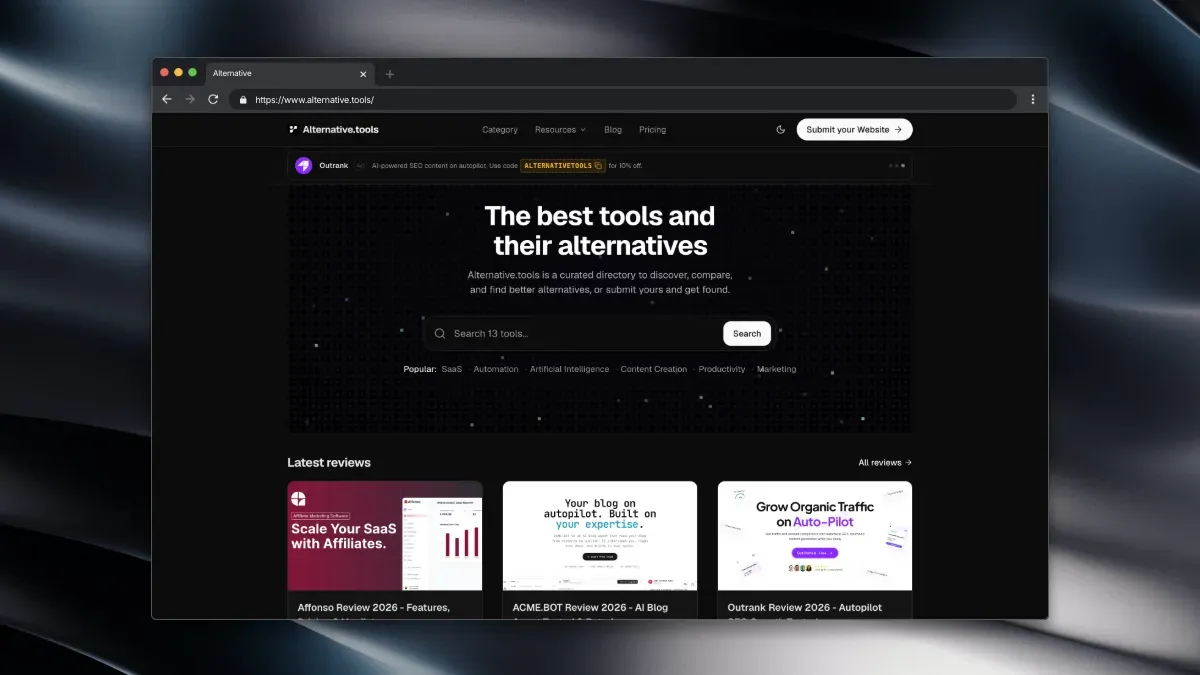
Alternative.tools is an independent platform designed to be a one-stop resource for discovering new websites, tools, and digital products. Its mission is to provide honest, in-depth reviews that go beyond surface-level descriptions. The directory currently lists a small but carefully selected number of products, each accompanied by a dedicated review article. The site is structured around categories such as SaaS, Artificial Intelligence, Automation, Content Creation, Productivity, Marketing, and more, allowing users to browse by use case.
The homepage immediately communicates the platform's purpose with the headline "The best tools and their alternatives." A search bar invites visitors to search through the collection, while sections for "Latest reviews," "Top Products," and "Recently Listed" provide curated entry points. The platform also includes a resource hub with guides, how-to playbooks, a glossary, and "Best for" lists, making it more than a simple directory.
For product owners, Alternative.tools offers a way to submit their websites for potential listing. The company has a pricing page with various plans, and sponsored placements are available, as seen with the Web Review ad that appears throughout the site. This dual focus on content and commerce creates a business model that supports the editorial work required for quality reviews.
Compared to other directories like Product Hunt, G2, or SaaSHub, Alternative.tools occupies a niche space. It emphasizes editorial depth over sheer volume, which appeals to users who want trustworthy assessments rather than a long list of unvetted tools. However, the limited number of listings means it is not yet a comprehensive source for software discovery.
For a visitor, the journey starts on the homepage. The first thing they see is the hero section with the tagline and a search bar. Typing a query like "SEO" will pull up relevant tools, or they can browse the category page to explore all products in a niche. The homepage also features a carousel of "Latest reviews" that scrolls through new articles, allowing users to discover fresh content without leaving the page.
Clicking on a product card leads to a detailed review. The review page typically includes the product's logo, website link, category, and a full article explaining what the product does, who it is for, and how much it costs. For example, the Viktor review describes an AI employee that lives in Slack and Teams, connects to over 3,200 tools, and starts free. This gives readers a clear picture of the product's capabilities and limitations.
For product owners, the process begins by visiting the submission page. They fill out a form with their website details, and the editorial team reviews the submission. Once approved, the product is added to the appropriate category and may be featured in "Recently Listed" or "Top Products." The platform also offers paid plans for faster approval or better placement, as detailed on the pricing page.
The resource hub is accessible through the top navigation. Users can browse guides, how-to articles, glossary terms, and "Best for" lists. These resources are interlinked with product reviews, creating a cohesive ecosystem where readers can learn about a topic and then explore the recommended tools.
Alternative.tools does not display specific pricing on the homepage, but the existence of a dedicated pricing page indicates that the platform uses a freemium or paid submission model. There is likely a free basic listing option, with paid tiers for featured placement, priority reviews, or analytics. The presence of sponsored ads suggests that advertising is another revenue stream.
For casual users, the entire directory and all its reviews are free to access. The value is in the editorial quality and the time saved researching products. For product owners, the value depends on the level of exposure the directory provides. With only a small number of listings, a product is more likely to stand out, but the overall traffic to the site may be lower than that of larger directories. The pricing likely reflects this balance, making it an affordable option for early-stage startups.
Compared to alternatives like Product Hunt, which is free to launch but highly competitive, Alternative.tools offers a more curated and potentially less noisy environment. For niche products, the return on investment may be higher.
Alternative.tools succeeds as a focused, editorial-driven directory. The quality of the reviews is high, with consistent structure and honest assessments. The resource hub adds significant educational value, making the platform useful beyond simple product discovery. However, the small database limits its utility as a comprehensive comparison tool. Users looking for a wide range of options may be disappointed by the current selection. The platform is best suited for founders and makers who want to get their products reviewed and for tech enthusiasts who appreciate detailed analysis. If the directory continues to grow and attract new submissions, it has the potential to become a trusted alternative to the bigger names in the space. For now, it is a promising niche player with room to expand.