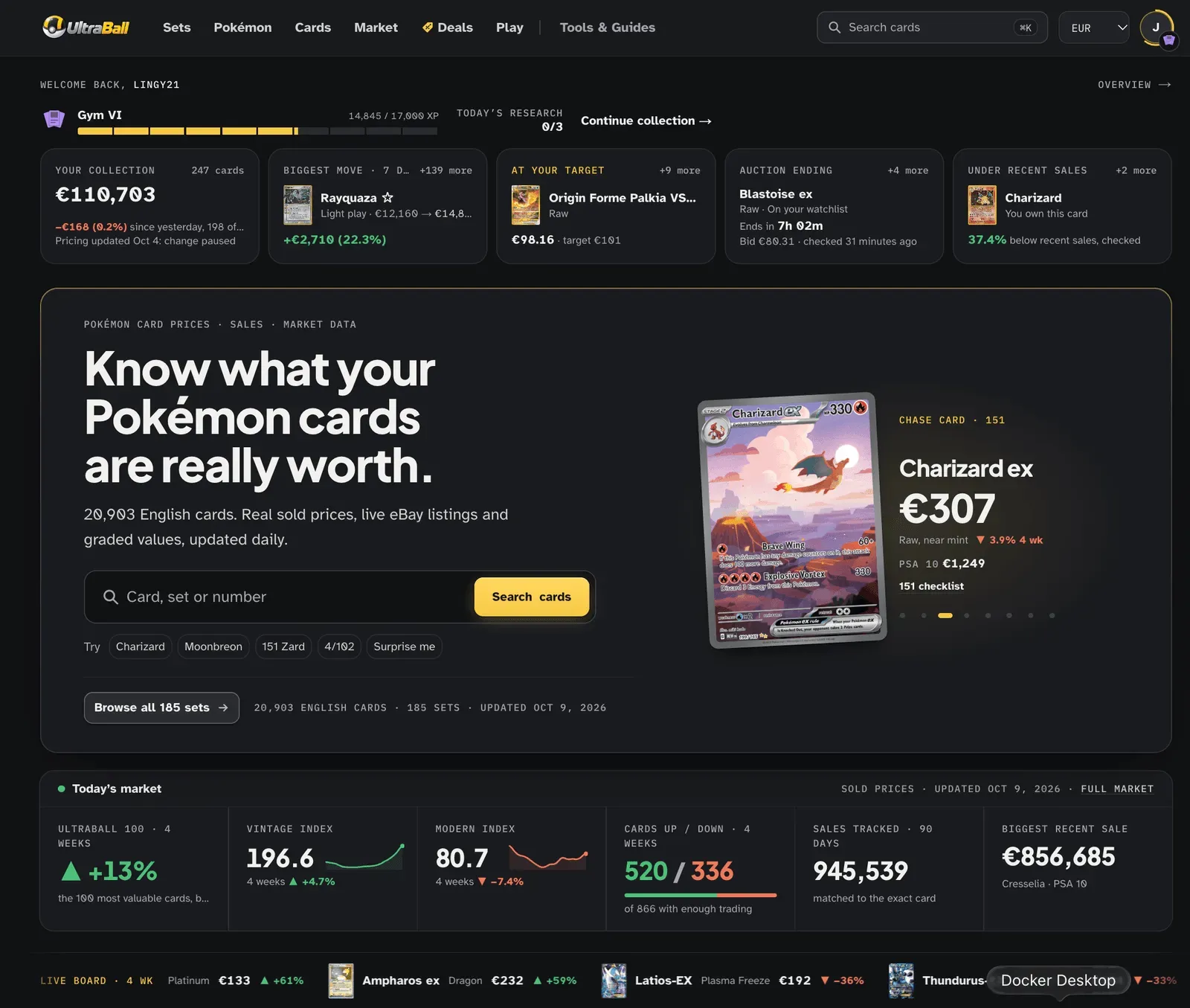
Pokémon card prices, values and market data for 20,903 English cards across 185 sets, with daily updates, graded price ladders and tracked eBay sales.
Submit your website to get discovered by thousands of potential customers and boost your SEO.
Get ListedUltraBall is a Pokémon card price and market data platform covering 20,903 English cards across 185 sets, from the 1999 Base Set through to upcoming Mega Evolution releases such as Delta Reign. It answers the hobby's most repeated question: what is this card actually worth right now? Rather than forcing collectors through scattered eBay sold listings and forum threads, UltraBall presents an ungraded price beside its four week change, a graded value ladder, a price history chart, liquidity and confidence marks, and the recorded sales behind each figure. Values refresh daily, and coverage spans every English set from Wizards of the Coast printings to Scarlet & Violet and the Mega Evolution block. The platform serves collectors sorting a childhood binder, resellers pricing inventory, grading submitters weighing a slab decision, and market watchers who follow card indexes the way others follow equities. It runs entirely in the browser with no installation required, and a currency selector renders every figure in more than thirty global currencies.
Card pages with graded price ladders. Every one of the 20,903 card entries opens into a dedicated page showing the ungraded market value next to its four week change, followed by a ladder that breaks out values for each graded condition tier. A price chart plots movement over time, while liquidity and confidence badges report how many copies sold, how recently, and how easily that specific grade changes hands.
Sales anchored methodology with strict grader separation. UltraBall Market Values are derived from recorded transactions rather than asking prices, and listings still for sale are kept separate from completed sales. Graded figures are never blended across companies, so PSA, CGC, BGS, SGC and TAG prices are each computed only from that grader's own sales, and the methodology page documents exactly how every number is produced.
Market indexes and a daily market pulse. The homepage publishes a Vintage index at 196.6 and a Modern index at 80.7 alongside 925,164 sales tracked in the last 90 days and a headline record of $1,020,000 for a Rayquaza Star in CGC 10 Pristine. Separate indexes cover the UltraBall 100, Charizard, Raw and PSA 10 segments, while market pages rank most traded cards, recent sales, record sales, low population cards and the hardest PSA 10s.
Deal hunting on live eBay listings. The Deals section filters eBay for cards listed below their tracked value, and Sniper surfaces auctions alongside a sensible maximum bid. Slab Hunter flags raw cards whose grading upside outweighs the submission cost, while additional feeds cover auctions ending soon, new listings and price drops.
A grading, valuation and selling toolkit. Free utilities include an AI card grader, a card centering tool, a grading calculator and a selling calculator, plus a price checker, a set symbol identifier, a nickname finder and a full collection tracker. Each tool feeds back into the same pricing data, so a centering check and a grading estimate can be read against real sold values.
Browse paths beyond search. The database can be navigated by card nickname such as Moonbreon, Van Gogh Pikachu or Bubble Mew, by rarity tier from Special Illustration Rare to Gold Star and Shining, by illustrator, by Trainer character, and by era from Wizards of the Coast through to Mega Evolution. Set checklists, sealed product prices and a 1,025 species Pokémon index round out the browsing layer.
Play and progression features. A daily card challenge, fantasy portfolio with public leaderboards, pack simulator, luck checker and set completion views turn price tracking into something closer to a game, with Collector Routes, level achievements and an UltraBall Wrapped summary rewarding repeat visits.
A session begins on the homepage, where a search field accepts a card name, set title or collector number and responds to the Cmd+K keyboard shortcut for fast lookups. A row of quick chips including Charizard, Moonbreon, 151 Zard and 4/102 demonstrates the expected input format, and a Surprise me button jumps straight to a random card. Setup requires nothing beyond a modern browser. No extension, desktop client or account is needed to read prices, browse the 185 set checklists, or explore the Pokémon index.
From a card page, the natural next steps are the market section, which aggregates most traded cards, recent sales and record sales, or the tools area for grading and centering checks. Collectors who want persistence create an account to unlock the watchlist, price alerts, Grail Radar, the collection tracker and the fantasy portfolio, with state carried across sessions. A currency dropdown in the header and footer switches every displayed value between USD, GBP, EUR and roughly thirty other currencies, so international users read the same underlying data in familiar units.
A vintage collector who uncovers a shoebox of 1999 Wizards of the Coast cards can open the era page, work through its 19 sets, and check individual card pages to separate a Shadowless Charizard from an Unlimited reprint before assuming the binder is worth a small fortune.
A reseller assembling an eBay lot uses Slab Hunter to shortlist raw cards whose graded value exceeds the cost of submission, then runs the selling calculator to estimate net proceeds after marketplace fees and shipping.
A deal hunter builds a watchlist, switches on alerts, and uses Sniper to place disciplined maximum bids on auctions ending soon, leaning on tracked market values to avoid overpaying during a bidding war.
A set completionist measures progress against the 185 checklists and the collection tracker, consulting the UltraBall 100 index and most traded list to decide which missing cards to prioritise given current demand.
A content creator or market commentator follows the Vintage and Modern indexes, the most traded leaderboard and record sales for talking points, citing the methodology page whenever figures are quoted publicly.
UltraBall is aimed at hobbyist collectors, resellers, grading submitters and market observers rather than enterprise buyers. The typical user owns a collection worth a few hundred to several thousand dollars, is comfortable reading checklists and sales histories, and needs no technical background whatsoever. Relative to alternatives such as PriceCharting, TCGplayer market data or raw eBay sold filters, the differentiators are granularity and transparency: per card graded ladders that keep each grading company distinct, explicit confidence and liquidity markers rather than silent single numbers, and a connected toolset spanning grading decisions, deal discovery and collection tracking inside one interface.