Forgefy is an AI marketing co-pilot that turns SaaS product updates and customer conversations into weeks of ready-to-publish content.
Submit your website to get discovered by thousands of potential customers and boost your SEO.
Get ListedForgefy is an AI marketing co-pilot for SaaS founders, indie hackers and small startup teams that need to keep several products growing at once. The problem it targets is familiar: shipping roadmaps consume the working week, so social posts, announcements and email campaigns slip, and older products quietly stall while attention moves to the next build. Forgefy takes the raw material a team already produces, including product updates, customer reviews and community conversations, and rewrites it into weeks of publishable content delivered in the founder's own voice. The result is a distribution pipeline that runs alongside development instead of competing with it. The company positions the platform as a content and distribution engine for founders rather than a plain social scheduler, and bundles it with calculators, templates and reference libraries aimed at the same audience.
Product-Aware Content Generation. Feeds drawn from product updates, customer reviews and conversations are converted into finished posts, threads, captions and emails. Output is matched to the founder's established tone rather than generic AI copy, and each draft carries the context of the product it came from. This is the feature that separates Forgefy from blank-slate writing assistants.
Multi-Platform Publishing and Scheduling. One calendar handles distribution across the major social networks, so a single launch note can become a LinkedIn post, a short-form thread and an Instagram caption in one pass. Scheduling happens inside the same dashboard, which removes the need to jump between native platform composers.
Email Campaign Management. Alongside social output, Forgefy manages email campaigns, allowing a product announcement to reach a subscriber list and then be recycled as social content. A single source update therefore works across two channels without duplicated effort.
Visual Generation. Copy arrives with matching visuals, so a completed post ships with an accompanying image instead of pushing the founder into a separate design tool. Media processing happens in the browser, and the application preconnects to a WASM media library for video exports.
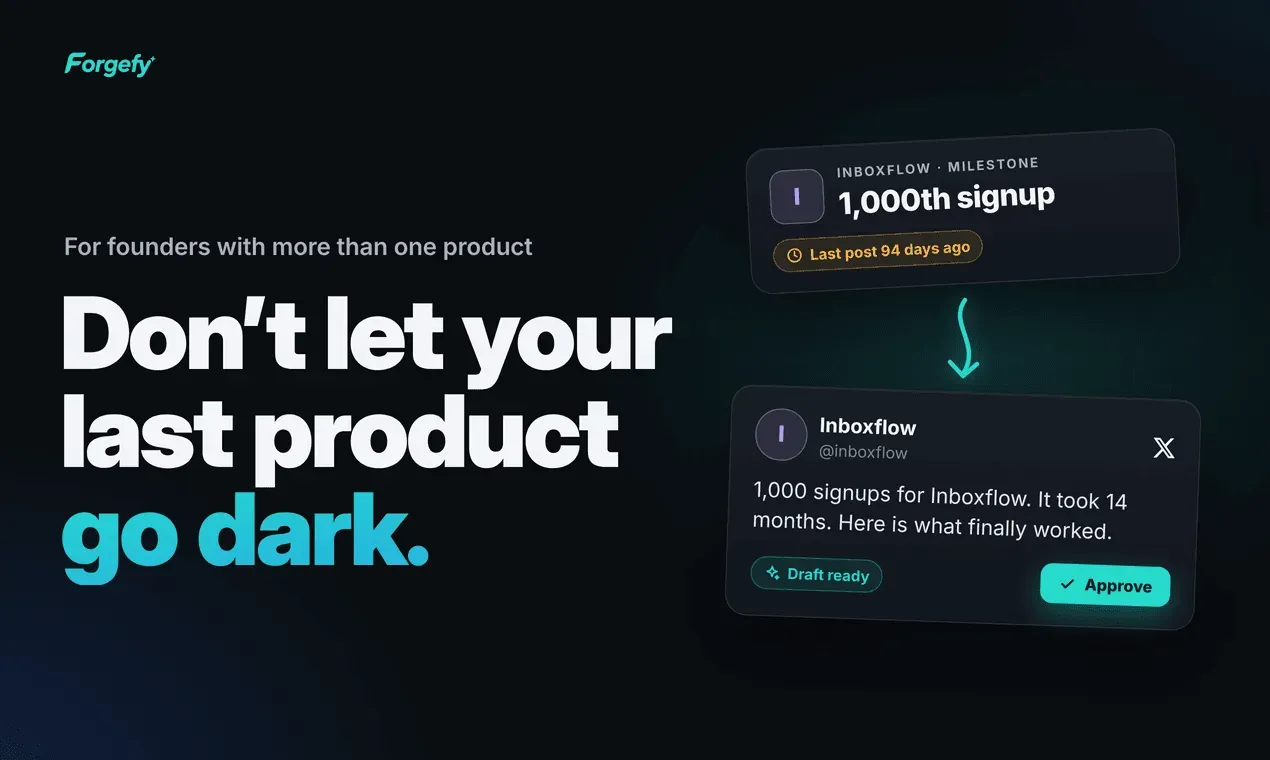
Event-Driven Automation. Marketing automation can be triggered by product and revenue events, meaning a release, a milestone or a billing change can start a content sequence automatically. Rules are configured once, and the system handles the repetition that founders usually abandon after the first busy week.
Free Founder Calculators. Five standalone tools are available at no cost: a Content ROI Calculator for pricing the dollar value of a piece of content, a Weekly Time Audit for comparing hours against founders at the same stage, a Positioning Statement Generator that returns three usable statements, a Revenue Leak Scanner, and a Content Load Calculator for estimating real content workload.
Template and Reference Libraries. A template catalogue spans build-in-public, SaaS marketing, startup launch, growth milestone, contrarian take, thread starter, LinkedIn post, Instagram caption, cold outreach, product update, landing page copy and customer story formats. Supporting reference material includes a SaaS metrics and marketing glossary, benchmarks for trial conversion, CAC, ARPU and email, end-to-end founder playbooks, pre-launch and growth checklists, honest tool reviews and more than thirty competitor comparison pages covering Buffer, Hootsuite, Typefully, Tweet Hunter, Hypefury, Later, Sprout Social and FeedHive.
The entry point is a free signup at the /start route, which places the visitor straight into the product rather than a long sales funnel. Onboarding captures the products a founder runs, the audience being addressed and the voice they write in, because the platform generates content on behalf of those products. From there the daily loop is straightforward: a release note, a customer review or a community exchange is submitted, and the system returns ready-to-publish drafts for social channels and email. Drafts are reviewed, adjusted if needed, then placed on the shared calendar or sent through an email campaign. Automation rules sit on top of this loop, letting product and revenue events trigger content sequences without further manual prompting, and the /docs reference explains each feature in plain language. Because everything runs in the browser with no install step, the workflow fits founders who market in short bursts between development sessions. A public roadmap page signals that the automation surface is still expanding.
A solo founder launching a B2B SaaS who needs to publish a steady build-in-public narrative can drop changelog entries and support threads into Forgefy, then let product-aware generation produce a week of posts without breaking concentration on the codebase. The template library supplies the structural formats, from milestone posts to contrarian takes.
An indie hacker running two or three small products faces the classic problem of an older tool going quiet while a newer one ships. Event-driven automation tied to product and revenue events keeps those legacy products generating content, so their funnels keep receiving traffic even when nobody is writing manually.
A two-person startup team with no dedicated marketer can use the unified dashboard to handle social scheduling and email campaigns from a single place, replacing the combination of a scheduler, an email platform and a design tool that a small budget rarely justifies.
A creator or consultant selling a productised service can put the Positioning Statement Generator and Revenue Leak Scanner to work first, then move to content production once messaging is settled. The free calculators make the platform useful before any commitment.
A founder evaluating the crowded social scheduling market can work through the comparison pages covering Buffer, Hootsuite, Typefully and others to see where a product-event-driven approach differs from calendar-first tools.
Forgefy targets solo founders, indie hackers, creators and startup teams of roughly one to ten people who are responsible for both product and marketing. No technical setup is required, and the browser-based interface assumes a marketing beginner rather than a growth engineer. Alternatives include Buffer, Hootsuite, Later, Sprout Social, Typefully, Hypefury, Tweet Hunter and FeedHive, most of which are scheduling-first tools that expect the user to supply finished copy. Forgefy differentiates by sourcing content from product activity, automating on product and revenue events, and folding email campaigns into the same workspace.