erecruit links every open Australian government ICT opportunity to the tender-panel job ad behind it, giving recruiters contract-level intelligence.
Submit your website to get discovered by thousands of potential customers and boost your SEO.
Get Listederecruit is an Australian government ICT opportunity intelligence platform that links every open BuyICT opportunity to the tender-panel job advertisement running behind it. The product addresses a persistent coordination gap in public sector recruitment. Government procurement notices sit on one system, agency job ads sit on another, and recruiters are left to reconcile the two by hand before deciding which contract deserves attention. erecruit automates that reconciliation, attaches role, clearance, location and timing evidence to each match, and then routes the result into a compact recruiting workflow. The target audience is recruitment agencies, tender and bid teams, and talent suppliers that place contractors into federal and state government ICT panels.
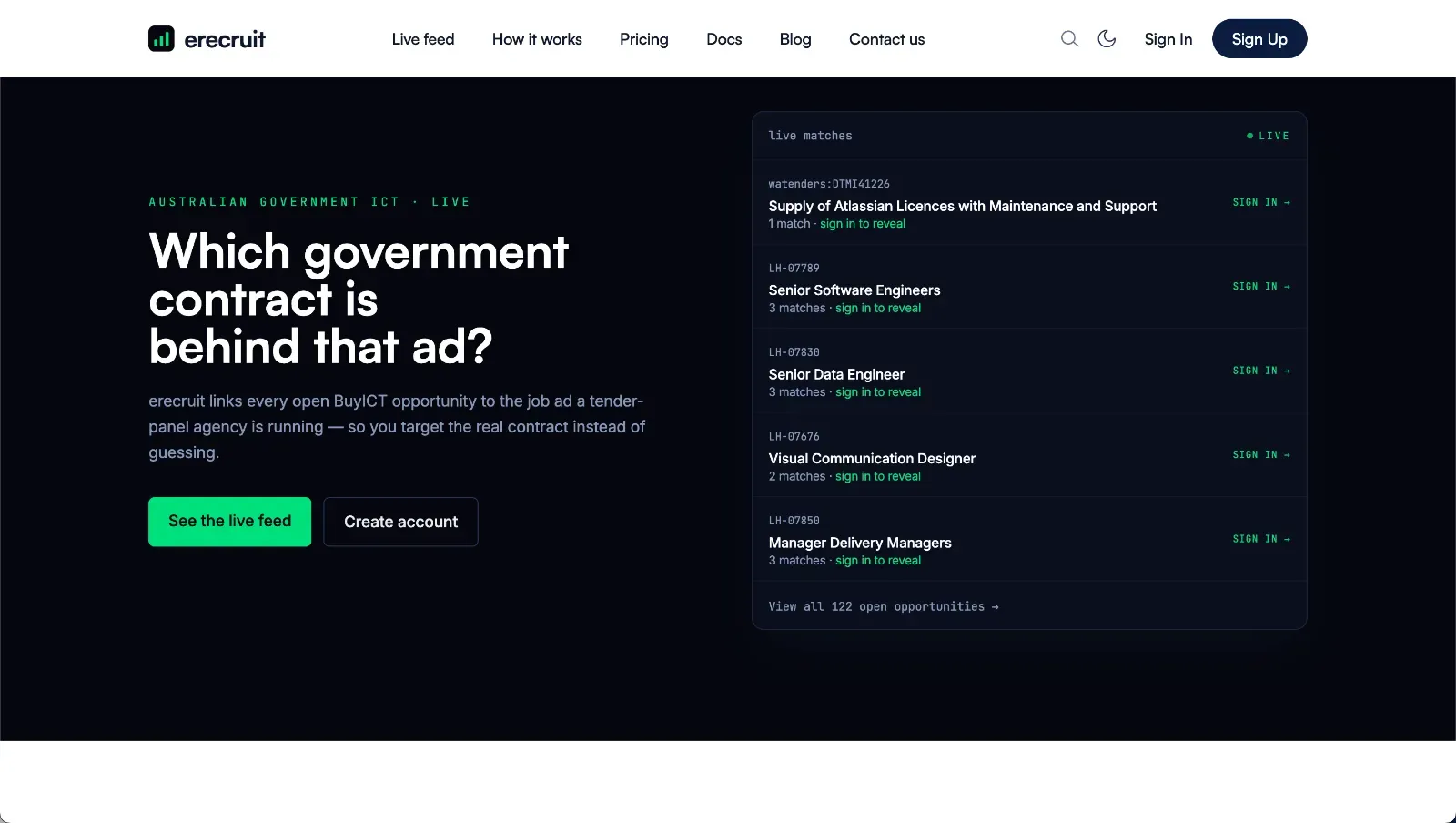
Live opportunity feed. The platform maintains a running list of open Australian government ICT opportunities, identified by procurement references such as LH-07789, LH-07830, LH-07676 and watenders:DTMI41226. Representative listings include Senior Software Engineers, Senior Data Engineer, Visual Communication Designer, Manager Delivery Managers, and a supply of Atlassian licences with maintenance and support. Each row displays a match count, for example one match or three matches, together with a sign in prompt to reveal the connected advertisement. The homepage reported 122 open opportunities at the time of capture and links through to a full feed plus a recently closed view.
Tender to ad matching with evidence. Rather than pairing records on a hunch, erecruit explains each link using concrete signals: the role being hired, the security clearance involved, the work location, and the timing of the posting. This evidence trail means a recruiter can sanity check a match before spending time on it, which matters when a single misread advertisement can waste a day of business development effort.
CV matching and scoring. Recruiters upload candidate CVs and the system scores them against individual roles. Crucially, every score arrives with the reasons behind it, so shortlisting decisions can be defended internally and explained to account managers instead of resting on an opaque ranking number.
Candidate search and import. The workspace can search external sources for candidates and pull them inward, caching the results so a talent pool persists between sessions. This removes the repeated copy and paste cycle that typically accompanies sourcing from job boards and public profiles.
Pipeline kanban. Candidates move through stages on a drag and drop board that can be filtered by opportunity. Filtering by opportunity is the distinctive part, because it keeps a single contract view intact while still showing the broader bench.
Consent gate. Before a candidate is submitted, the platform requires representation consent to be requested. This introduces a deliberate checkpoint into the submission flow, which suits agencies operating under panel obligations and client compliance rules.
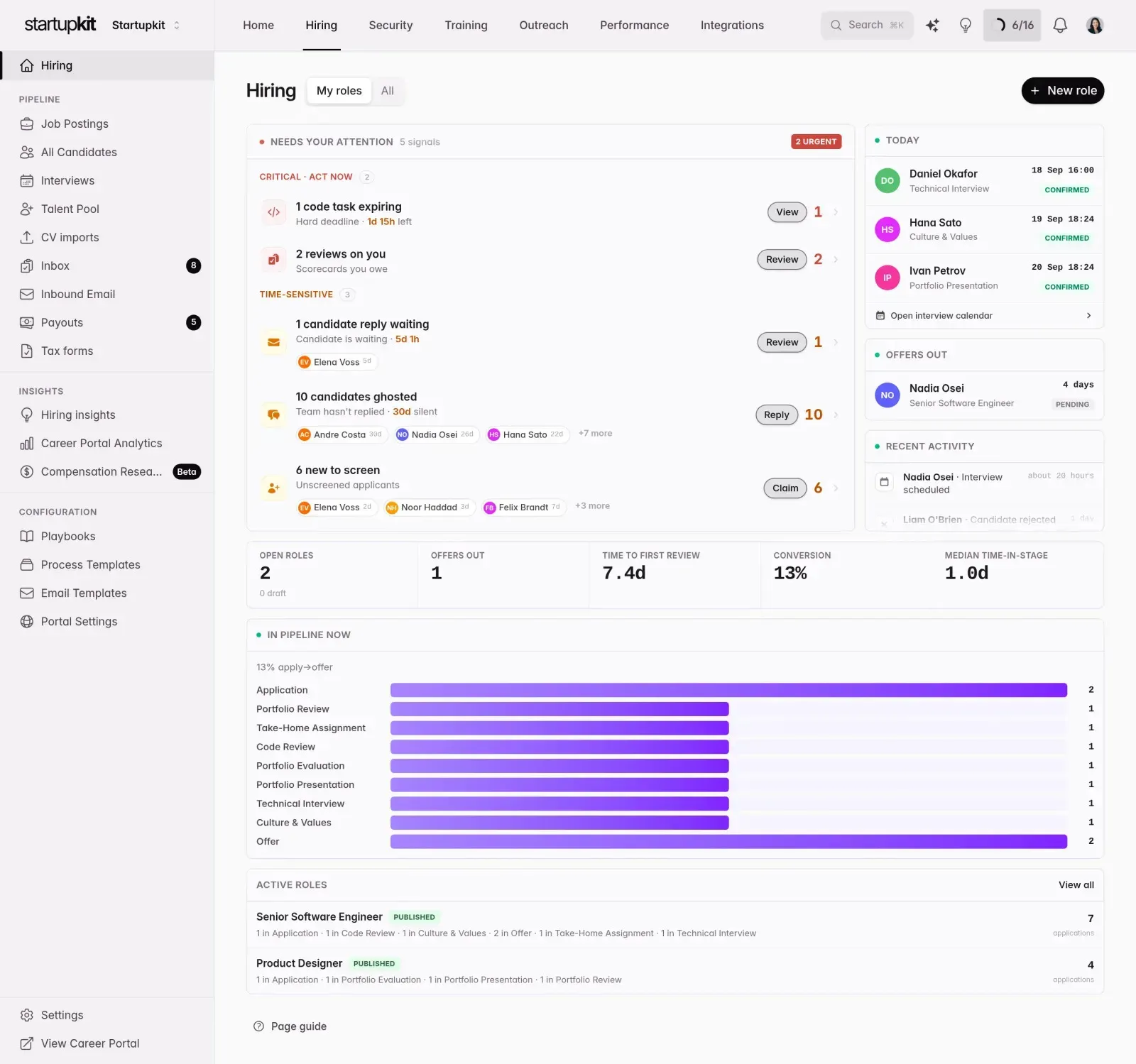
Recruiter dashboard. A summary layer surfaces KPIs, CV matches, items flagged as needs review, and recent activity. Team leads can therefore see where attention is required without opening each opportunity individually. Supporting documentation covers CV matching and FAQs, while a blog and weekly briefings extend the resource library.
Getting started follows a short path. A user creates an account, which unlocks the detail hidden behind the sign in links visible to anonymous visitors, then lands on the live feed of open opportunities. Because contact and match specifics are gated, the first meaningful step after registration is reviewing the matched advertisements and deciding which contracts are worth pursuing.
The working rhythm then moves into candidate handling. CVs are uploaded and scored against selected roles, with the reasoning displayed alongside each score. Candidates that pass review are imported into the workspace, where they enter the pipeline kanban and progress through stages, filtered by the opportunity they belong to. Before any submission leaves the agency, the consent gate prompts a representation consent request.
Day to day, most users start on the dashboard rather than the feed. The dashboard highlights CV matches, needs review queues and recent activity, so the morning routine becomes triage rather than search. Setup requirements are light: a browser, an account, and CV files to upload. There is no indication of a desktop client or a local install step, and the interface supports language selection through a flag switcher.
A boutique ICT recruitment agency with three consultants needs to know which panel contracts are genuinely live before committing business development hours. Using the live feed and the evidence attached to each match, the team replaces manual cross referencing of procurement notices with a single filtered view.
A bid and tender specialist tracking labour hire demand across federal departments wants early visibility of emerging roles. The platform's opportunity intelligence and weekly briefings give a structured feed of new listings rather than a scattered inbox of alerts.
An account manager holding forty contractor CVs needs to shortlist for a senior data engineering role. CV matching produces a ranked set with justification for each candidate, cutting the first pass down to minutes and leaving a defensible audit trail.
A compliance conscious agency operating under a panel agreement needs documented consent before submitting any candidate. The consent gate bakes that requirement into the pipeline, so submissions cannot skip the step by accident.
A team lead supervising several recruiters wants a single view of where the desk stands. The dashboard aggregates KPIs, needs review items and recent activity, which removes the need for a manual status meeting.
ercruit is built for recruitment agencies and talent suppliers of roughly two to fifty consultants that place contractors into Australian government ICT panels, along with in house bid and tender teams at larger staffing firms. Users are typically recruiters, account managers and delivery leads rather than engineers, and the interface assumes no technical setup beyond a browser and uploaded CVs. Alternatives include generic job boards, which publish advertisements without connecting them to procurement notices, manual monitoring of BuyICT with spreadsheets, and broad recruiter CRMs and applicant tracking systems that manage candidates but do not map contracts to ads. The differentiator is the contract to advertisement link, paired with evidence backed CV scoring and a consent checkpoint built for panel compliance.