StoreToAds is an AI ad generator that turns real product pages into verified, multi-size ad creative without redrawing the original product photo.
Submit your website to get discovered by thousands of potential customers and boost your SEO.
Get ListedStoreToAds is an AI ad generator for online stores that builds advertising creative around a merchant's genuine product photography instead of synthesizing new product imagery. The platform reads a store's product page, isolates the original photo, verifies every price, review count and product claim against that source page, and then lays the material into ad designs at five standard aspect ratios. It is built for independent ecommerce operators, especially those running Shopify, Etsy, WooCommerce, Wix, Squarespace, PrestaShop or Amazon listings, who need a steady stream of platform-ready static ads but have no in-house design team. The product is in free public beta, with fifteen free ads available to account holders and a three-ad no-signup preview path.
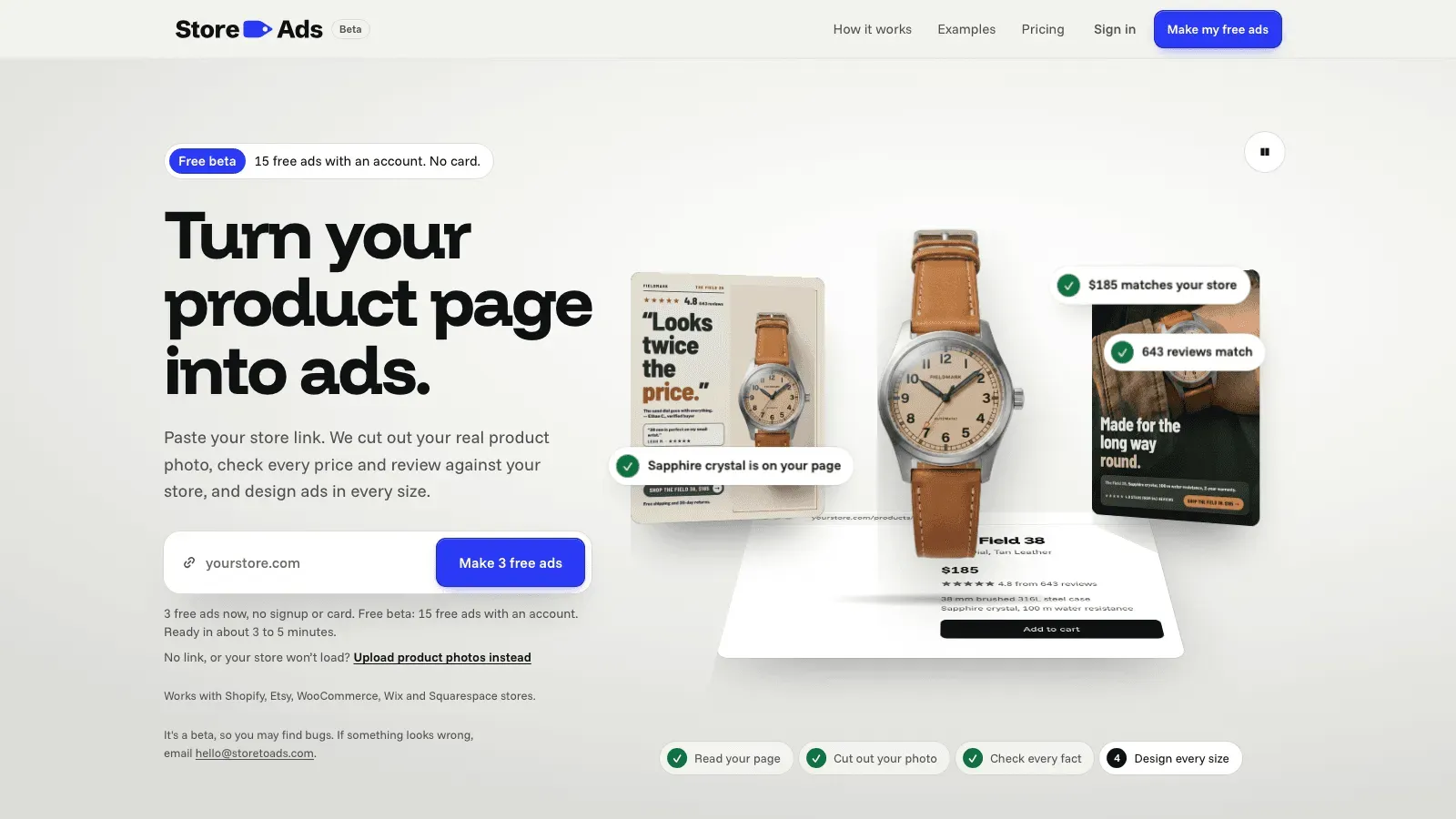
Store link ingestion. A merchant pastes a single store or product URL into the hero form and the system crawls the catalog to surface products, prices, reviews and photography. Fallback paths exist for stores that block automated reading, including screenshot uploads or fully manual product entry. The whole parsing step typically resolves in three to five minutes.
Cutout compositing instead of AI redraw. Rather than regenerating product pixels, StoreToAds extracts the original photograph and designs around it. This keeps packaging text, ingredient panels and embossed labels sharp and readable, which matters for categories where a smudged label becomes a compliance problem. The FAQ states plainly that the tool reuses original photos rather than generating new product pixels.
Fact verification against the source page. Every price, sale price, star rating, review count and quoted claim is cross-checked against the merchant's own product page before an ad is delivered. Anything that cannot be matched to the source is stripped out. The landing page visualizes this with inline checkmarks on matched figures and a struck-through example of an unsupported best-seller badge being removed.
Five aspect ratios per paid design. Each paid ad ships in Feed (4:5), Story (9:16), Square (1:1), Pinterest (2:3) and Google (1.91:1) formats. The three free preview designs are restricted to the 4:5 feed size, so the full size set is a paid-plan benefit rather than a trial feature.
Conversational editing in the browser. Headlines, price blocks, badges and call-to-action buttons are all editable directly on the rendered ad, and the platform supports natural-language revision requests such as asking for a different word or tone. Edits are described as instant and free, which removes the re-roll cost that plagues pure image-generation tools.
Paused delivery to Meta and free downloads. Completed ads can be downloaded as files or pushed into a Facebook and Instagram ad account in a paused state, so nothing spends until the operator manually activates a campaign. Posting organically to owned pages stays free, while media spend stays with the merchant's own ad account.
Agent access through Claude and ChatGPT. A dedicated Connect AI surface lets merchants generate ads from inside third-party AI chat assistants, positioning StoreToAds as a background capability rather than a mandatory destination app. The company also publishes standalone utilities, including a free ad grader and an ad readiness checker.
The workflow is deliberately compressed into three steps. First, the merchant submits a store or product link, and the crawler pulls products, pricing, reviews and images into a working set. Second, the merchant ticks which products should receive an ad, optionally attaching a style direction, with one ad generated per selected product. Third, results appear as a reviewable grid where weak concepts are discarded and strong ones kept, with each paid design expanding automatically into the full five-size set.
Setup requires nothing beyond a public store URL, though merchants whose storefront blocks crawlers can upload page screenshots or key in product details manually and confirm everything before generation. The interface exposes a visible four-stage progress narration (read the page, cut out the photo, check every fact, design every size) so the wait feels legible rather than opaque. Output review happens in the browser, and nothing is published or posted without an explicit action from the operator.
A solo Shopify founder launching a seasonal collection needs twelve product ads across feed, story and Pinterest placements in a single afternoon. StoreToAds ingests the collection URL and returns designs that already carry correct prices and review counts, avoiding the copy errors that slip in when a founder hand-builds creatives at speed.
An Etsy ceramics seller with strong photography but no design skills uses the photo cutout pipeline to place existing product shots into polished layouts without commissioning a designer. Because the original glaze and maker's mark stay intact, the listings remain recognizable to returning buyers.
A small DTC skincare brand with regulatory caution relies on the claim verification layer. The system removes unsupported superlatives and only retains ingredient and review statements traceable to the brand's own product page, reducing advertising compliance exposure.
A growth marketer running Meta Advantage+ campaigns needs fresh creative volume to feed an automated bidding system. StoreToAds supplies new static assets on a scheduled cadence, then sends them into the ad account paused so the marketer retains activation control.
An agency managing several small ecommerce accounts can spin up multi-size batches per client store quickly, using the Starter plan's logo and brand color application to keep each account visually consistent.
StoreToAds fits small and mid-sized direct-to-consumer ecommerce teams, typically one to twenty people, where a founder, marketing generalist or freelance media buyer owns creative production. Technical skill required is minimal, since the entry point is a store URL rather than a design canvas or prompt editor. It sits alongside rather than replaces Meta Advantage+ and Shopify Campaign Autopilot, supplying the raw creative those systems optimize. Compared with Canva, AdCreative.ai or Pippit, the differentiators are the no-redraw product fidelity policy and the source-verification step applied to every price and review quote.