Overview
SysRound is a tech interview preparation platform that pairs a large company tagged question library with an AI mock interviewer for system design rounds. It targets a specific weakness in most interview preparation: the system design round is spoken, sketched, and time boxed, while the majority of tools offer static question lists and written answers. SysRound wraps 8,847 questions drawn from 489 companies, coding study plans, a multi panel practice workspace, and a voice driven interviewer named Alex into a single product. The platform is aimed at software engineers working through mid level (L4/E4), senior (L5/E5), and staff (L6+/E6+) loops at large technology employers, and the study layer is free while mock interview rounds are sold in packs.
Key Features
- Voice AI interviewer named Alex: Alex runs a full system design round out loud, asks one question at a time, answers sizing questions the way a product owner would, and deliberately withholds the solution. Speaking and listening happen at the same time so candidates can interrupt and think aloud rather than read a transcript during the round.
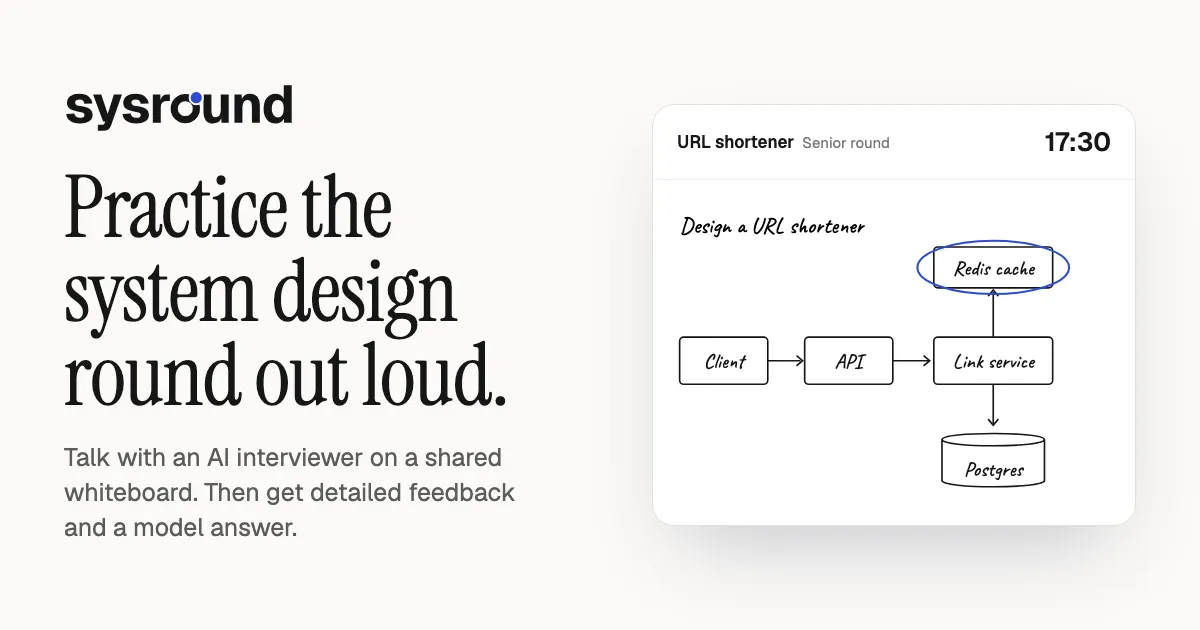
- Shared whiteboard that the interviewer reads: Candidates draw boxes and arrows while Alex follows the diagram, records agreed figures in the notes panel, and attaches comments to specific components such as a Redis cache layer. A minute by minute replay of the whiteboard ships with the feedback.
- Company tagged question library: The catalog holds 8,847 questions across 489 companies, including 834 Meta questions, 738 from Amazon, 671 from Google, and 642 from OpenAI. Each entry lists its sources and report dates, and the library splits into coding (4,878), system design (1,593), machine learning (965), and behavioral (594) sections, plus object oriented design, practical engineering, and product categories.
- Coding study plans: Two curated tracks organize problems by pattern. Coding Patterns 150 covers 150 problems in 18 groups for candidates with six or more weeks, and Coding Core 75 covers 75 problems in 22 groups for two to four week sprints. Progress is tracked group by group as problems are marked done, and each problem includes a full statement with examples checked by a reference solution.
- Multi tool practice workspace: Any question opens in a workspace with a code editor for Python, JavaScript, and TypeScript, a notes tab with headings, lists, and checklists, a whiteboard for design diagrams, and AI hints that can deliver a nudge, a review, or an explanation when a candidate is stuck.
- Seven skill scorecard with model answer: Feedback grades problem framing, navigation and ownership, high level architecture, technical depth, trade offs and judgment, scale, reliability and operations, and communication against the bar for the selected level. Every score quotes what the candidate said or drew, and the grader runs three passes and keeps the median result.
- Pack based pricing on a free study layer: The question bank, company pages, study plans, and workspace cost nothing. The beta includes two 45 minute rounds, after which packs cost $29 for one round, $99 for five ($19.80 each), or $199 for twelve ($16.58 each), with no subscription and no expiration.
How It Works
Entry starts from the homepage search field, which accepts a company name and routes to a company page listing that employer's reported questions. Candidates who prefer structure open a coding study plan and work the grouped problems in pattern order. Selecting any question loads the practice workspace, where code, notes, whiteboard, and AI hint panels sit side by side, and the two sum sample is reachable without an account.
A mock interview begins from the practice page. The candidate picks a level (mid, senior, or staff) plus a length of 45 or 60 minutes, then enters a voice room. Alex moves the session through six timed phases: requirements, estimation, API and data model, high level design, deep dives, and wrap up. The interviewer keeps the clock and signals when to move on. After the closing question about what breaks at ten times the traffic, the scorecard, quoted highlights, model answer, and a practice plan for the weakest skills are delivered. Setup requires only a browser with a microphone, and the site installs to a phone home screen as a progressive web app, though voice rounds with a whiteboard work best on a computer or tablet.
Use Cases
- A senior engineer with an onsite in three weeks opens the company page for the target employer, filters system design questions by difficulty, and books three mock rounds to rehearse out loud under time pressure.
- A mid level developer stepping into a first senior loop selects the senior level in the mock interview, which raises the deep dive questions and the scoring bar, exposing gaps in scale and reliability reasoning before the real round.
- A career switcher with a six week runway follows Coding Patterns 150 in sequence and marks problems done group by group, so patterns build on each other instead of being sampled at random.
- An ML engineer targeting an AI lab drills the 965 machine learning questions and the separate ML system design set, coverage that general purpose coding trackers rarely offer.
- A staff candidate who freezes when speaking uses the voice room to rehearse narration, then reads the quoted feedback to see exactly where an explanation lost the interviewer.
Who It's For
SysRound fits individual software engineers preparing for structured loops at large technology companies, especially candidates facing a system design round where verbal delivery matters as much as the architecture itself. It suits mid, senior, and staff level engineers who can self direct study and want something closer to a rehearsal than a reading list. The free library and study plans serve cost conscious job seekers, while paid rounds target engineers with interviews already scheduled. Compared with live peer platforms such as Pramp or human coaching marketplaces like interviewing.io, SysRound trades human realism for on demand repetition at a fixed price. Against written course libraries such as Educative or Exponent, the differentiator is a spoken round with a whiteboard the interviewer can actually read.