CiteTrue is a free AI citation checker that verifies APA and MLA references against academic databases to flag fake or AI-hallucinated sources.
Submit your website to get discovered by thousands of potential customers and boost your SEO.
Get ListedCiteTrue is a free AI-powered citation checker built to confirm that every reference in an academic manuscript corresponds to a real, accurately described publication. The platform accepts pasted reference lists, splits them into individual entries, and cross-references each one against a wide set of scholarly databases before returning a confidence score. The problem it addresses is well documented: language models routinely invent plausible looking sources, and manual reference checking does not scale for long theses or high volume editorial workflows. CiteTrue is built for students, researchers, professors, journal editors, and peer reviewers who need fast, repeatable verification ahead of submission, grading, or review.
Multi-database citation verification. Every reference is queried against a network of academic sources that includes arXiv, CORE, Crossref, Google Scholar, OpenAlex, PubMed, IEEE, Springer, Wiley, Elsevier, Semantic Scholar, ACM, BMC, ResearchGate, ScienceDirect, OpenLibrary, and Cambridge University Press, so a citation has to hold up across several registries rather than one.
Field-level reference checking. The checker separates each entry into distinct components and validates them individually. Titles are matched against indexed records, author lists are compared name by name, publication years are tested against the formal date on record, DOIs are resolved against the registry that issued them, and venue, volume, and page numbers are compared field by field.
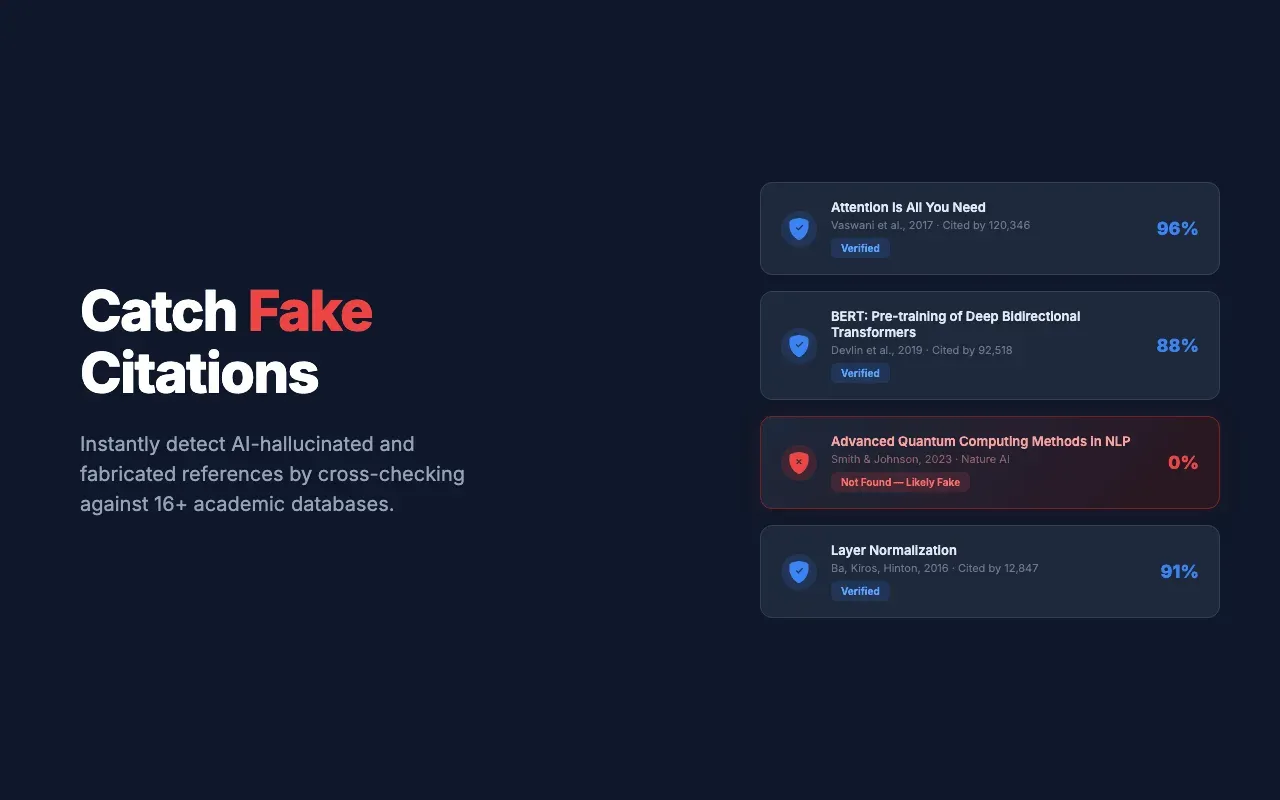
Fabricated and AI-generated reference detection. Because the pipeline compares submitted text against real publication metadata, it surfaces entries pointing to papers that were never published, real papers credited to the wrong people, invented DOIs, dead links, and numeric details silently altered in transit.
Confidence scoring. Each citation receives a score expressing how likely it is to be authentic and accurate. High values indicate a clean match against the underlying record, while low values direct attention to the entries that need manual correction.
Batch verification and automatic format handling. CiteTrue processes dozens or hundreds of references in a single pass and normalizes input formatting during verification, which helps with APA, MLA, and other styles that arrive in inconsistent order.
Companion tools and clients. The same account covers a Citation Finder for locating real peer-reviewed sources behind a paragraph, a Paper Draft generator, and an AI Humanizer, plus a Chrome extension and a Mac desktop app alongside documented API and MCP access.
The workflow follows a short, linear pipeline. A researcher pastes a reference list into the checker and submits it. CiteTrue splits the block into individual citations and places each one into a task queue. Every queued citation is then queried against multiple databases in turn, with additional sources pulled in as the system determines they are needed. Retrieved records are analyzed and aggregated, and the platform produces a final report. That report shows a confidence score per reference together with flags such as year mismatch or not found, which turns the output into a prioritized correction list rather than a simple pass or fail.
CiteTrue targets academic and research focused audiences across several roles. Undergraduate and graduate students run it before submitting coursework or conference papers. Doctoral candidates use it over bibliographies that easily reach hundreds of entries. Professors and advisors apply it to student submissions. Journal editors and peer reviewers use it during initial screening to filter manuscripts containing bogus references. Editorial offices handling high submission volumes are also a natural fit.
CiteTrue draws on a deliberately broad set of indexing partners. Open repositories and aggregators such as arXiv, CORE, OpenAlex, Semantic Scholar, and Google Scholar sit alongside publisher and registry sources including Crossref, PubMed, IEEE, ACM, Springer, Wiley, Elsevier, BMC, ScienceDirect, Cambridge University Press, ResearchGate, and OpenLibrary. A separate group of paid data sources extends coverage where open indexes are thin. The stated reasoning is that verification should not hinge on a single catalog, since no single database indexes every legitimate publication.
The site frames citation verification as a measured problem rather than an anecdote, and it cites three peer-reviewed findings. Walters and Wilder, writing in Scientific Reports in 2023, reported that 55 percent of bibliographic citations generated by GPT-3.5 were fabricated outright, alongside 18 percent of those generated by GPT-4. A 2023 Cureus study by Bhattacharyya and colleagues found that across 30 ChatGPT generated medical papers, each reference carried an average of 4.3 incorrect components and 93 percent of the papers contained a wrong PMID. Van Noorden, reporting in Nature in 2023, noted that more than 10,000 papers were retracted that year, an annual record driven by sham papers and peer review fraud.
The citation checker is one part of a broader research toolkit. The Citation Finder accepts a paragraph and returns real peer-reviewed sources for the claims inside it. Paper Draft takes a topic and produces a section draft in which each sentence is tied to a genuine source. The AI Humanizer rewrites machine generated drafts into prose that reads as human authored. Distribution channels include a Chrome extension, a Mac application, and documented API and MCP endpoints for teams that want to wire verification into their own systems.
CiteTrue is positioned as a free tool with a daily allowance of citation checks. Past that allowance, the platform operates on a credit system. Fast verify is the default mode, while a Deep Verify option costs five credits per reference and is recommended when submitted text has a structure the standard parser cannot handle reliably. Credits can also be earned by inviting colleagues, with a bonus credited to both parties once a referral signs up. A dedicated pricing page and an acceptable use policy cover how verification capacity is consumed, and the platform publishes guides, comparison pages, and a help center for onboarding.