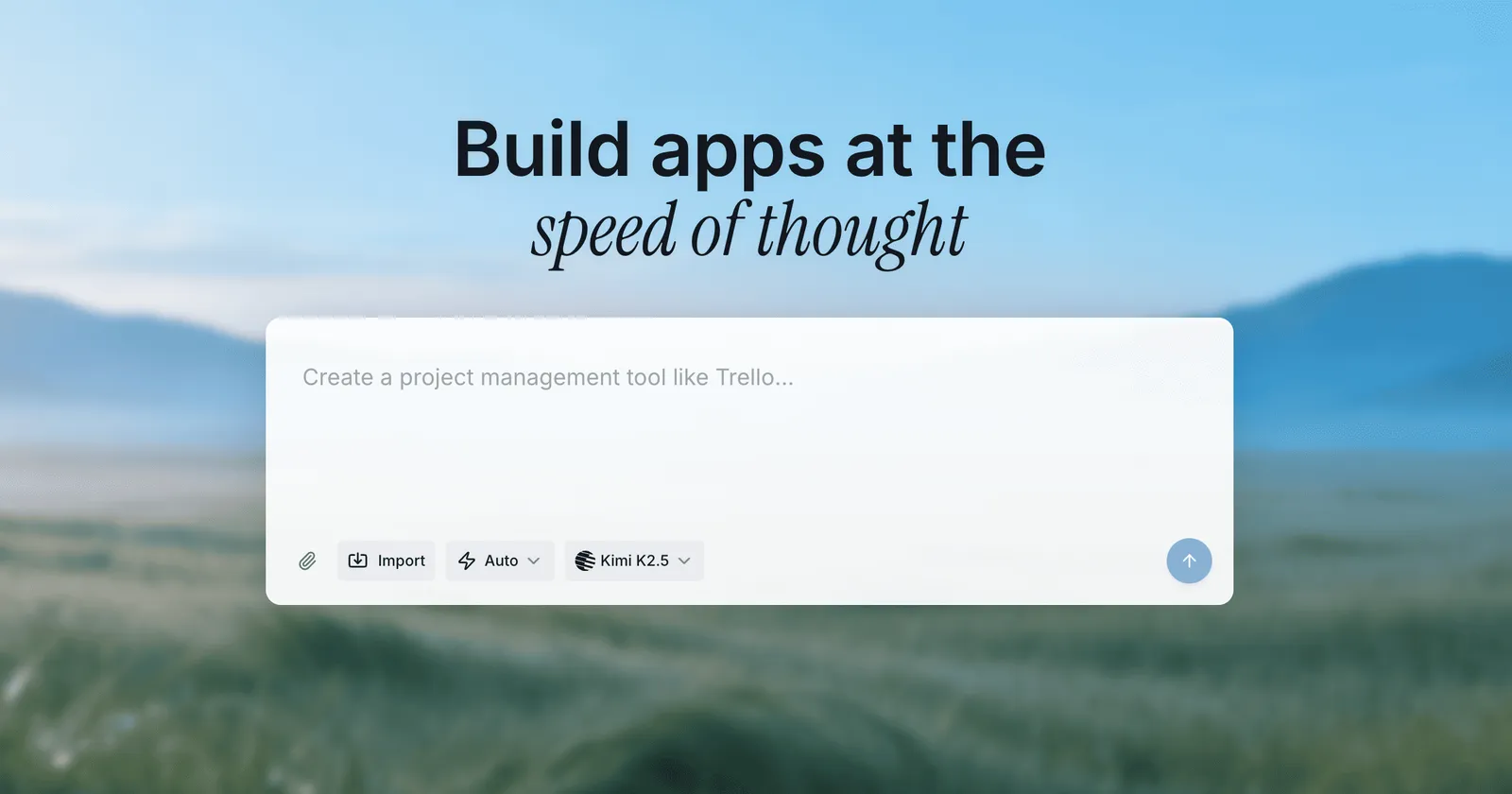
Ideavo is a free AI app builder that turns chat prompts into production-ready websites, mobile apps, and internal tools with no vendor lock-in.
Submit your website to get discovered by thousands of potential customers and boost your SEO.
Get ListedIdeavo is a free AI app builder that converts natural-language chat prompts into production-ready websites, mobile applications, games, and internal tools. Marketed as a no-code, low-code workspace for people who want more control than typical hosted generators provide, the platform positions itself against tools such as Lovable, Bolt.new, v0.dev, Replit, and Emergent. The central promise is speed: an idea described in a chat window becomes scaffolding, frontend, backend, and a deployment target without a single engineering ticket.
Ideavo addresses a specific friction point in software creation, the distance between a validated idea and a shippable product. Traditional paths require bootstrapping a repository, wiring authentication, configuring a database, and negotiating deployment pipelines before any user-facing value appears. Ideavo compresses that sequence into a conversational workflow that generates the same artifacts automatically. The product is designed for founders validating a concept, product managers who need working prototypes without engineering dependencies, non-technical builders with strong domain knowledge, developers who want to skip boilerplate, and agency owners who need to deliver client projects faster than their current headcount allows. It runs entirely in the browser, requires no credit card to start, and supports a bring your own key model so users connect their own AI provider credentials rather than paying a platform markup.
Bring Your Own Key Model Access: Ideavo connects to an existing API key or subscription from OpenAI, Anthropic, Google, OpenRouter, OpenCode, Kimi coding plan, or any other provider. The model picker surfaces options such as GPT-4o, GPT-4o mini, and o3-mini directly inside the build interface. Because credentials remain with the user, there is no model markup and users can take advantage of subsidized or free-tier provider offerings as they appear.
Backend That Builds Itself: Authentication, database schema, payments, and business logic are generated automatically while the user describes the product idea. A live build panel narrates each step, from initializing the monorepo and setting up TypeScript configuration to creating the folder structure and installing dependencies. The result is a genuine full-stack project rather than a static frontend mockup.
Multi-Platform Output From One Workflow: Projects can target web, mobile, or game platforms from a single codebase and a single build session. Ideavo handles the configuration differences between targets so that the same product description resolves to the appropriate runtime, avoiding duplicate work when a concept needs to reach more than one surface.
Deploy and Integrate Pipeline: Existing codebases can be imported, and finished projects export to GitHub. Deployment runs through connected providers such as Vercel and Railway, with custom domain attachment handled in the same interface. The integration layer effectively wires the whole stack in one place instead of scattering setup across separate dashboards.
Agents, MCPs, Skills and Workflows: Beyond simple prompt-and-response generation, Ideavo supports parallel agents for concurrent task execution, context-aware MCP tool servers that can be connected on the fly, reusable skills that package repeatable behavior, and multi-step workflow automation chains. These primitives allow more ambitious automation than a single conversational thread permits.
Real-Time Team Collaboration: Teammates can be invited into a workspace, sessions can be shared, and multiple collaborators appear as live cursors editing the same interface simultaneously. Everyone sees every change as it happens, which turns the builder into a shared environment rather than a solo tool.
Enterprise Grade Controls: The platform states SOC 2 certification, encryption at rest, full audit trails, and SSO support. These controls exist for teams that operate under compliance obligations and cannot adopt consumer-grade generation tools for internal or customer-facing work.
The entry point is a free account with no credit card required. Once inside, a user connects an AI provider by supplying an API key or linking an existing subscription, which determines which underlying models are available for generation. From there, the workflow is conversational: the user describes an application, and Ideavo responds with a plan and a visible build sequence. A status panel lists concrete steps such as initializing the monorepo, writing configuration files, creating directories, and installing packages, so the process is observable rather than a black box.
After the first generation, iteration happens through the same chat surface. Users refine prompts, adjust requirements, and request new features while the project state updates alongside the conversation. Sessions can be shared with teammates, who join as live participants. When the project is ready, the user imports or exports through GitHub, connects a deployment provider, attaches a domain, and pushes to production. Because there is no vendor lock-in and code can be exported, the output remains portable at every stage.
A solo founder launching a B2B SaaS who needs a deployable MVP before a fundraising conversation can describe the core product, rely on automatic authentication and database generation, and connect a deployment provider to have a working URL in a single day rather than a quarter.
A product manager at a mid-size company who wants stakeholder feedback on a feature concept can build a functional prototype without opening an engineering ticket, then share the live session so reviewers interact with real behavior instead of static screens.
A non-technical builder with deep domain expertise in travel, education, or local services can describe a platform in plain language and have Ideavo generate the frontend, backend, and payment logic, removing the coding barrier entirely.
A freelance developer or agency owner handling multiple client engagements can import an existing repository, use agents and workflows to parallelize repetitive tasks, and deliver projects in days while absorbing more work without expanding the team.
An engineering lead building internal tooling can generate admin dashboards and operational utilities that previously consumed an entire sprint, freeing the team for product-critical work while still benefiting from audit trails and SSO.
Ideavo targets individual builders and teams across the technical spectrum. Founders, product managers, designers, marketing leads, freelancers, agency owners, and professional developers all appear as intended users, with the common thread being a need to move from idea to artifact quickly. The platform suits small startups and lean teams most naturally, while SOC 2 certification and SSO make it viable for enterprise departments as well. Compared with Lovable, Bolt.new, v0.dev, Replit, and Emergent, Ideavo differentiates through being free to use, supporting bring your own key access to any provider, offering code export without lock-in, and adding agent, MCP, skill, and workflow primitives for more complex automation.