Turbofy is an AI app builder that turns a plain-language business process into a hosted app with data, authentication, and automations built in.
Submit your website to get discovered by thousands of potential customers and boost your SEO.
Get ListedTurbofy is an AI app builder that converts a written description of a business process into a working, hosted application. Rather than producing a disposable prototype, the platform assembles the interface, the underlying data model, authentication, and the surrounding automations in a single pass, then hands the finished app to the team that actually owns the process. The product is aimed at operations teams, founders, and internal tooling groups who understand their workflows in detail but do not want to fund a full engineering cycle for every portal, approval chain, or landing page. A conversational prompt box anchors the experience, and an MCP server lets external coding agents such as Claude Code, OpenAI Codex, OpenCode, and Cursor work inside the same workspace.
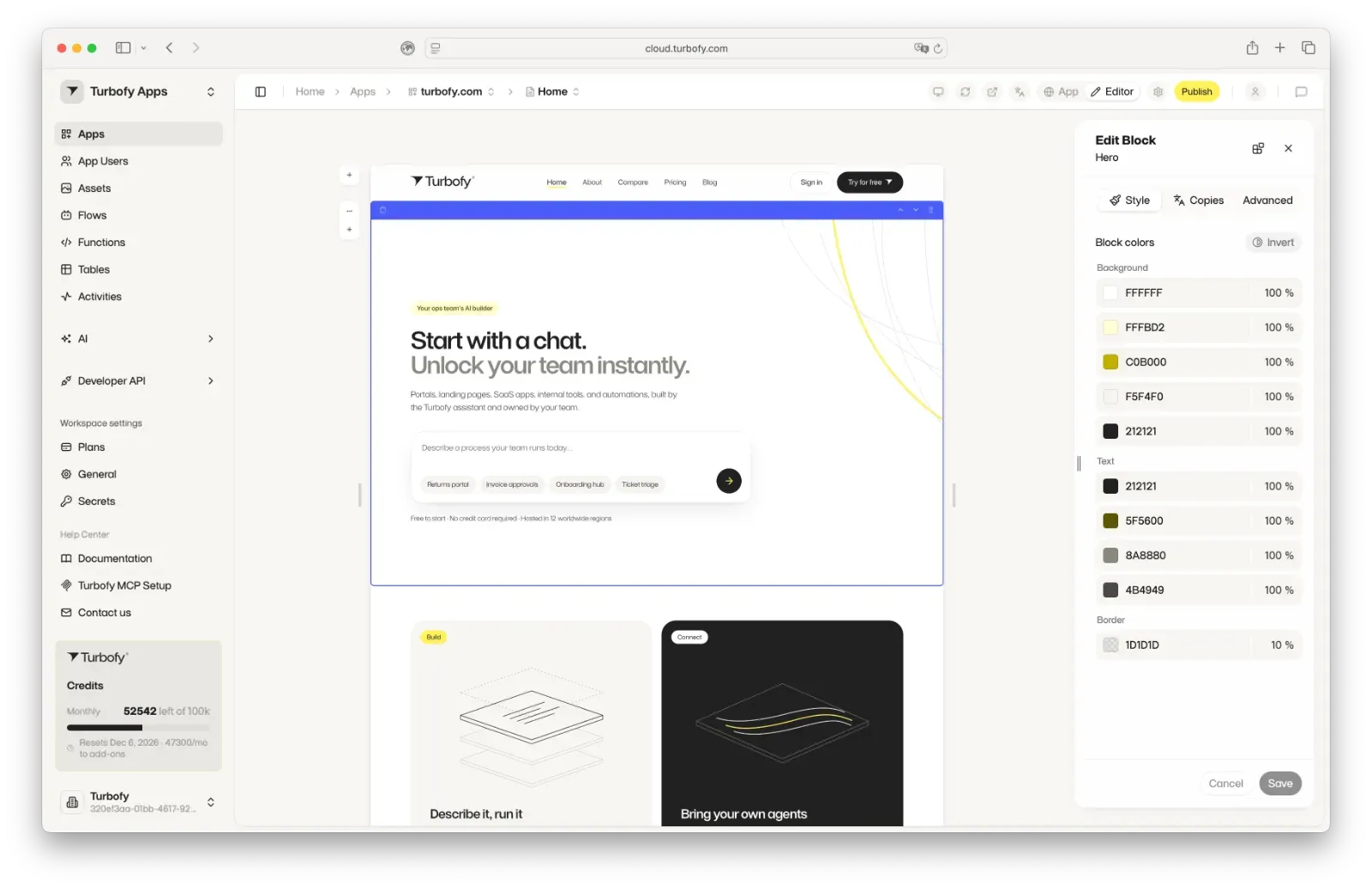
Conversational build canvas. The homepage centers on a single text field that asks the visitor to describe a process the team runs today. Submitting that prompt routes to a Turbofy workspace where the assistant generates the interface, the data structures, and the automations behind it. A short footer under the field states that starting is free, that no credit card is required, and that apps are hosted across 12 worldwide regions.
Prompt starter chips. Beneath the input sit four example prompts: Returns portal, Invoice approvals, Onboarding hub, and Ticket triage. These chips demonstrate the product's bias toward operational software rather than marketing pages, and they give first time visitors a concrete starting point without requiring them to invent a use case from scratch.
MCP bridge for external coding agents. The second pillar of the product is an MCP connection that links Claude Code, Codex, OpenCode, or Cursor to a Turbofy workspace. The site explicitly promises the same platform and the same governance regardless of which agent performs the work. A dedicated repository, turbofy-ai/turbofy-ai-plugin, is published on GitHub, and the page lists Claude, OpenAI, Gemini, OpenCode, and Cursor as compatible agent families.
Bundled infrastructure. Data storage, user authentication, hosting, and workflow execution are described as built in rather than bolted on. Turbofy positions this as the difference between a real application and a throwaway demo, since every generated app inherits the same persistent backend from the first prompt. Hosting spans 12 worldwide regions to keep latency reasonable for distributed teams.
Continuous editing by non-developers. The "Describe it, run it" panel explains that the assistant builds the interface, data, and automations from a sentence, and that the team changes the app as the business changes. This reframes the output as a living internal system that survives staff turnover and process drift rather than a fixed deliverable.
Customer evidence in production. The site showcases two named deployments. Typograph, built at G-W Technologies, reportedly ships weekly features at a pace that previously took six months, per Managing Director David Prentell. RM Components runs a B2B commerce shop and surrounding apps built by non-programmers, with Managing Director Claus Grabinger describing the platform as making the company independent of external development capacity.
Video walkthroughs and field notes. An on camera section collects builds covering an AI weather app, an image generation studio comparing FLUX, Gemini, and GPT Image, an Airbnb style property marketplace, a marketing agency site, and a pitch deck generator wired to LinkedIn automation. The blog and compare sections publish long form pieces on build versus buy economics, zero ops app builders, and platform alternatives such as Replit, Lovable, Retool, Bubble, and Airtable.
A new user lands on turbofy.com and is greeted by a single prompt field with autofocus enabled. Typing a sentence such as "approve supplier invoices over ten thousand euros" and submitting sends that prompt to cloud.turbofy.com/signup, where the workspace is provisioned. No credit card is requested at that stage, so evaluation begins before any commercial commitment.
Inside the workspace the assistant produces a running application that already includes a data layer, user accounts, and any requested workflow logic. From that point the same conversational surface handles changes, and the team can rephrase, extend, or correct the app in plain language. Teams that prefer a code oriented workflow instead connect their own agent through the Turbofy MCP, installing the published plugin and pointing Cursor, Claude Code, Codex, or OpenCode at the workspace. The site stresses that the platform and its governance model stay identical in both paths, so a mixed team can move between the built in assistant and an external agent without changing the hosting or permission model.
An operations lead at a mid sized distributor needs a returns portal for retail partners. Using the Returns portal starter prompt, the assistant generates a request form, a status workflow, and the backing data, and the operations team edits the approval thresholds as policy changes.
A finance manager at a services firm needs invoice approvals above a spending threshold. The Invoice approvals prompt produces a routing app with reviewers and states, removing the spreadsheet and email chain that previously tracked sign off.
A solo founder launching a B2B SaaS product needs a marketing site plus a small authenticated customer area but has no engineering budget. Connecting Cursor through the Turbofy MCP lets a familiar coding agent scaffold the app while Turbofy handles hosting and authentication.
A people team building an onboarding hub needs a single page that new hires walk through with document checkpoints, which the Onboarding hub prompt generates and the team maintains without developer tickets.
A B2B commerce company such as RM Components runs a high performance shop alongside internal apps, built and maintained by staff who do not program, which the published case study presents as the practical ceiling of the platform today.
Turbofy suits operations, finance, and internal tooling teams inside companies of roughly five to five hundred people, plus founders shipping their first product. Users are typically non engineers comfortable describing processes precisely, or developers who prefer to drive the platform through an MCP connection to an existing agent. Compared with Lovable, Retool, Bubble, and Airtable, the differentiator is the combination of a conversational builder and a governed MCP endpoint on top of managed data, authentication, and hosting in 12 regions.