White Space Signal is opportunity decision intelligence that ranks what to build and which business categories to buy as AI reshapes the economy.
Submit your website to get discovered by thousands of potential customers and boost your SEO.
Get ListedWhite Space Signal is an opportunity decision intelligence subscription built for founders, operators, acquisition entrepreneurs and private business investors who must decide what to BUILD and which categories of business to BUY while artificial intelligence reshapes the economics of entire sectors. Rather than forecasting which AI model or vendor prevails, the service works forward from changes already visible in technology, regulation, standards, procurement and infrastructure, then follows the money toward the constraint that becomes scarcer as intelligence gets cheaper. Every published ranking is scored, dated and preserved so earlier judgments can be inspected instead of quietly rewritten. Both current number one dossiers, one covering a BUILD opportunity and one covering a BUY category, are readable in full without signup or email.
Separate BUILD and BUY ranking models: White Space Signal refuses to force two different economic decisions through one scorecard. BUILD examines what new product, service, data layer or assurance capability may be worth creating, while BUY assesses categories of existing businesses that may become more attractive to own. The BUILD model applies eighteen factors, the BUY model applies twenty, and each keeps its own ranking logic.
Three deliberately separated scores: Every dossier reports Opportunity Quality, which measures how attractive the economics and strategic position appear, Conviction, which measures how strong and complete the supporting evidence is, and White Space, which estimates how much useful and under-recognised value may still remain before competition closes the gap. The current leading BUILD entry shows a quality score of 8.8, conviction of 8.2 and remaining white space of 7.0, while the leading BUY category shows 8.5, 8.3 and 6.2 respectively. Keeping these apart prevents an exciting but early thesis from looking as proven as a thoroughly evidenced one.
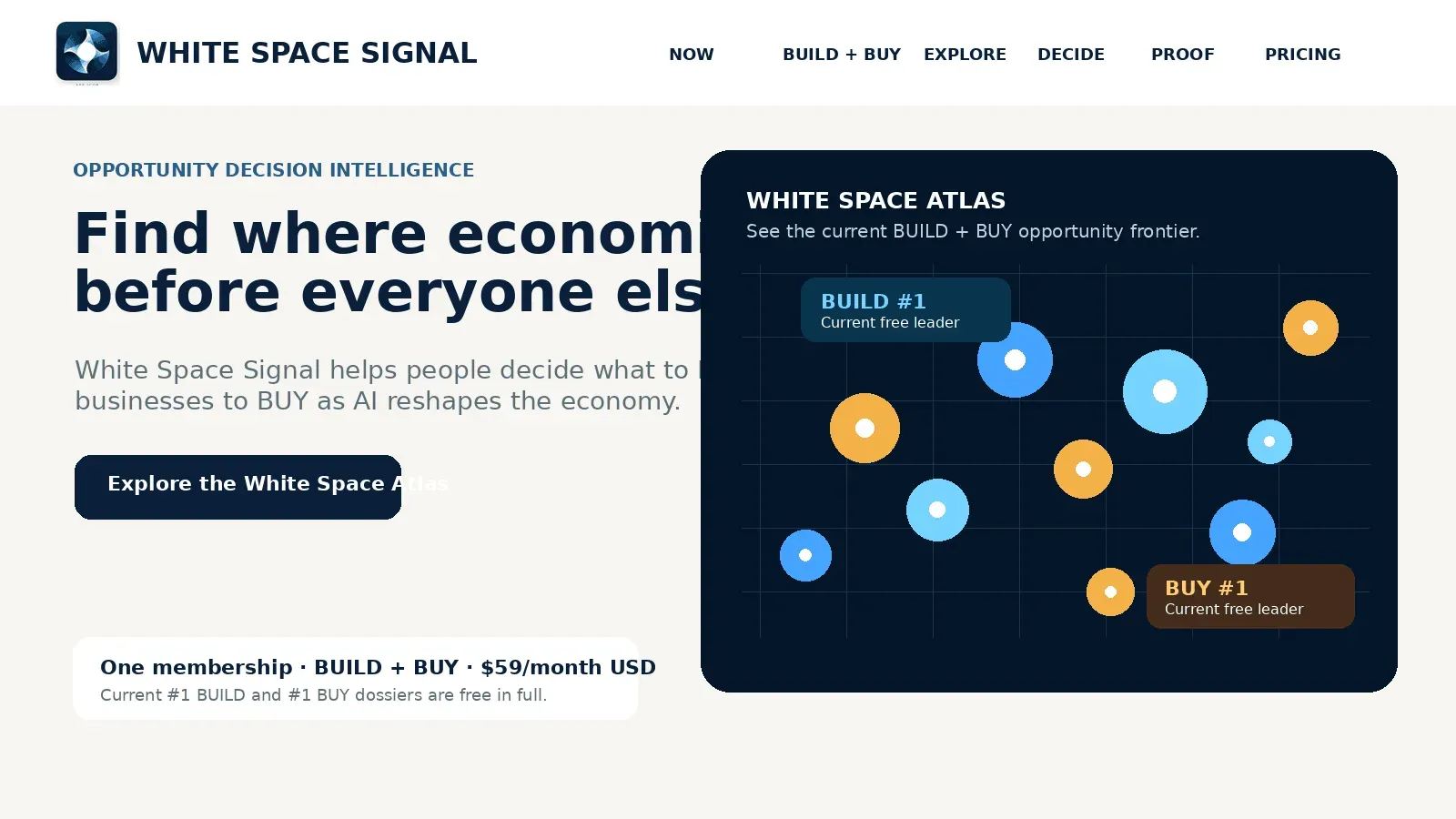
The White Space Atlas: The EXPLORE area renders a frontier zoom rather than a generic zero to ten scatterplot. Colour indicates remaining white space, horizontal position indicates AI compounding strength, vertical position indicates commercial quality, orb size reflects how much room may remain, and glow intensity signals conviction. The field is divided into four labelled zones, Proven value, Compounding frontier, Emerging leverage and Watch zone, and can be filtered between all opportunities, BUILD only and BUY only.
Emerging opportunity sets: Each ranking can carry up to five Emerging entries. These are explicitly not ranks eleven to fifteen and not filler. Each one documents why the opportunity is interesting, what evidence is still missing, what would move it into the Top 10 and what could remove it from consideration entirely.
A dated PROOF track record: Published snapshots are time stamped, with the homepage carrying a current date against its two number one signals. Historical calls are archived so that a previous judgment cannot be altered after new evidence arrives, and rank movement has to be earned by evidence rather than manufactured to keep the product looking busy.
Decision workflow tools: A membership unlocks NOW for current developments, EXPLORE for the atlas, DECIDE for comparison work, the Catalyst and Risk Clock for timing signals, and watch functionality for tracking specific opportunities. The site frames these as a single decision system rather than separate reports.
A public method layer with private weighting: The Method page publishes the factor families, evidence rules and failure tests, including the standard that ten articles repeating one announcement counts as a single real world event rather than ten independent proofs. Proprietary source weighting, exact score weights, internal queries and thresholds stay private, which lets prospective subscribers judge the reasoning without exposing the ranking engine.
The journey begins without registration. A visitor landing on the homepage sees the two live number one signals, one BUILD and one BUY, each with its three scores, and can open either full dossier immediately. From there the primary navigation splits into NOW, BUILD plus BUY, EXPLORE, DECIDE, PROOF, Pricing and Account, with the atlas offered as a visual entry point for readers who prefer to survey the whole field before reading individual reports. Subscribers who continue to the paid tier gain access to both Top 10 lists, both Emerging sets, the complete deep dossiers, the atlas, the Catalyst and Risk Clock, watch functionality and the historical record for a stated price of 59 dollars per month. There is no software to install and no data to connect. The workflow is editorial and analytical rather than operational: the platform reassesses rankings continuously against new evidence, publishes movement only when buyer evidence, regulation, competitor entry or economic conditions justify it, and leaves stable ranks in place when nothing material has changed. Each ranked report is structured to answer a fixed set of practical questions covering what the opportunity is, why the timing matters, who pays, how money is made, what competition exists, what remains open, what could invalidate the thesis, what is still unknown and which evidence should be watched next.
A solo founder evaluating a technical product idea: Someone considering a development tooling concept can open the free number one BUILD report on a release compatibility regression guard, which describes a release check that prevents software updates from breaking support for older customer systems, and compare its factor breakdown against a personal thesis. The dated scores and explicit counter-case give a fast read on whether the concept is already crowded.
An acquisition entrepreneur screening a sector: A buyer holding capital and looking at industrial or utility services can read the free number one BUY dossier on utility asset inspection and condition monitoring, which frames the thesis around acquiring a recurring inspection service and applying AI and autonomy to lift productivity, coverage and data value. The BUY-specific factors cover cash flow durability, owner dependence, transferability and installed base advantage, which are the questions a lender or broker will raise.
An operator tracking timing risk: A team already committed to a category can use the Catalyst and Risk Clock alongside the continuously reassessed rankings to see whether a regulation, standard or incumbent move is tightening or loosening the window. Because every published call is dated and archived, the shift can be compared against the original reasoning rather than reconstructed from memory.
A private investor building a watchlist: An investor who follows several themes can use the atlas filters to separate BUILD opportunities from BUY categories, then watch specific entries and monitor which Emerging candidates accumulate enough evidence to enter a Top 10. The Emerging notes state precisely what evidence is missing, which turns vague interest into a defined research task.
A strategy lead challenging an internal thesis: A corporate or consulting analyst can run an existing idea against the published failure tests, including the platform bundle test, the exact competitor test and the stronger AI test, to see whether an internal business case depends on AI remaining weaker or more expensive than it is likely to become.
White Space Signal targets founders, small business operators, acquisition entrepreneurs, search fund participants and private market investors, plus analysts inside larger organisations who need an outside challenge to an existing thesis. It suits people comfortable with structured research rather than people wanting a daily news feed, and it does not assume every ranked opportunity is reachable by a solo operator, since the reports make capital intensity, licensing requirements and specialist expertise visible. Compared with general market research subscriptions such as Gartner or Forrester, business listing marketplaces, and startup idea newsletters, the differentiation sits in AI durability testing, separate BUILD and BUY scorecards, separately reported opportunity strength and evidence strength, dated and preserved calls, and two complete number one dossiers published without a paywall.