Best AI / LLM APIs in 2026
The leading large language model APIs compared for builders shipping real products, from coding agents to multimodal apps.



Key takeaways
- 1. Anthropic (Claude)Best for coding & agents
Teams building coding assistants, agentic systems, and tool-using apps that need reliable, careful reasoning and strong safety.
Visit Anthropic (Claude) - 2. OpenAIBest all-rounder
Builders who want a versatile all-rounder with the most mature tooling, integrations, and multimodal coverage.
- 3. Google GeminiBest for long context
Apps that need very long context, strong multimodal input, and cost-competitive tiers, especially within Google Cloud.
- 4. Mistral AIBest for open-weight & self-hosting
Teams that want cost-effective, open-weight models they can self-host, with European data residency options.
Overview
Choosing an LLM API in 2026 is less about raw benchmarks and more about fit. The right provider depends on whether you are building coding agents, multimodal apps, long-document pipelines, or cost-sensitive self-hosted systems. Each of the four leaders below is excellent, but they win in different lanes.
This guide compares Anthropic (Claude), OpenAI, Google Gemini, and Mistral AI across models, pricing posture, context length, tool use, and standout strengths. Pricing is qualitative and moves often, so always verify current rates on each provider's page before you commit.
How to choose
Before you pick, weigh these against your own situation — the right choice depends on your stage, budget, and goals.
Model quality per task — Benchmark the specific models on your own workload (reasoning, coding, extraction) rather than trusting generic leaderboard scores.
Pricing and token limits — Compare input/output token costs, context window size, and rate limits, since these drive both bill and architecture.
Latency and reliability — Check p95 latency, uptime SLAs, and streaming support if you are serving real-time or user-facing traffic.
Ecosystem and tooling — Look for tool/function calling, structured outputs, and SDKs in your language so you spend less time on plumbing.
Data and compliance terms — Verify whether prompts are used for training, plus available regions and certifications (SOC 2, HIPAA) for your requirements.
Comparison at a glance
| Provider | Best for | Flagship models | Pricing | Standout |
|---|---|---|---|---|
| Coding, agentic workflows, and long careful reasoning | Claude Opus 4.8, Claude Sonnet 5, Claude Haiku 4.5 | Usage-based, per-token (verify) | Top-tier code quality, reliable tool use, strong safety | |
| General-purpose apps needing a mature ecosystem | GPT flagship and mini model tiers | Usage-based, per-token (verify) | Deepest tooling, integrations, and multimodal features | |
| Very long context and multimodal at competitive cost | Gemini Pro and Flash model tiers | Competitive tiers, usage-based (verify) | Huge context windows and Google Cloud integration | |
| Cost-effective, open-weight, and self-hostable deployments | Mistral Large and open-weight model families | Cost-effective, usage-based (verify) | European provider with open weights you can run yourself |
Pricing and features change often. Verify current details on each provider's site. Last checked August 2026.
Feature comparison
| Feature | ||||
|---|---|---|---|---|
| Text generation | ||||
| Vision / multimodal | Partial | |||
| Long context (200k+) | Partial | |||
| Tool use / function calling | ||||
| Prompt caching | Partial | |||
| Open-weight models |
"Partial" means available via add-on, in beta, or more limited than competitors.
Anthropic's Claude family is the go-to choice for teams building coding tools and autonomous agents. Claude Opus 4.8 leads on complex, multi-step engineering tasks, while Claude Sonnet 5 balances speed and quality and Claude Haiku 4.5 handles high-volume, latency-sensitive work.
Beyond code, Claude is known for careful long-context reasoning, dependable function calling, and a strong safety posture. Features like prompt caching and large context windows make it well suited to agent loops and document-heavy pipelines where consistency matters.
Best for: Teams building coding assistants, agentic systems, and tool-using apps that need reliable, careful reasoning and strong safety.
Pros
- Best-in-class for coding and agentic workflows
- Reliable tool use and function calling
- Long context with prompt caching support
- Strong safety and instruction-following
Cons
- Flagship Opus tier can be pricier for heavy use
- No open-weight models to self-host
- Multimodal scope is narrower than some rivals
- Smaller third-party ecosystem than OpenAI
OpenAI's GPT family remains the most mature and widely adopted LLM API, backed by the broadest ecosystem of SDKs, libraries, and third-party integrations. If you want the safest default that works with almost every framework, this is it.
It is a strong all-rounder across text, vision, audio, and image generation, with well-documented tooling for function calling, structured outputs, and assistants. That breadth makes it a natural fit for teams that value ecosystem depth over any single specialization.
Best for: Builders who want a versatile all-rounder with the most mature tooling, integrations, and multimodal coverage.
Pros
- Most mature ecosystem and documentation
- Broad multimodal support across text, vision, and audio
- Wide framework and third-party integration coverage
- Multiple tiers for cost versus capability
Cons
- No open-weight flagship to self-host
- Premium tiers can get expensive at scale
- Rapid model churn requires ongoing testing
- Rate limits can bite high-volume new accounts
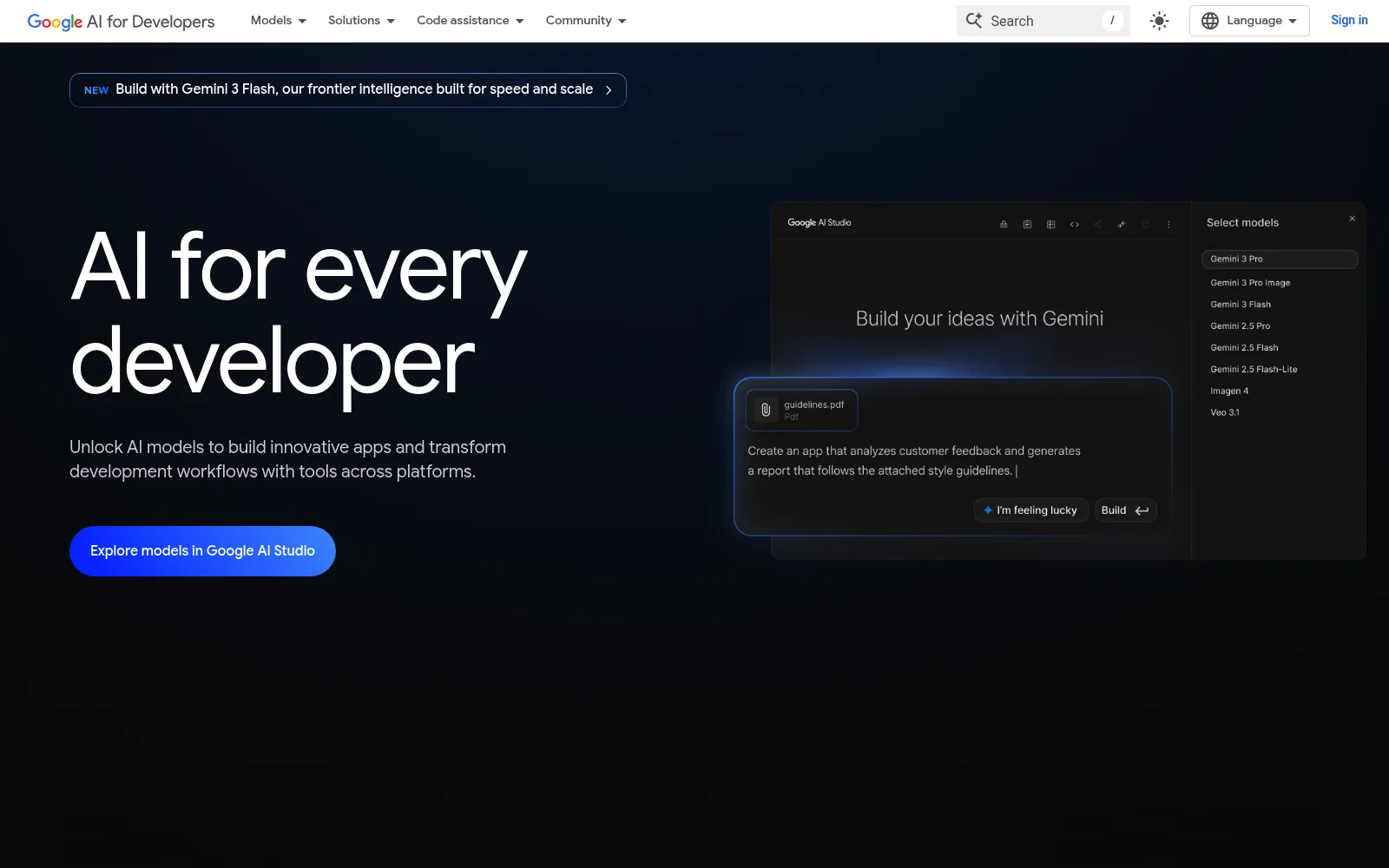
Google Gemini stands out for its very long context windows and strong native multimodal support, making it a great fit for processing large documents, codebases, video, and mixed-media inputs in a single call.
Competitive and often cheaper pricing tiers, plus tight integration with Google Cloud and Vertex AI, make Gemini attractive for teams already in the Google ecosystem or those optimizing cost on large-context workloads.
Best for: Apps that need very long context, strong multimodal input, and cost-competitive tiers, especially within Google Cloud.
Pros
- Very long context windows (200k plus)
- Strong native multimodal capabilities
- Competitive and often lower-cost tiers
- Tight Google Cloud and Vertex AI integration
Cons
- Tooling ecosystem less mature than OpenAI
- Behavior can vary across model tiers
- No open-weight flagship to self-host
- Best value often tied to Google Cloud
Mistral AI is the leading European option and the top pick for teams that want open-weight models. You can call the hosted API for convenience or self-host the open models for control, data residency, and predictable costs.
Its models are cost-effective and efficient, which suits high-volume workloads and on-premise deployments. For organizations with strict data governance or a preference for owning their stack, Mistral offers flexibility the closed providers cannot match.
Best for: Teams that want cost-effective, open-weight models they can self-host, with European data residency options.
Pros
- Open-weight models you can self-host
- Cost-effective for high-volume workloads
- European provider with data residency options
- Flexible hosted or on-premise deployment
Cons
- Flagship quality trails the top closed models
- Smaller ecosystem and tooling footprint
- Multimodal support is more limited
- Self-hosting adds operational overhead
Frequently asked questions
Which LLM API is best for coding and agents in 2026?+
Anthropic's Claude is the standout choice for coding and agentic workflows. Claude Opus 4.8 leads on complex engineering tasks, and the Claude 5 family (Sonnet 5, Haiku 4.5) delivers reliable tool use and careful reasoning that agent loops depend on.
What is the most mature and versatile LLM API?+
OpenAI's GPT family has the deepest ecosystem, the widest framework support, and broad multimodal features across text, vision, and audio. It is the safest general-purpose default when you want maximum tooling and integration coverage.
Which API is best for very long context and multimodal input?+
Google Gemini is strong here, offering very long context windows, solid native multimodal support, and competitive pricing tiers. It is especially attractive for teams already using Google Cloud and Vertex AI.
Can I self-host any of these models?+
Yes. Mistral AI offers open-weight models you can run on your own infrastructure, which is ideal for data residency, control, and predictable costs. The other three providers are API-only with no open-weight flagship to self-host.
How much do these APIs cost?+
All four use usage-based, per-token pricing, and rates change frequently. Gemini and Mistral tend to be the most cost-competitive, while premium flagship tiers from Anthropic and OpenAI cost more for heavy use. Always verify current pricing on each provider's page.
The verdict
For coding and agentic workflows, Anthropic's Claude is the top pick, led by Claude Opus 4.8 and the Claude 5 family. Choose OpenAI when you want the most mature all-round ecosystem, Google Gemini for very long context and cost-competitive multimodal work, and Mistral AI when open-weight, self-hostable, European-friendly models matter most.
Related guides
Alternative.tools review team
Editorial team
We are the editorial team behind Alternative.tools, an independent platform that helps you find the best tools and their alternatives. We use AI to research and summarize newly launched websites, tools, and products, focusing on what each one does, who it's for, and which popular tools it can replace, so you can pick the right alternative faster, without the marketing spin.