Best Product Hunt Alternatives in 2026
Four launch and discovery platforms that help founders find early users, drive traffic, and build momentum without relying on Product Hunt alone.


Key takeaways
- 1. BetaListEarly-stage discovery
Founders who want to validate an idea and gather beta signups before a public launch.
Visit BetaList - 2. UneedDaily launches
Makers who want an approachable daily launch with badges and steady referral traffic.
- 3. FazierLaunch platform
Founders who want launch-day social proof plus backlinks and embeddable badges.
- 4. PeerlistProfessional network
Founders launching developer tools or products aimed at technical professionals.
- 5. ShipycornShip-in-public launches
Makers who ship in public and want a community-driven launch with a dofollow backlink.
- 6. FridayHuntWeekly Friday launches
Founders who want a relaxed weekly launch spotlight with a dofollow backlink.
- 7. StartuupsStartup launch directory
Startups that want to be discovered by a founder and investor audience with a dofollow backlink.
- 8. TinyLaunchDaily indie launches
Indie makers who want an approachable daily launch with a badge and a dofollow backlink.
- 9. TinyLaunchpadQuick launchpad listing
Founders who want a quick, quality listing with a dofollow backlink.
- 10. Aura++Best for AI-assisted launches
Founders who want an AI-assisted launch with ongoing, automated promotion beyond launch day.
- 11. Idea KilnBest for build-in-public
Makers who build in public and want a community, trending rankings, and handy launch tools as they ship.
Overview
Product Hunt is still the default launch pad for many makers, but it is no longer the only place worth your time. A crowded homepage, timezone-driven ranking games, and an audience that skews toward power users mean a single launch there rarely delivers the traction it once did. Smart founders in 2026 treat launches as a portfolio, spreading effort across several platforms that each reach a different slice of early adopters.
This guide covers nine strong alternatives worth building into your launch plan, from early-stage startup previews to weekly launches, maker communities, and startup directories. Most are free to start with optional paid boosts, so you can test them without a budget and double down on the ones that convert. And if submitting to each platform by hand feels tedious, services like launchdirectories.com keep a curated list of launch platforms and even offer a done-for-you submission service that gets you listed across many at once.
If what you are launching is an AI tool, pair this with our best AI tool directories guide: launch platforms give you a spike, while directory listings give you the durable links and the citations AI assistants read.
How to choose
Before you pick, weigh these against your own situation — the right choice depends on your stage, budget, and goals.
Audience fit — Choose a platform whose community actually uses your product type, since a design crowd and a dev crowd reward very different launches.
Traffic and referral — Estimate the real click-through and signups a top spot delivers, not just the badge or vanity upvote count.
Launch mechanics — Understand ranking rules, timezones, and whether upvotes are gamed so you can plan the day for maximum visibility.
Backlink value — Confirm the launch page gives a lasting dofollow link and indexes well, because that outlives the launch-day spike.
Cost to feature — Compare free listings against paid promotion tiers and decide if the boosted placement is worth it for your stage.
Comparison at a glance
| Tool | Focus | Cost | Best for | Standout |
|---|---|---|---|---|
| Early-stage startup previews | Free with paid skip-the-line | Pre-launch and beta signups | Curated pre-launch audience | |
| Daily product launches and badges | Free with paid premium options | Steady traffic and embeddable badges | Founder-friendly daily format | |
| Launches with badges and embeds | Free with optional paid boosts | Backlinks and launch social proof | Embeddable widgets and badges | |
| Weekly launches on Peerlist Launchpad | Free with optional paid boosts | Reaching a professional maker network | Weekly format inside a career network | |
| Ship-in-public launches | Free + paid | Makers shipping in public | Community of builders | |
| Weekly launch roundup | Free + paid | Weekly launch spotlight | Relaxed weekly cadence | |
| Startup launches & directory | Free + paid | Getting your startup discovered | Startup-focused audience | |
| Daily indie launches | Free + paid | Indie maker launches | Badge + dofollow backlink | |
| Quick launchpad listing | Free + paid | Fast, embeddable listing | Speedy setup | |
| AI-assisted product launches | Free; paid tiers (verify) | Founders who want AI-assisted, ongoing promotion | AI submission plus auto-generated launch content | |
| Build-in-public launches | Free; sponsorships (verify) | Makers shipping in public who want a community and tools | Trending rankings plus a suite of builder tools |
Pricing and features change often. Verify current details on each provider's site. Last checked August 2026.
Feature comparison
| Feature | |||||||||||
|---|---|---|---|---|---|---|---|---|---|---|---|
| Dofollow backlink | |||||||||||
| Free to launch | |||||||||||
| Embeddable badge | |||||||||||
| Recurring launch format | Partial | Partial | |||||||||
| Pre-launch focus | Partial | Partial | |||||||||
| Paid boost available |
"Partial" means available via add-on, in beta, or more limited than competitors.
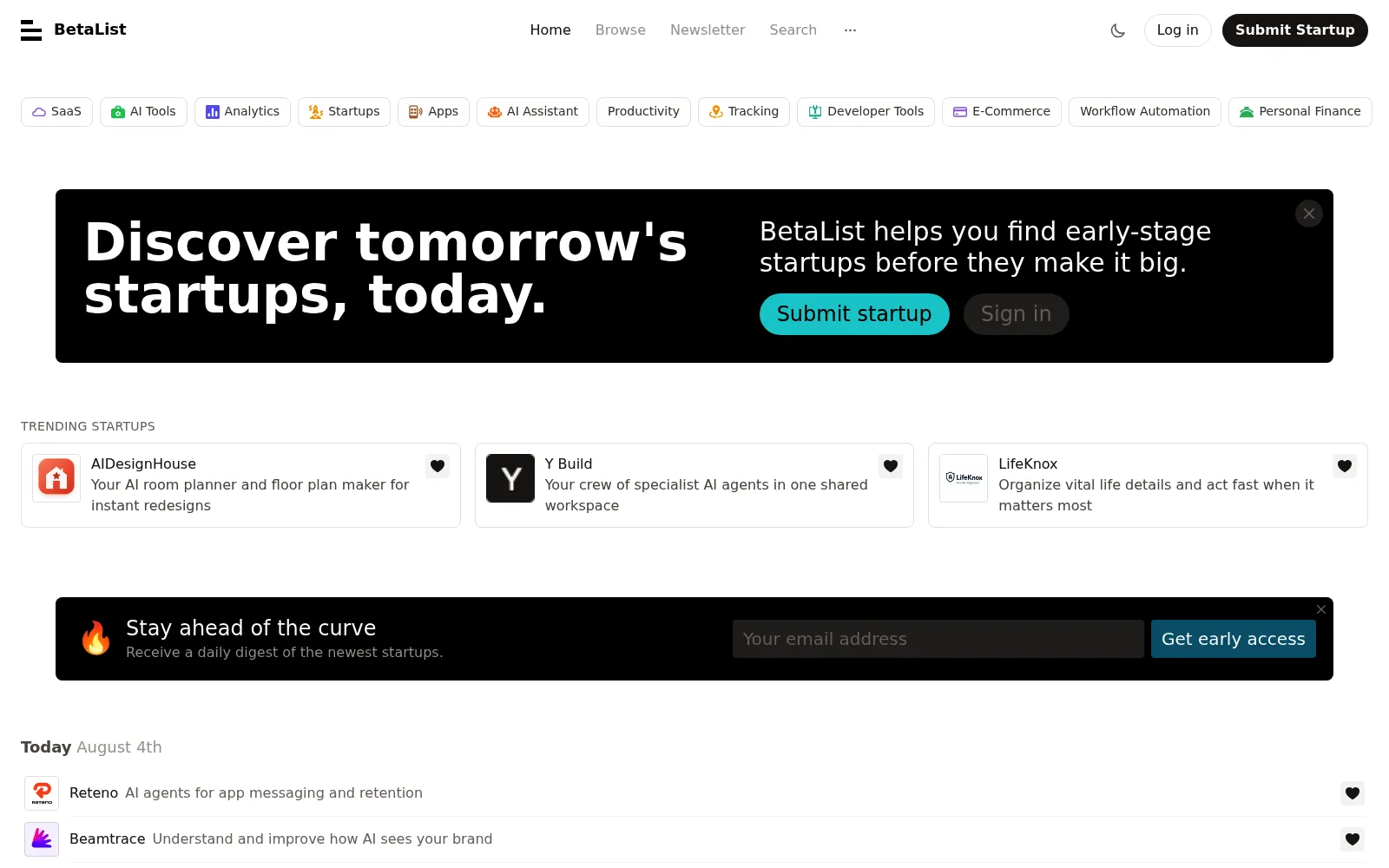
BetaList is built for products that are not ready for a full launch yet. It showcases early-stage startups to an audience of curious early adopters who actively want to try new tools before everyone else, which makes it ideal for collecting beta signups and validating demand before you ship.
Listings are curated, so there is a review queue and a wait unless you pay to skip ahead. The tradeoff is quality: a BetaList feature puts you in front of people who expect rough edges and are happy to give feedback, rather than a general audience judging a finished product.
Best for: Founders who want to validate an idea and gather beta signups before a public launch.
Pros
- Reaches early adopters who expect and forgive pre-launch products
- Great for building an email list of engaged testers
- Curation lends credibility to featured startups
- Free tier available with no upfront cost
Cons
- Review queue can mean a long wait without paying
- Skewed toward pre-launch, less useful for mature products
- Traffic spike is short-lived
- Curation means acceptance is not guaranteed
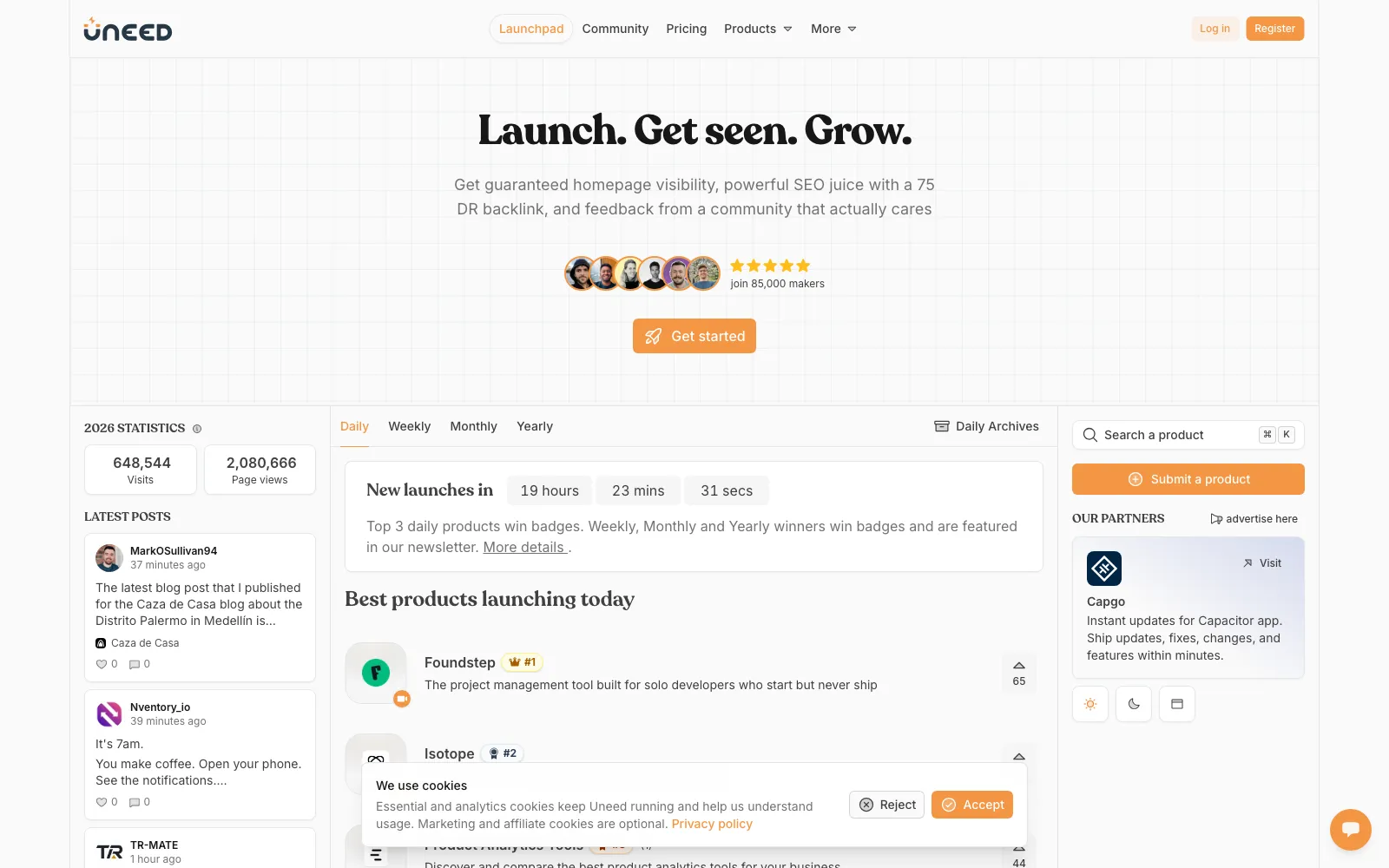
Uneed runs a daily launch format similar to Product Hunt but with a smaller, friendlier community and less ranking pressure. Products compete within a single day, and standing out is far easier than fighting for a top spot on a saturated homepage, which makes it a reliable source of early traffic.
The platform hands out badges you can embed on your site to signal recognition, and it offers both a free path and paid premium placements. For founders who want a low-stakes launch that still drives real clicks and a bit of social proof, Uneed is one of the easiest wins on this list.
Best for: Makers who want an approachable daily launch with badges and steady referral traffic.
Pros
- Less competitive than Product Hunt on any given day
- Embeddable badges add credibility to your site
- Free option lowers the barrier to launching
- Supportive, founder-friendly community
Cons
- Smaller audience than Product Hunt overall
- Best placements require paying for premium
- Traffic volume varies day to day
- Less press and investor attention than larger platforms
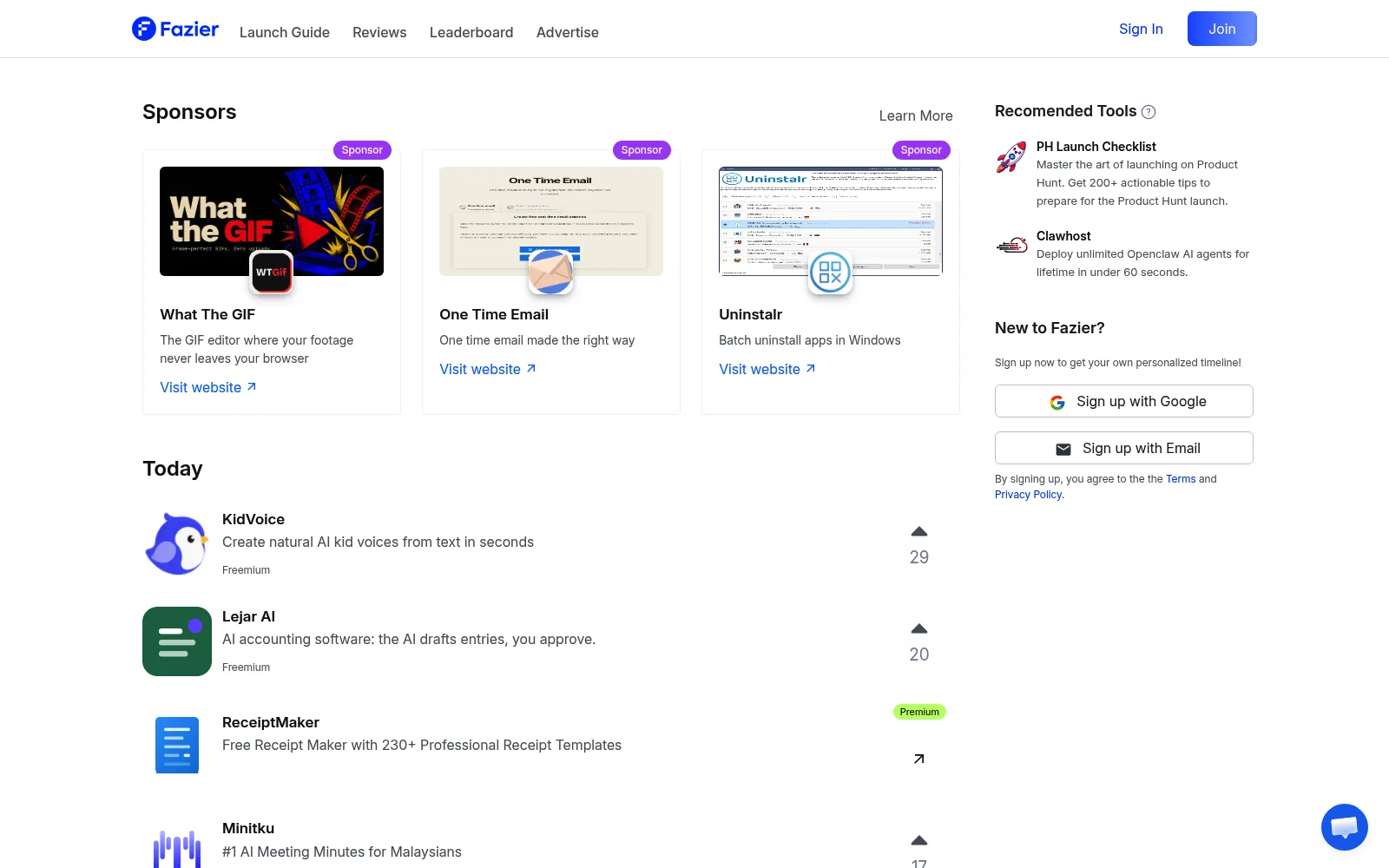
Fazier is a modern launch platform that leans into badges and embeddable widgets. You launch your product, earn recognition, and drop the resulting badges and embeds onto your landing page to build trust with visitors, which doubles as a source of quality backlinks.
It is a strong complement to a Product Hunt launch rather than a full replacement. The audience is growing, the format is simple, and optional paid boosts let you increase visibility on launch day. For founders focused on SEO value and on-site social proof, Fazier punches above its weight.
Best for: Founders who want launch-day social proof plus backlinks and embeddable badges.
Pros
- Badges and embeds boost on-site credibility
- Provides quality backlinks for SEO
- Simple, fast launch process
- Free to launch with optional paid boosts
Cons
- Audience smaller than established platforms
- Less brand recognition than Product Hunt
- Impact depends on pairing with other channels
- Paid boosts needed for maximum reach
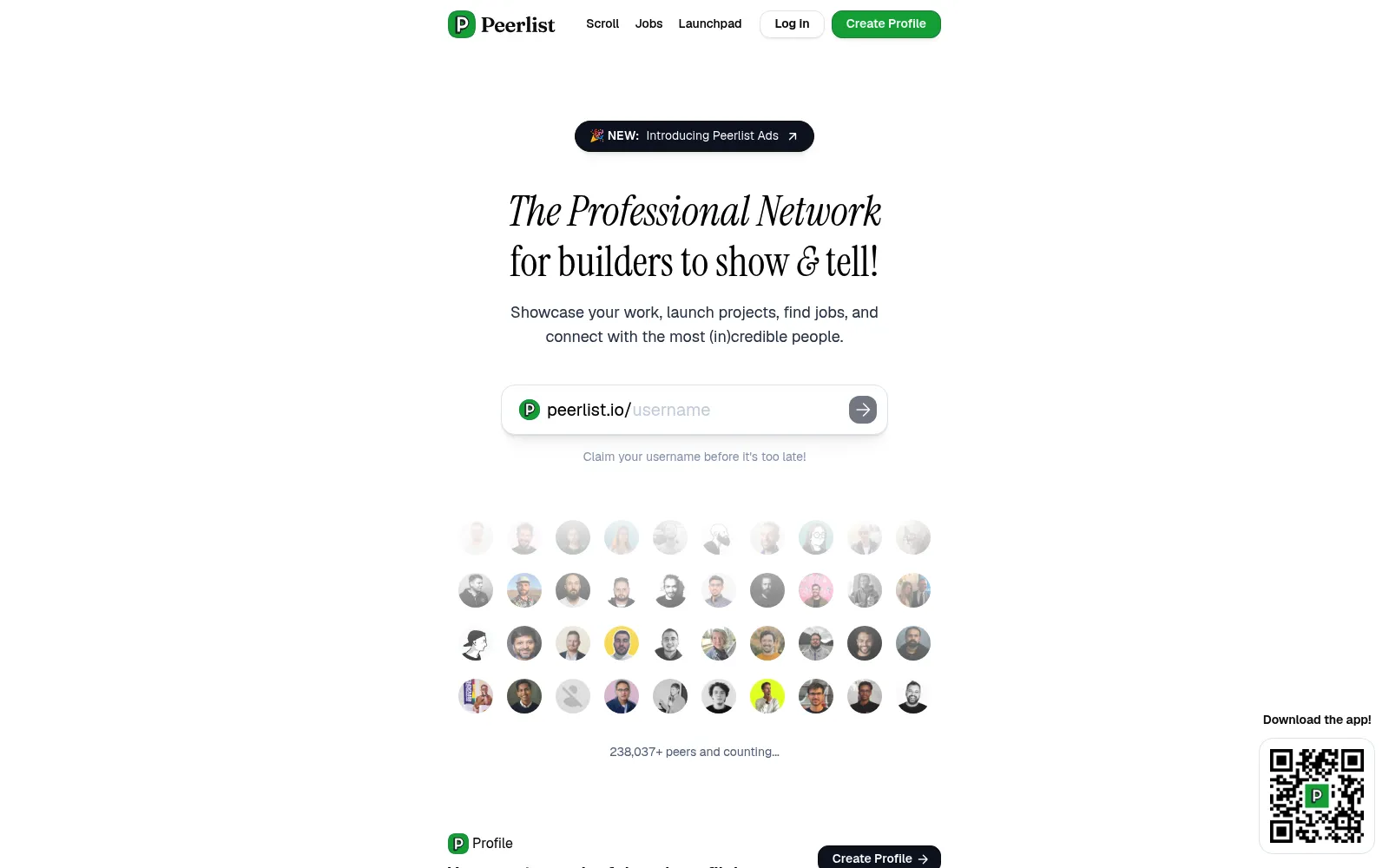
Peerlist Launchpad is the launch arm of Peerlist, a professional network for developers, designers, and makers. Products launch on a weekly cycle, and because the audience is made up of working professionals, you reach people who often become both users and advocates within their own teams.
The weekly format takes the pressure off a single make-or-break day and gives your launch more room to breathe. It is especially effective for developer tools and products aimed at technical professionals, where credibility inside a career-focused network carries real weight.
Best for: Founders launching developer tools or products aimed at technical professionals.
Pros
- Reaches an engaged professional and maker audience
- Weekly format reduces single-day launch pressure
- Strong fit for developer and design tools
- Free to launch with optional paid boosts
Cons
- Audience narrower than a general consumer platform
- Less suited to non-technical products
- Smaller overall reach than Product Hunt
- Weekly cadence means fewer launch slots
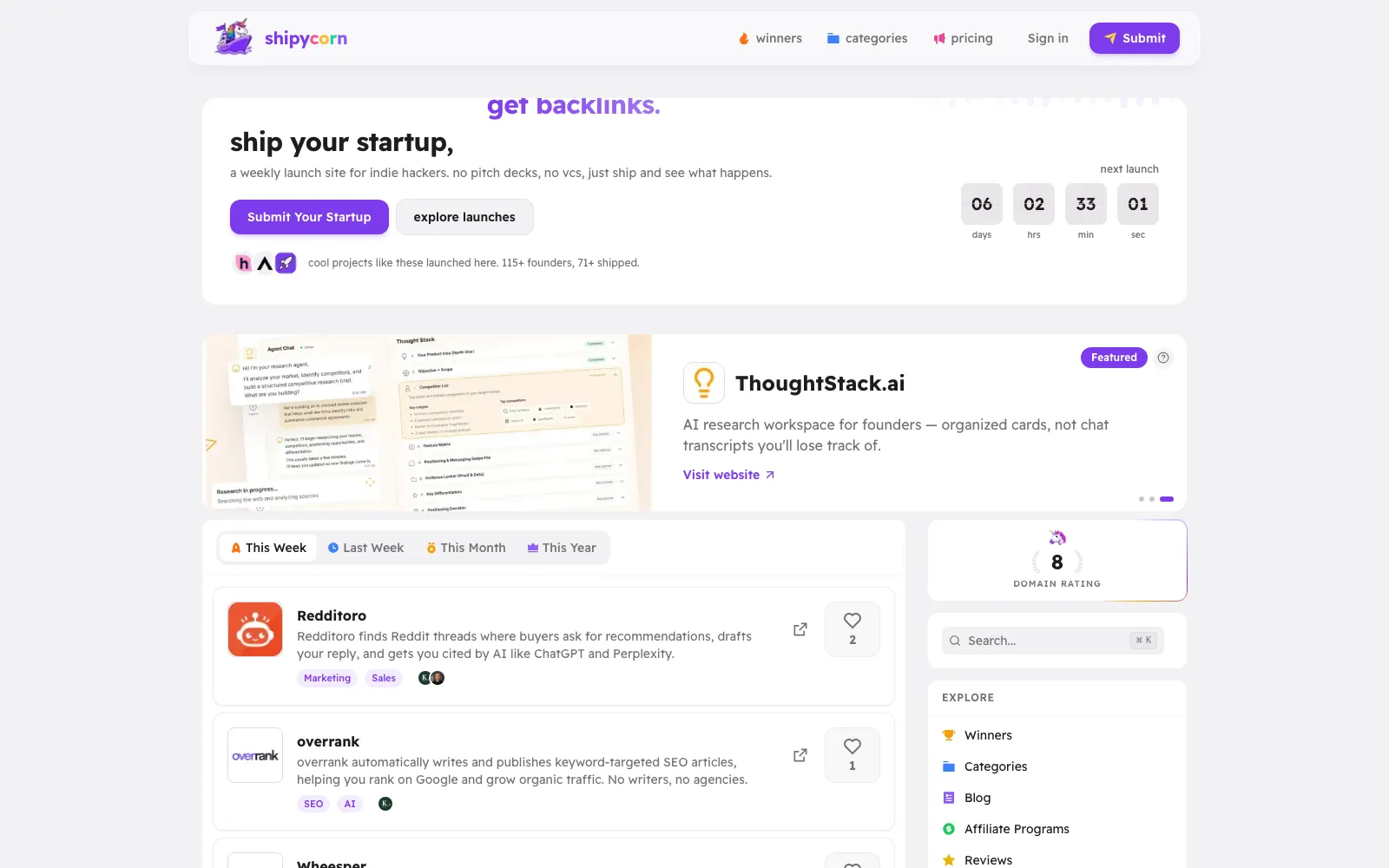
Shipycorn is a launch and discovery platform built around makers who ship in public. It puts your product in front of an engaged community of builders and early adopters, and a launch here comes with a dofollow backlink for lasting SEO value.
The vibe is upbeat and community-driven, which makes it a fun, low-pressure place to launch and gather feedback. It pairs naturally with a bigger launch as part of a stacked release.
Best for: Makers who ship in public and want a community-driven launch with a dofollow backlink.
Pros
- Engaged community of builders
- Dofollow backlink for lasting SEO value
- Fun, low-pressure launch experience
- Free to start with paid upgrades
Cons
- Smaller reach than major platforms
- Community skews toward fellow makers
- Launch-day visibility fades quickly
- Still growing its audience
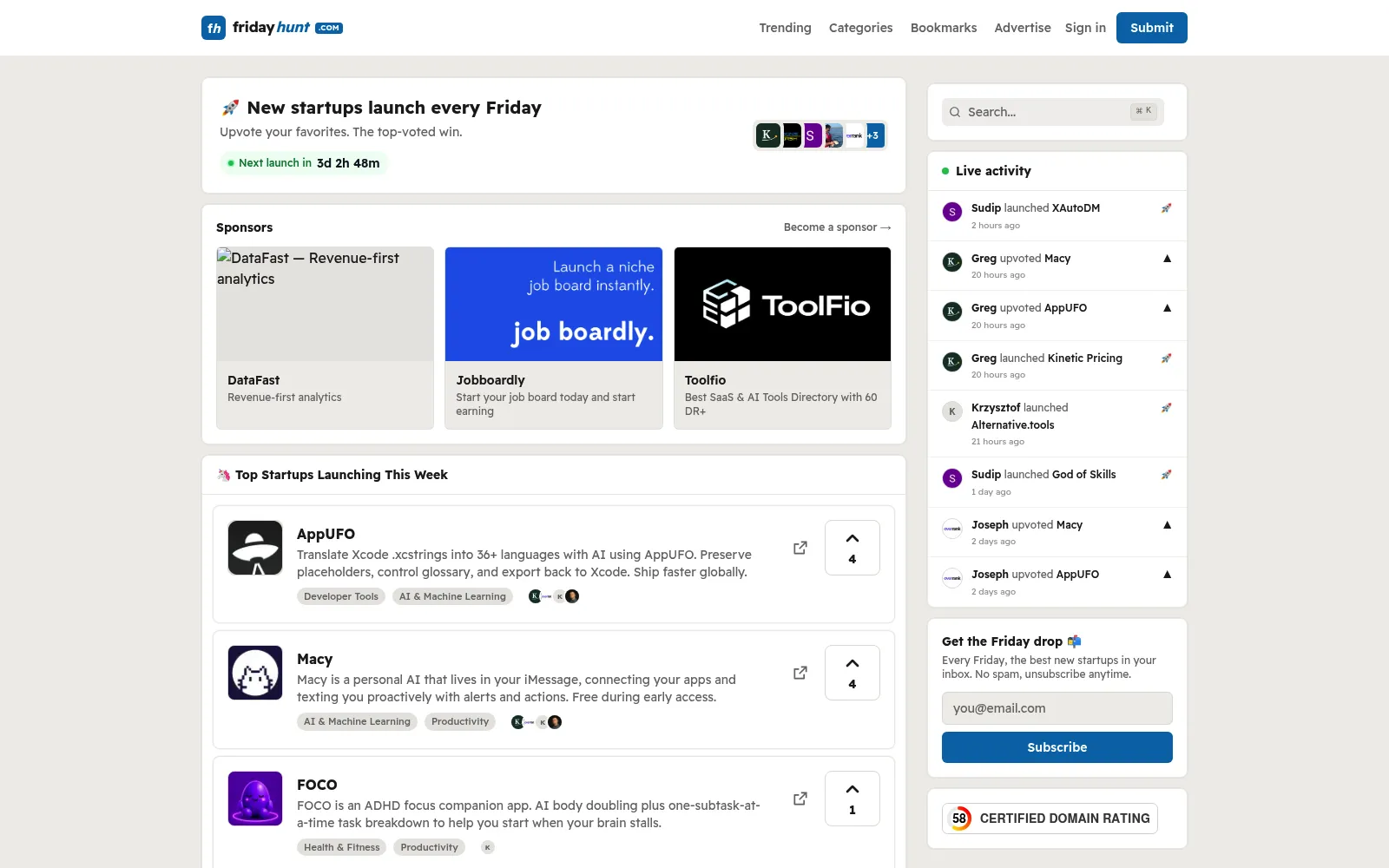
FridayHunt spotlights new products every Friday in a weekly roundup. The weekly cadence removes single-day pressure and gives your launch more room to be seen, while a dofollow backlink adds durable SEO value.
It is a great option when you miss a daily platform's timing or simply want another quality, indexable feature in your launch rotation.
Best for: Founders who want a relaxed weekly launch spotlight with a dofollow backlink.
Pros
- Weekly format reduces launch-day pressure
- Dofollow backlink included
- Simple submission and spotlight process
- Free to start with paid options
Cons
- Fewer slots than daily platforms
- Smaller reach than major sites
- Newer and still expanding
- Best visibility may need a paid boost
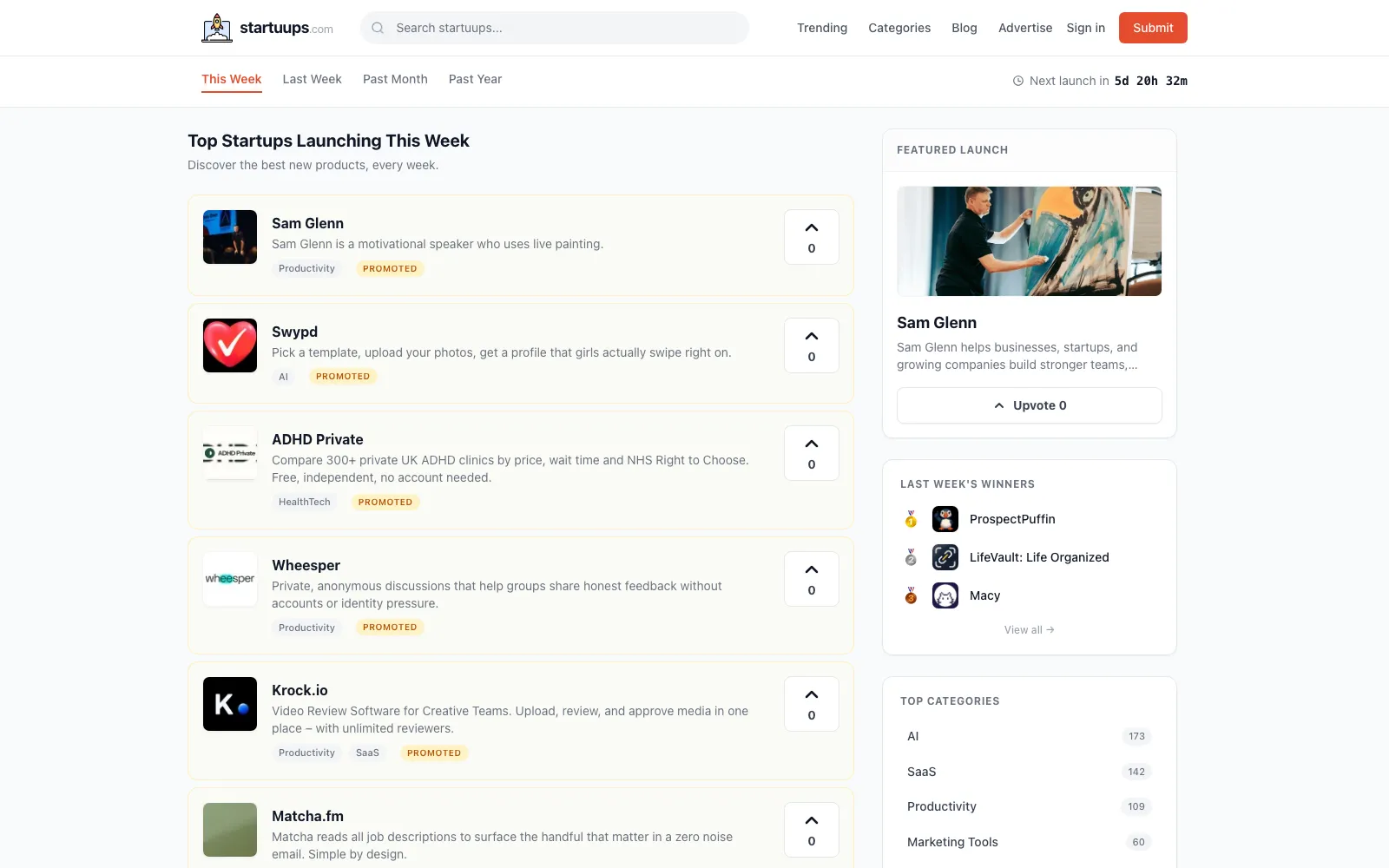
Startuups is a startup-focused launch and directory platform that helps new companies get discovered by an audience of founders, investors, and early adopters. Listings include a dofollow backlink, so you build SEO value alongside visibility.
It is a solid addition to a launch stack when your product is squarely aimed at the startup world. Quick to submit and founder-friendly, it complements broader launch platforms nicely.
Best for: Startups that want to be discovered by a founder and investor audience with a dofollow backlink.
Pros
- Startup-focused audience
- Dofollow backlink for SEO value
- Fast, founder-friendly submission
- Free and paid options
Cons
- Smaller than mainstream launch platforms
- Best fit for startup products specifically
- Launch visibility is time-limited
- Still building its reach
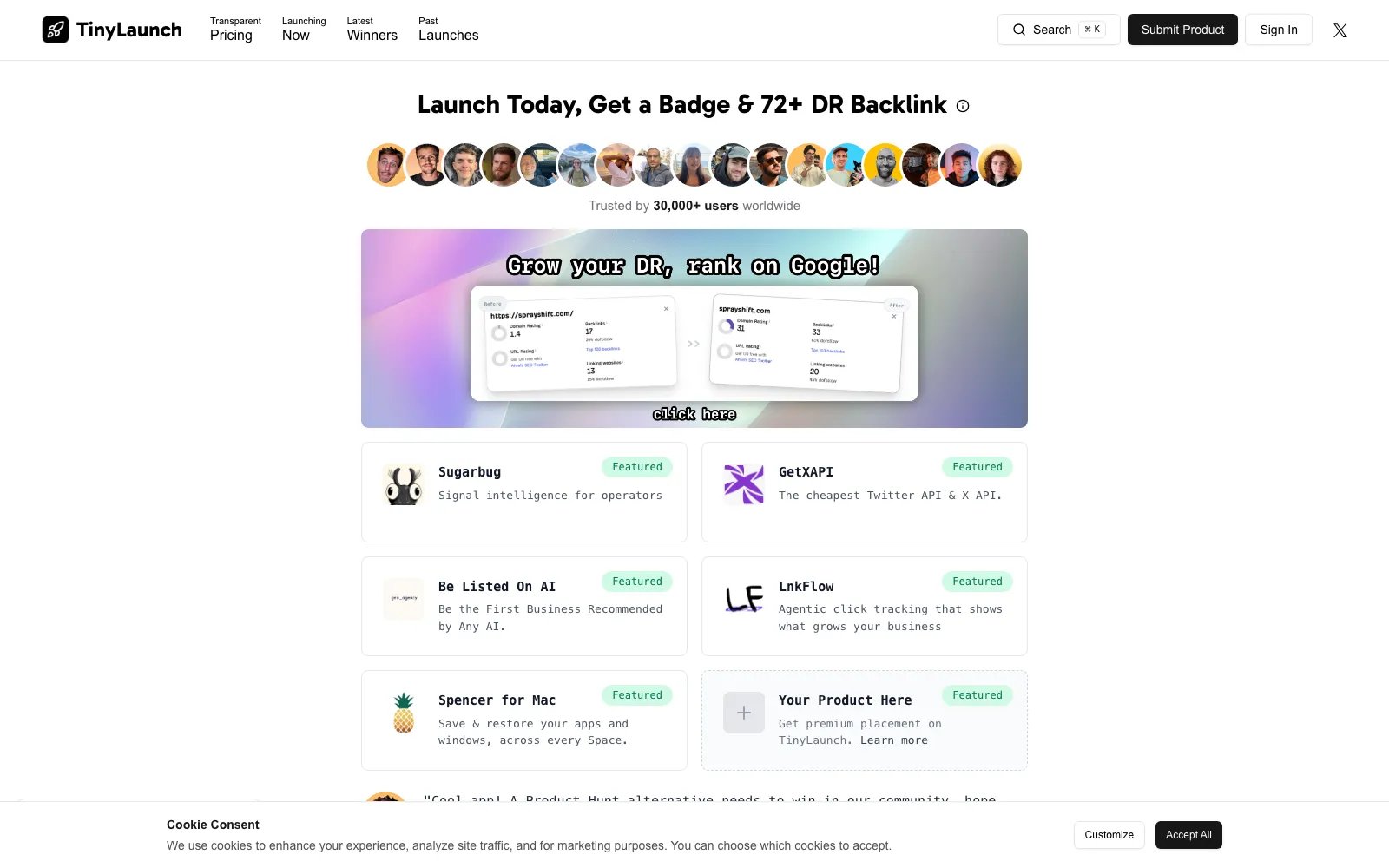
TinyLaunch is a friendly daily launch platform for indie makers who want a low-pressure way to ship in public. You launch, earn an embeddable badge, and pick up a dofollow backlink in the process.
The community is supportive and the format is simple, making it an easy win for early traffic and a durable link alongside a bigger launch.
Best for: Indie makers who want an approachable daily launch with a badge and a dofollow backlink.
Pros
- Simple, low-pressure launch format
- Embeddable badge plus a dofollow backlink
- Supportive indie maker community
- Free to start with paid boosts
Cons
- Smaller reach than the biggest platforms
- Visibility concentrated on launch day
- Best placements may require paying
- Younger platform still growing
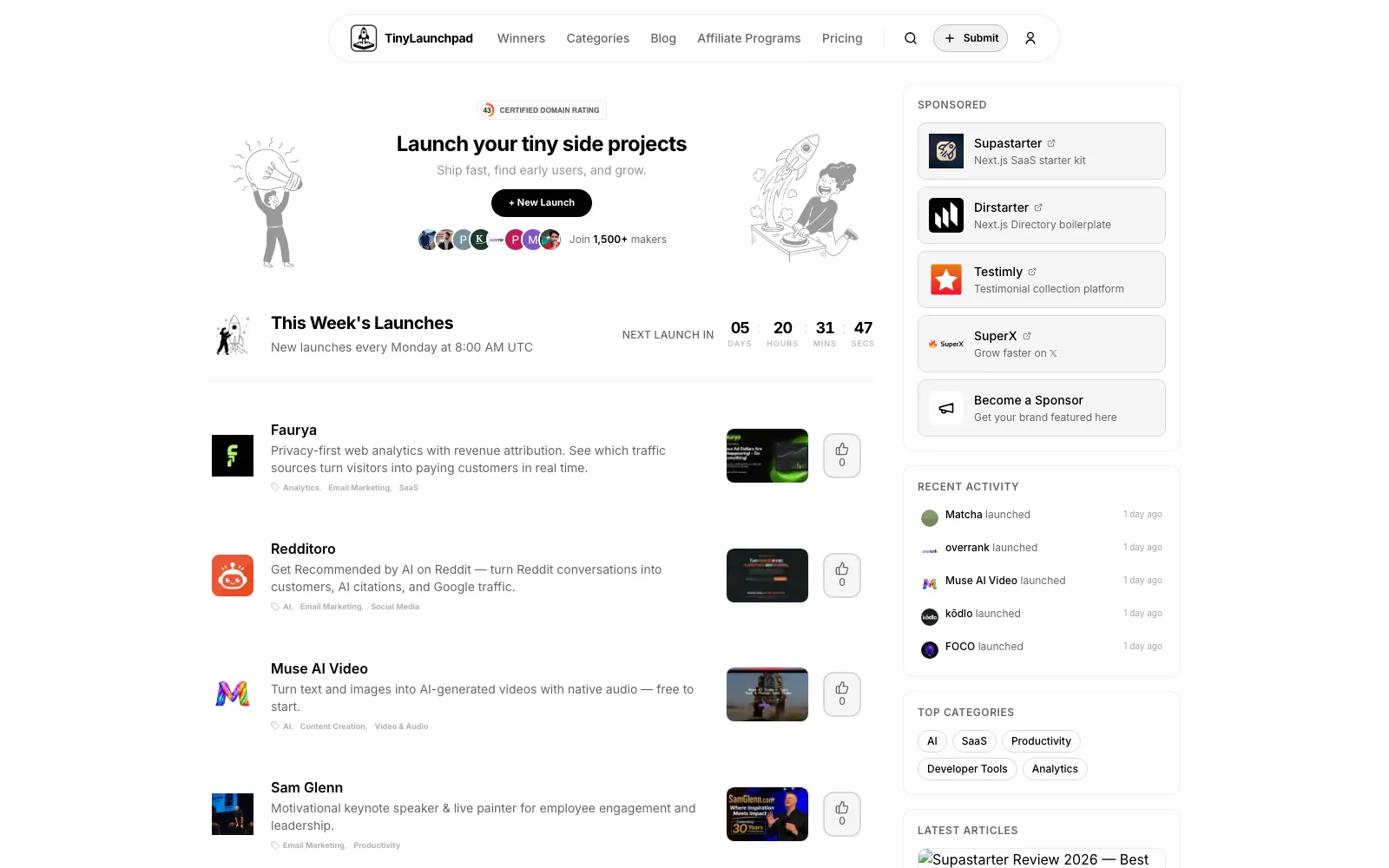
TinyLaunchpad is a lightweight launchpad and directory that helps early startups get listed and discovered fast, without a heavy launch campaign. Listings include a dofollow backlink for lasting SEO value with minimal effort.
It is ideal when you just want another quality, indexable listing pointing at your site. Quick to submit, it slots neatly into a broader launch and directory strategy.
Best for: Founders who want a quick, quality listing with a dofollow backlink.
Pros
- Fast and easy to get listed
- Dofollow backlink included
- Low-effort SEO value
- Founder-friendly and free to start
Cons
- Smaller audience than major launch sites
- Lighter on community features
- Newer and still building reach
- Premium options on paid tiers
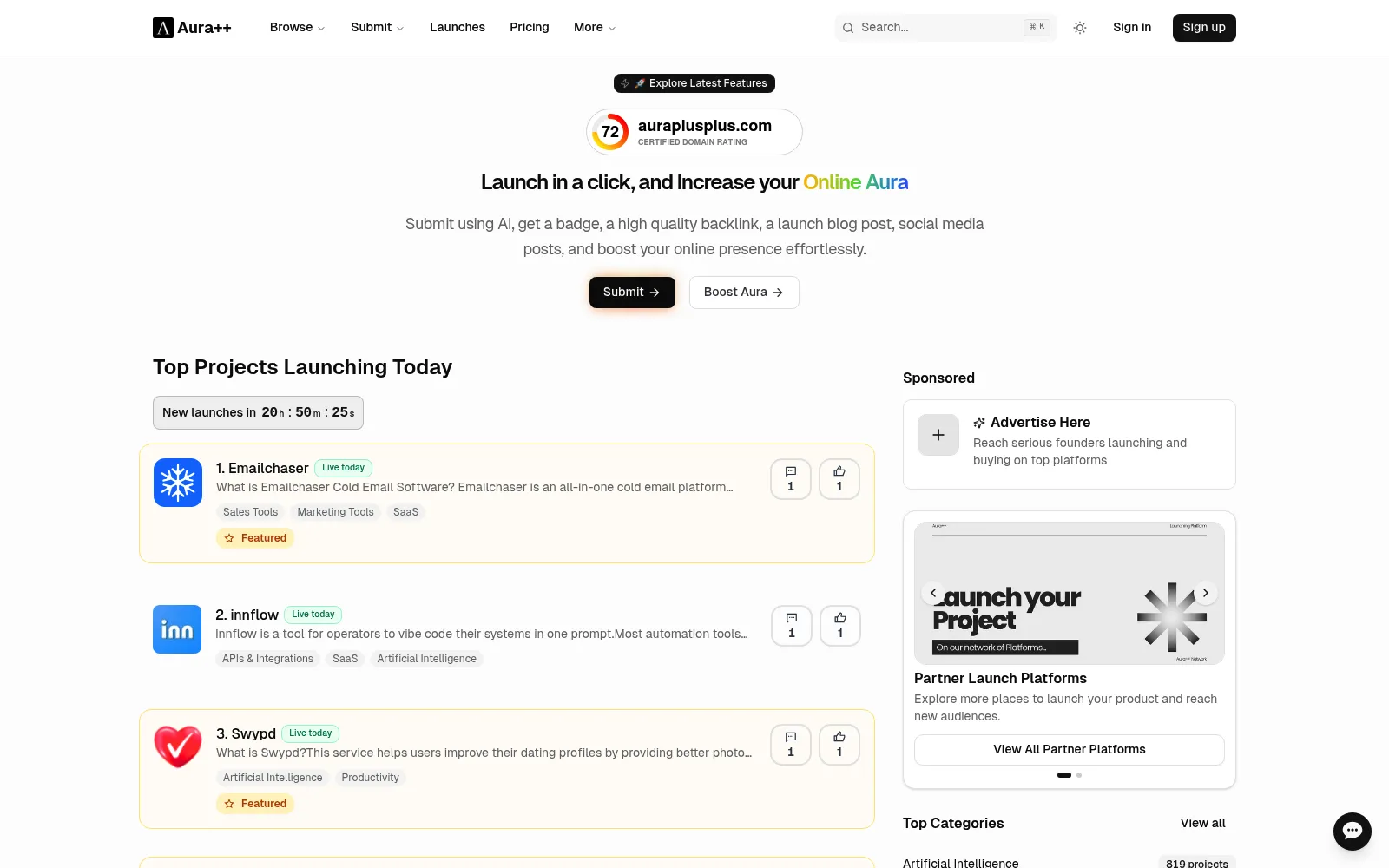
Aura++ is a Product Hunt alternative built around AI-assisted launches. You can submit a product with AI help, earn a featured badge, and get auto-generated launch content, blog posts and social posts, to promote it, with categorized directory browsing across AI, SaaS, and productivity niches. It leans into promotion that continues beyond launch day, including relaunches and a partner network of other launch platforms.
It is free to list with a basic badge, and paid tiers unlock more visibility. As a growing community it can be a useful extra launch surface, but it is newer and smaller than the established players, so treat it as a supplement to your main launch rather than the centerpiece.
Best for: Founders who want an AI-assisted launch with ongoing, automated promotion beyond launch day.
Pros
- AI-assisted submission and auto-generated launch content
- Featured badge and a categorized directory
- Promotion continues beyond launch day, with relaunches
- Free tier to list your product
Cons
- Newer and smaller than established launch platforms
- Best results need paid tiers
- Audience reach is still growing
- Another platform to maintain alongside bigger launches
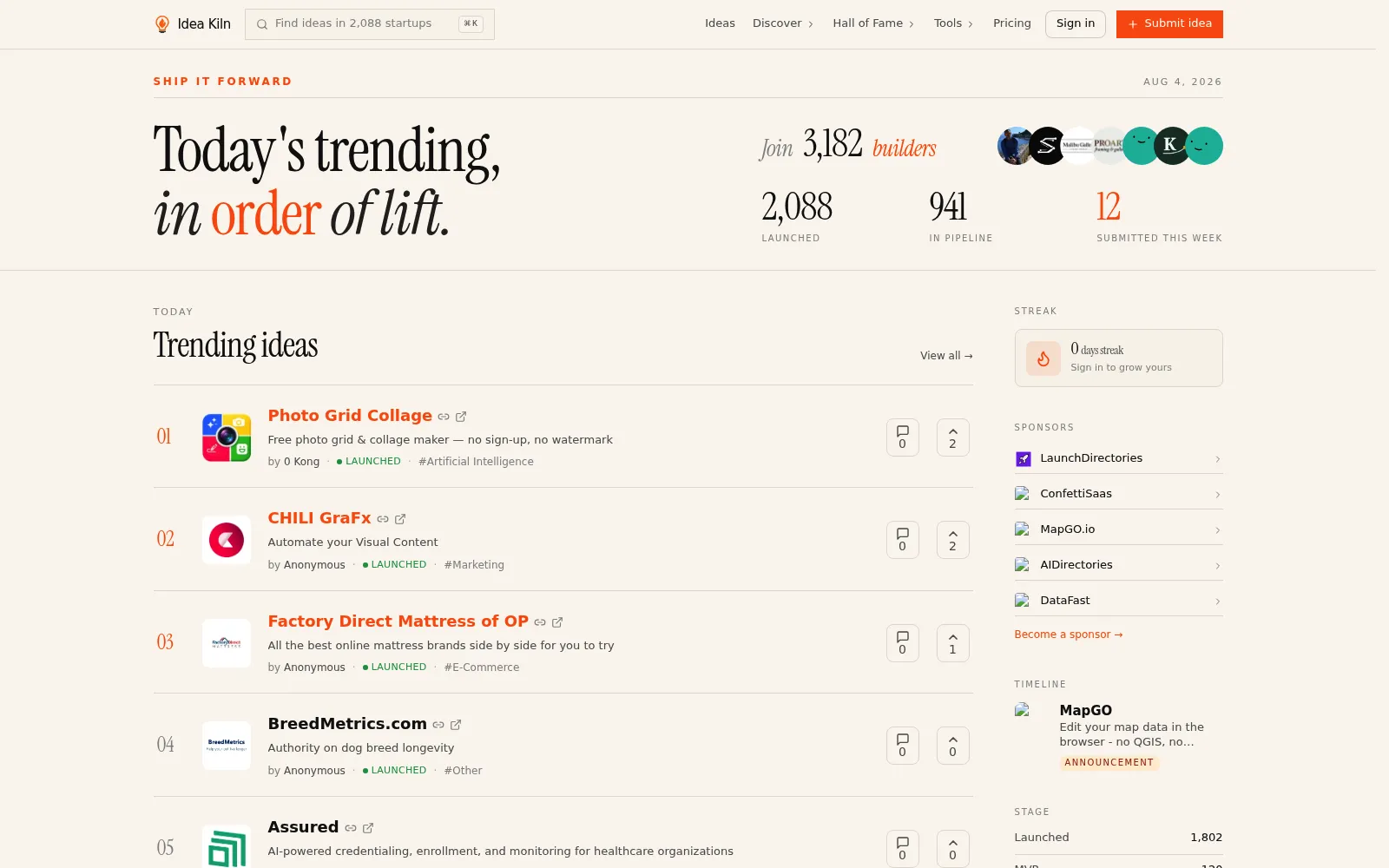
Idea Kiln is a build-in-public launch platform and startup directory where makers share projects at every stage, from concept to launched. It ranks products by trending, weekly, and monthly engagement and organizes them by industry and stage, so you get visibility in front of a community of thousands of builders and early adopters as you ship.
Beyond the directory, it bundles a suite of maker tools, an idea validator, a name generator, a SaaS revenue calculator, and a Product Hunt launch planner, which makes it a useful home base while you prepare a bigger launch. It runs on a freemium model with sponsored featured placements, and as a newer, community-driven platform it works best as a supportive launch surface alongside the larger sites.
Best for: Makers who build in public and want a community, trending rankings, and handy launch tools as they ship.
Pros
- Build-in-public focus with trending, weekly, and monthly rankings
- Community of thousands of builders and early adopters
- Bundled maker tools (validator, name generator, revenue calc, PH planner)
- Free to list with optional sponsored placements
Cons
- Newer and smaller than established launch platforms
- Domain authority is still growing as a young platform
- Featured visibility needs paid sponsorship
- Best used as a supplement to a bigger launch
Frequently asked questions
Are these Product Hunt alternatives free to use?+
Yes, all four platforms let you launch for free. BetaList, Uneed, Fazier, and Peerlist Launchpad each offer a free path, with optional paid boosts or premium placements if you want extra visibility on launch day.
Can I launch on more than one platform at the same time?+
Absolutely, and most founders should. Each platform reaches a different audience, so launching across several of them spreads your reach and reduces reliance on any single launch. If doing it by hand is too much work, launchdirectories.com maintains a curated list and offers a done-for-you submission service to get you listed across many platforms at once.
Which alternative is best for a pre-launch or beta product?+
BetaList is the strongest fit for pre-launch and beta products. Its audience actively seeks out early-stage tools and expects rough edges, making it ideal for collecting beta signups and validating demand before a full public launch.
Which platform is best for developer tools?+
Peerlist Launchpad is the best choice for developer tools. Its audience is made up of technical professionals, and its weekly launch format gives products aimed at developers and designers more room to gain traction.
The verdict
There is no single best replacement for Product Hunt in 2026, and that is the point. Treat launches as a portfolio: use BetaList to validate before you ship, Uneed for an easy daily win with badges, Fazier for backlinks and on-site social proof, and Peerlist Launchpad to reach technical professionals. Since all four are free to start, the smart move is to launch across several, measure which drives real signups, and reinvest paid boosts where they convert.
Related guides

Alternative.tools review team
Editorial team
We are the editorial team behind Alternative.tools, an independent platform that helps you find the best tools and their alternatives. We use AI to research and summarize newly launched websites, tools, and products, focusing on what each one does, who it's for, and which popular tools it can replace, so you can pick the right alternative faster, without the marketing spin.