How to Start a SaaS in 2026
A founder's playbook plus the 5 best tools to build and launch your product fast.


Key takeaways
- 1. MakerkitBest overall
Founders building a real, multi-tenant B2B SaaS who want production-grade auth, billing, and team features on a modern stack.
Visit Makerkit - 2. ShipFastBest for shipping fast
Solo indie hackers and first-time founders who want the fastest possible path from idea to a paying customer.
- 3. Open SaaSBest value
Developers who want a free, full-featured, production-ready SaaS starter and are open to learning the Wasp framework.
- 4. SaaS PegasusBest for Python/Django
Python developers and data/ML-focused teams who want a polished, batteries-included Django SaaS foundation.
- 5. BubbleBest no-code
Non-technical founders who want to validate and launch a working SaaS without writing or maintaining code.
Overview
Starting a SaaS in 2026 follows a clear path: validate an idea by talking to real users before you write a line of code, pick a stack or boilerplate that handles the boring plumbing, build a focused MVP around one core job, wire in authentication and payments so you can charge from day one, then launch and grind out your first users on the channels they already hang out in. The mistake most first-timers make is rebuilding auth, billing, emails, and dashboards from scratch, which burns the weeks that should go into your actual product and distribution.
That is exactly why the tooling you start with matters so much. A good boilerplate or no-code platform gives you login, Stripe subscriptions, a database, and a landing page on day one, so you ship in days instead of months. Below are the 5 best tools to build and launch a SaaS in 2026, ranked purely on merit across code boilerplates and no-code, so you can match the right foundation to your skills and timeline.
Watch
Start a SaaS From $0 in 2026 — Rob Walling.
How to choose
Before you pick, weigh these against your own situation — the right choice depends on your stage, budget, and goals.
Stack fit — Pick a boilerplate whose framework and language match what you already know so you ship features instead of learning tooling.
Auth and billing built in — Prioritize kits that ship working authentication, subscriptions, and webhooks, since these are the slowest, riskiest parts to build yourself.
Licensing terms — Read whether it is a one-time purchase, subscription, or open source, and confirm you can build unlimited commercial products on it.
Maintenance and updates — Favor actively maintained boilerplates with recent commits so dependency and security patches keep flowing after you buy.
Lock-in risk — Check how tightly it couples you to specific vendors for database, payments, and hosting so you can swap providers without a rewrite.
Comparison at a glance
| Tool | Best for | Pricing | Stack | Standout |
|---|---|---|---|---|
| Production B2B SaaS with teams | $299+ one-time (verify) | Next.js 16, React 19, Supabase, Tailwind | Real multi-tenancy, billing, and admin out of the box | |
| Solo founders launching quickly | $199–$299 one-time (verify) | Next.js App Router, Stripe, MongoDB/Supabase | Huge community and the fastest path to launch | |
| Budget-conscious and open-source fans | Free, open-source | Wasp (React, Node.js, Prisma), Shadcn | Full-featured production kit at zero cost | |
| Python and Django teams | $249–$999 one-time (verify) | Django, Python, React or HTMX, Tailwind | The most polished Django SaaS foundation | |
| Non-technical founders | Free; paid $29–$349/mo (verify) | Visual builder, hosted database and backend | Build a full SaaS with zero code |
Pricing and features change often. Verify current details on each provider's site. Last checked August 2026.
Feature comparison
| Feature | |||||
|---|---|---|---|---|---|
| Auth built in | |||||
| Payments/subscriptions | |||||
| Own the code | |||||
| No-code friendly | Partial | ||||
| One-time price | Free | ||||
| Database/backend included |
"Partial" means available via add-on, in beta, or more limited than competitors.
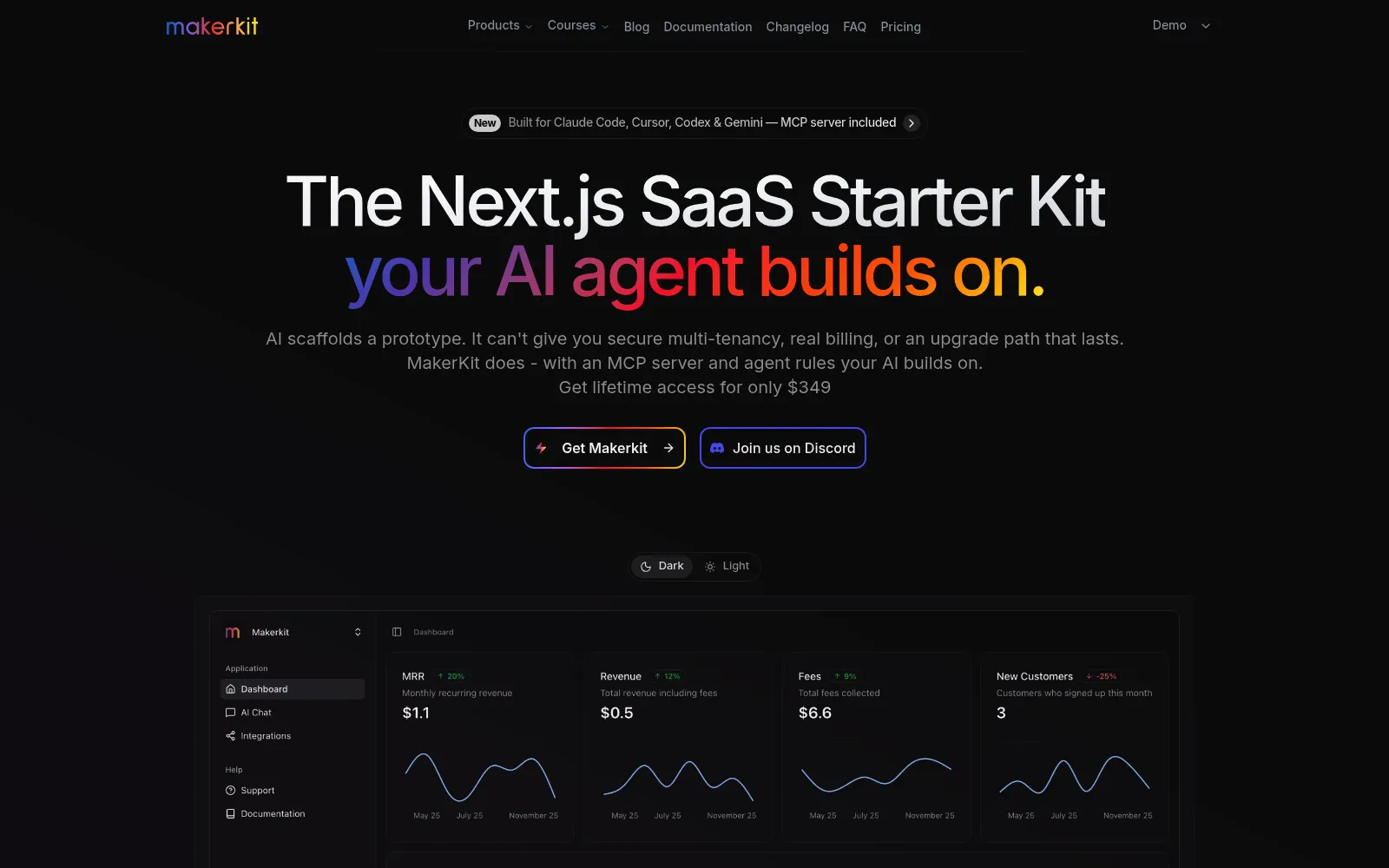
Makerkit is the most complete paid boilerplate for founders who want to build a serious, multi-tenant SaaS rather than a weekend project. It ships on a modern Turborepo monorepo with Next.js 16, React 19, Tailwind 4, and Shadcn UI, and lets you choose your backend: Supabase with Postgres row-level security, or Drizzle/Prisma paired with Better Auth. That flexibility means you are not boxed into one vendor as you scale.
Where it pulls ahead is the hard stuff most kits skip: team-based multi-tenancy, workspace switching, role-based permissions, a Stripe billing portal, onboarding flows, and an admin panel that actually work together. The trade-off is a steeper learning curve than a bare-bones starter, and the price climbs for team licenses, but for a real product you plan to charge for, it saves the most engineering time.
There is also a free, open-source Lite edition on GitHub if you want to test the architecture before buying the full kit.
Best for: Founders building a real, multi-tenant B2B SaaS who want production-grade auth, billing, and team features on a modern stack.
Pros
- True multi-tenancy with teams, roles, and workspace switching built in
- Modern, well-maintained stack (Next.js 16, React 19, Tailwind 4, Shadcn)
- Multiple backend options: Supabase, Drizzle, or Prisma with Better Auth
- You fully own the code with a reusable license across projects
Cons
- Steeper learning curve than simpler starter kits
- Higher price, especially for team and multi-developer licenses
- Feature depth can feel like overkill for a tiny solo MVP
- Requires solid React and TypeScript comfort to move fast
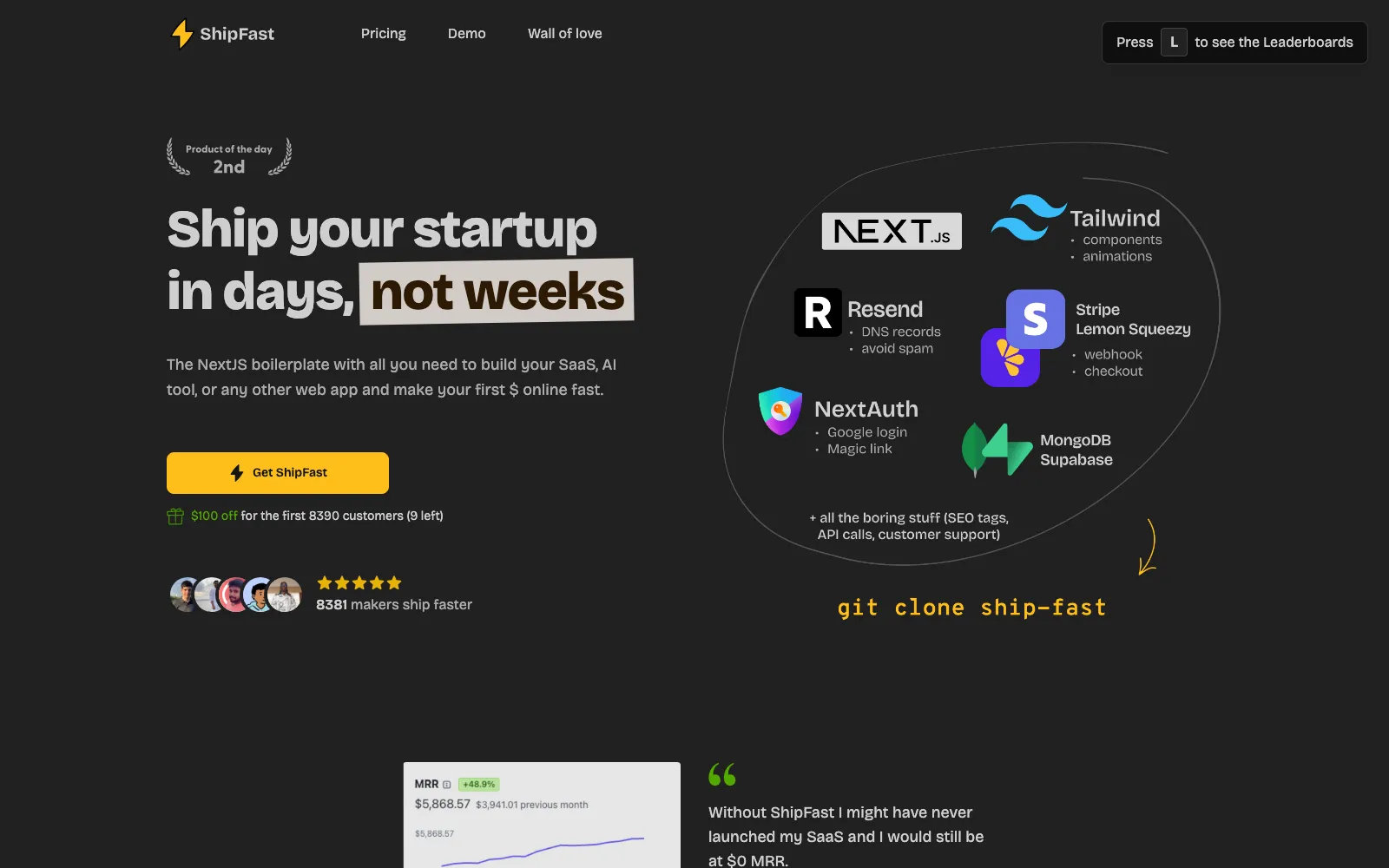
ShipFast, from Marc Lou, is the most popular paid SaaS boilerplate in the Next.js world, with 8,000+ makers who have used it to launch real products. It is deliberately opinionated and lean: Next.js App Router, Google OAuth and magic-link auth, Stripe payments, transactional email, SEO, and a working MDX blog, all pre-wired so you can go from clone to paying customer in a weekend.
It shines for solo indie hackers who value speed and momentum over enterprise architecture. The active Discord of thousands of builders means most integration snags have already been solved. The flip side is that it is less suited to complex multi-tenant apps, and the code style is pragmatic rather than heavily abstracted, but for shipping a v1 fast, few tools beat it.
Best for: Solo indie hackers and first-time founders who want the fastest possible path from idea to a paying customer.
Pros
- Extremely fast setup with auth, payments, and email pre-wired
- Massive, active community that has solved most edge cases
- One-time price with lifetime updates and reusable license
- Available in both JavaScript and TypeScript
Cons
- Not built for complex multi-tenant or team-based SaaS
- Opinionated, pragmatic code rather than a highly abstracted architecture
- Fewer built-in enterprise features than Makerkit
- Best value tiers bundle a course you may not need
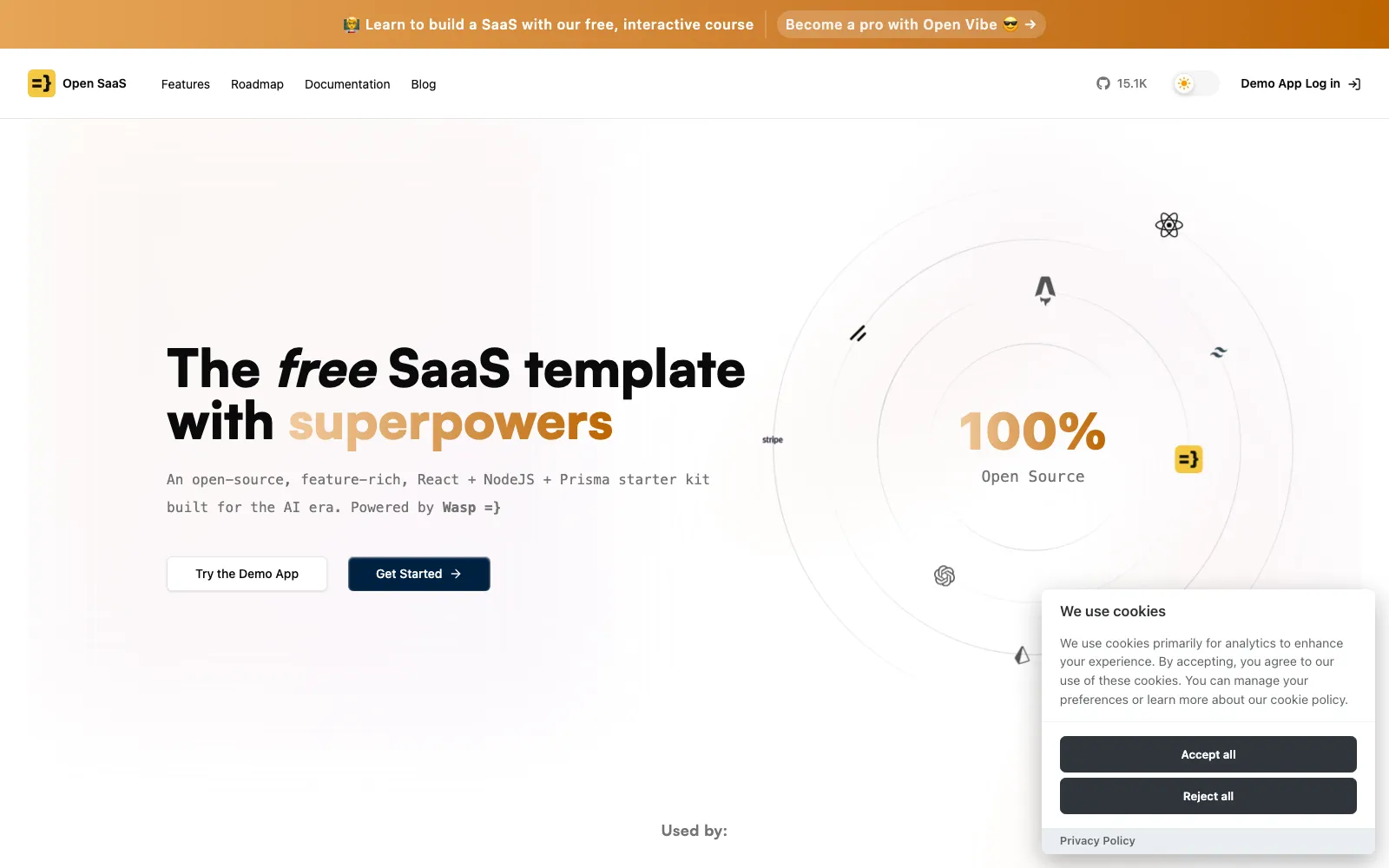
Open SaaS, by the team behind the Wasp framework, is a 100% free and open-source starter that punches far above its price. It bundles auth (email plus Google, GitHub, Slack, and more), Stripe/Lemon Squeezy/Polar payments, email sending, background jobs, an admin dashboard, S3 file uploads, and a landing page, all managed through Wasp's single declarative config file with end-to-end type safety.
Because Wasp generates much of the boilerplate from that config, the codebase stays compact and AI-friendly, and it even ships with tailored AGENTS.md files and a Claude Code plugin. The main consideration is that you are adopting the Wasp framework rather than plain Next.js, so there is a modest learning curve, but for a free, production-ready foundation it is unmatched.
Best for: Developers who want a free, full-featured, production-ready SaaS starter and are open to learning the Wasp framework.
Pros
- Completely free and open-source with no license cost
- Full feature set: auth, payments, jobs, admin, file uploads
- End-to-end type safety and a compact, AI-friendly codebase
- Deploy with a single command and strong community support
Cons
- Requires adopting the Wasp framework rather than plain Next.js
- Smaller ecosystem than mainstream React starters
- Fewer premium multi-tenant/team features out of the box
- Community support rather than paid, guaranteed help
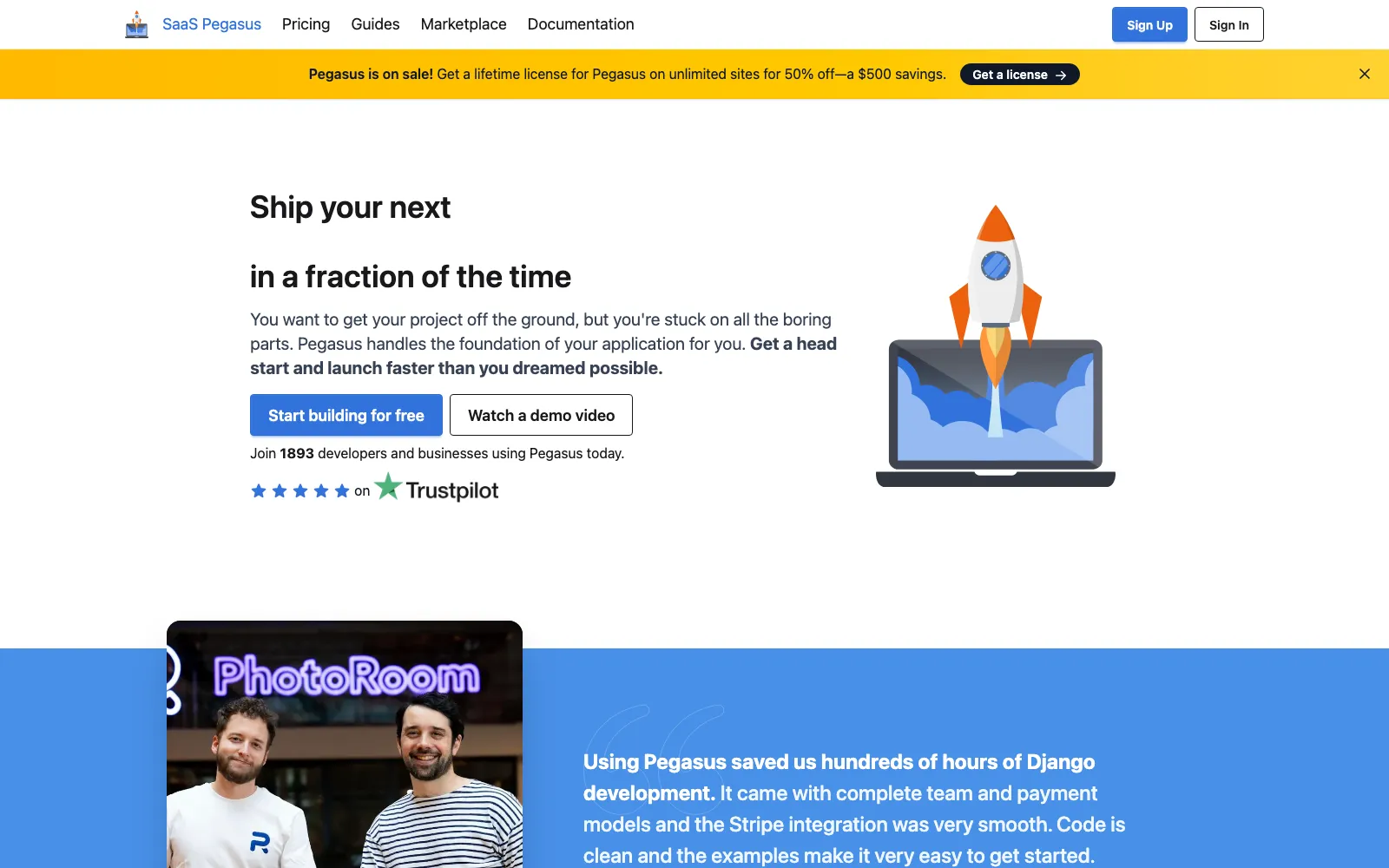
SaaS Pegasus is the definitive boilerplate for founders who prefer Python and Django over the JavaScript ecosystem. It is a code generator that scaffolds a production Django app with user auth, team and subscription management via Stripe, an admin panel, a CMS, and built-in AI features like a chatbot, image generation, and multi-model LLM integration.
It is unusually flexible on the frontend: choose React, HTMX, or native Django templates, and pick from Tailwind, Bootstrap, Material, or Bulma themes. That makes it ideal for data-heavy or ML-adjacent products where Python's ecosystem is an advantage. The trade-off is that pricing scales up for the higher tiers, and it assumes real Django familiarity, but for Python shops it is the strongest option available.
Best for: Python developers and data/ML-focused teams who want a polished, batteries-included Django SaaS foundation.
Pros
- Best-in-class Django boilerplate with teams, billing, and admin
- Flexible frontends: React, HTMX, or Django templates plus theme choices
- Built-in AI integrations (chatbot, image gen, multiple LLMs)
- One-time purchase and full ownership of the generated code
Cons
- Only makes sense if you are committed to Python/Django
- Requires solid Django knowledge to customize effectively
- Top tiers get expensive for individuals
- Smaller frontend community than the Next.js ecosystem
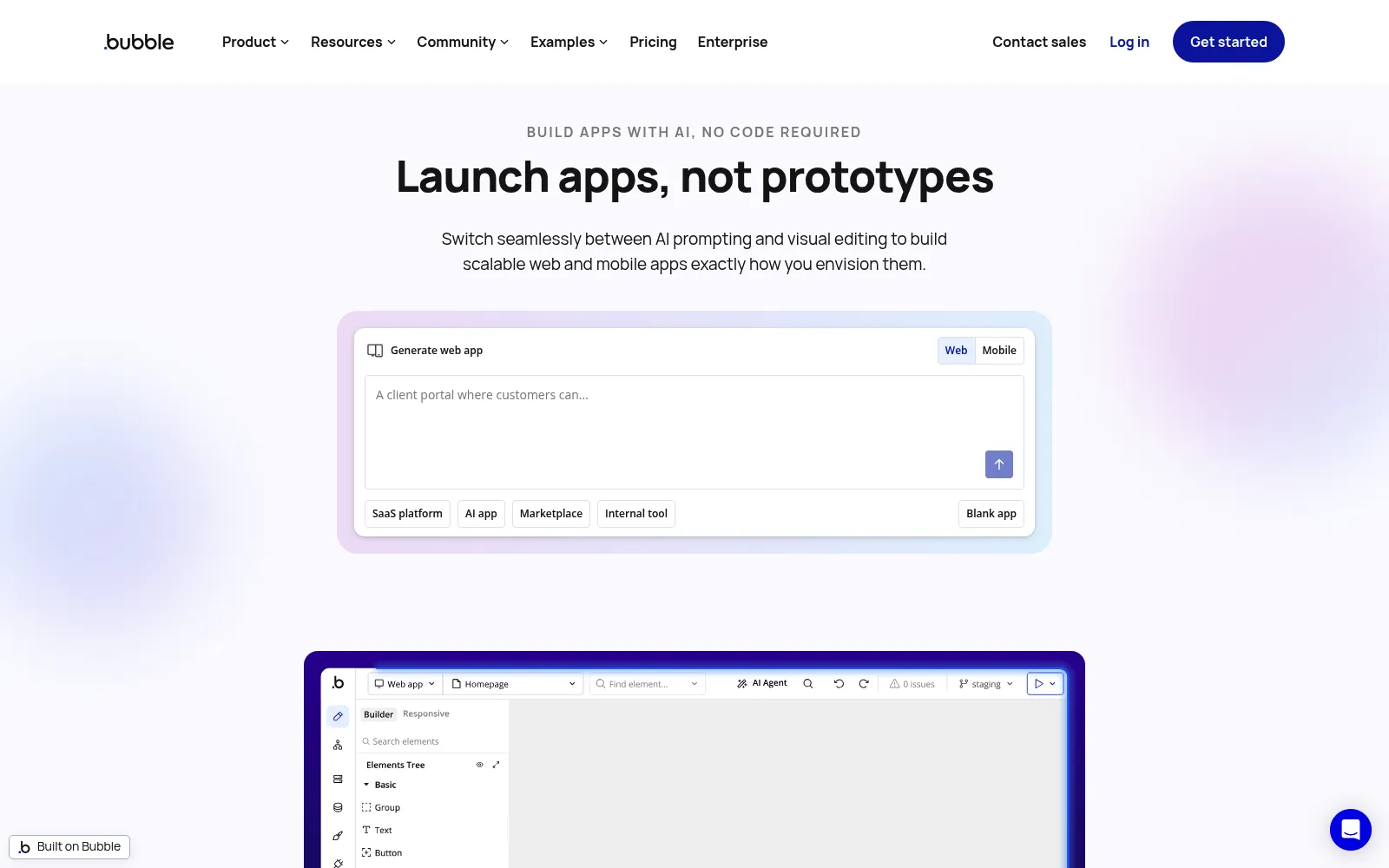
Bubble is the leading no-code platform for founders who cannot or do not want to write code. It combines a visual frontend designer, backend workflow logic, and a hosted database in one place, so you can build marketplaces, dashboards, and full AI-powered SaaS products without provisioning servers. It supports authentication, Stripe payments and subscriptions, workflows, and privacy rules natively.
The trade-off is real: you do not own the underlying code, and pricing runs on Workload Units that meter every query and workflow, so costs can climb as you scale and overages get pricey. But for validating an idea, landing early paying customers, or launching a product when you have no engineering team, Bubble gets you live faster than any code-based option.
Best for: Non-technical founders who want to validate and launch a working SaaS without writing or maintaining code.
Pros
- No coding required to build a fully functional SaaS
- All-in-one: frontend, backend logic, and database in one tool
- Native auth, Stripe payments, and subscription support
- Fast path to a live MVP for non-developers
Cons
- You do not own the code and are locked into the platform
- Workload Unit pricing can escalate unpredictably at scale
- Performance and deep customization lag hand-written code
- Migrating off Bubble later means a full rebuild
Frequently asked questions
How much does it cost to start a SaaS in 2026?+
You can start for very little. A code boilerplate like Open SaaS is free, while paid kits such as ShipFast, Makerkit, or SaaS Pegasus are one-time purchases roughly in the $199–$999 range (verify current pricing). Beyond that, expect modest monthly costs for hosting, a database, email, and a Stripe account, often under $50/month until you have real traffic. No-code tools like Bubble start free and scale with usage-based monthly plans.
Do I need to know how to code to build a SaaS?+
No. If you are non-technical, a no-code platform like Bubble lets you build a full SaaS with authentication, payments, and a database visually. If you can code, a boilerplate saves you months by handling auth, billing, and infrastructure so you focus on your unique features. The right choice depends on your skills, budget, and how much you want to own the underlying code long term.
How long does it take to build an MVP?+
With a modern boilerplate, a focused MVP can be ready in one to three weeks because auth, payments, and the database are already wired up. No-code tools like Bubble can get a working prototype live in days. Building everything from scratch typically takes two to three months or more, which is why most founders start from a proven foundation.
Should I use a SaaS boilerplate or build from scratch?+
For almost every founder, use a boilerplate. Rebuilding authentication, Stripe subscriptions, emails, and dashboards from scratch burns weeks that are better spent on your product and finding customers. A boilerplate gives you a production-ready foundation on day one, and since you own the code, you can customize anything as you grow. Build from scratch only if you have very unusual architecture needs.
What is the best SaaS boilerplate in 2026?+
For a modern, production-grade multi-tenant SaaS, Makerkit is the strongest overall thanks to its teams, billing, and admin features on a current Next.js and Supabase stack. ShipFast is best for shipping a solo project fastest, Open SaaS is the best free option, and SaaS Pegasus is the top choice for Python and Django teams. The best pick depends on your stack and goals.
The verdict
Makerkit is our #1 pick for 2026: it delivers real multi-tenancy, billing, and admin tooling on a modern Next.js and Supabase stack, saving the most engineering time on a serious SaaS. Choose ShipFast if you are a solo founder optimizing for speed, Open SaaS if you want a free foundation, SaaS Pegasus for Python/Django, and Bubble if you want to launch without writing code.
Related guides

Alternative.tools review team
Editorial team
We are the editorial team behind Alternative.tools, an independent platform that helps you find the best tools and their alternatives. We use AI to research and summarize newly launched websites, tools, and products, focusing on what each one does, who it's for, and which popular tools it can replace, so you can pick the right alternative faster, without the marketing spin.