Overview
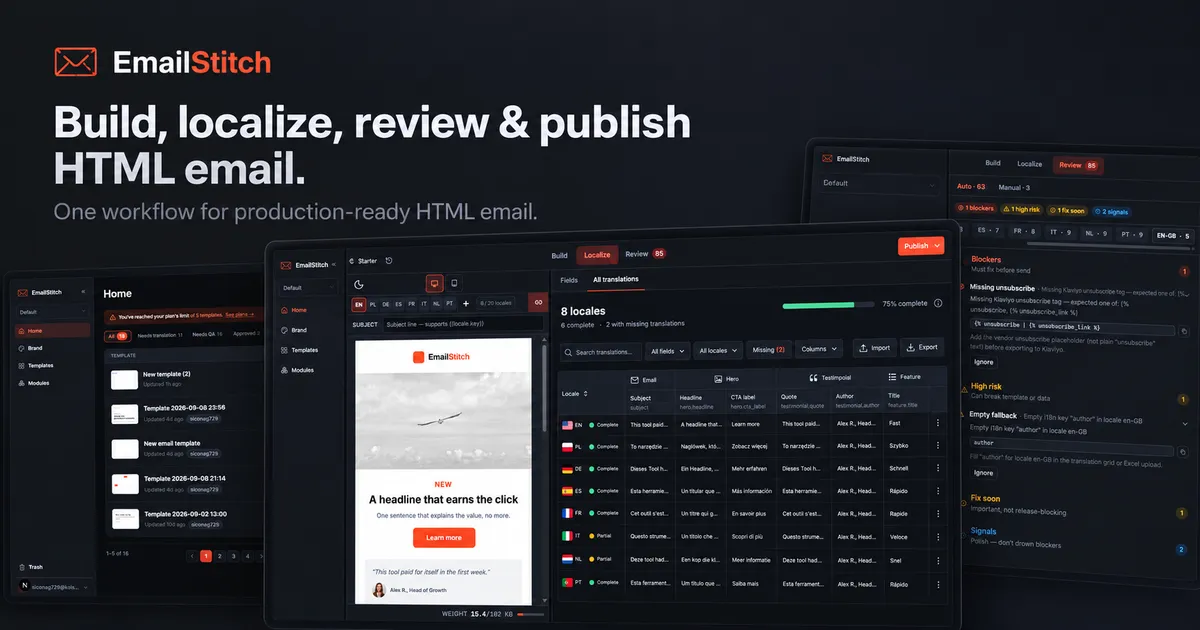
EmailStitch is a web-based email production platform that consolidates the entire HTML email workflow — building, localizing, reviewing, and publishing — into a single tool. It is designed for email developers, marketers, localization teams, QA reviewers, and CRM/ops specialists who currently juggle multiple tools such as Google Docs, spreadsheets, Slack, and test inboxes to get a single campaign out the door. A product by Vivivo Solutions, EmailStitch offers a free plan with no credit card required and positions itself as a replacement for the fragmented, handoff-heavy process that causes localized versions to drift from the source.
Key Features
- Dual build views (Canvas and HTML): Marketers can drag reusable modules from a workspace library onto a canvas and fill in fields, while developers write the underlying HTML in a real editor with a live preview. Both views edit the same template, so there is no file passing between roles.
- Brand tokens and design system: Colors, fonts, and the email frame are defined once at the workspace level. Modules and HTML reference them as tokens, so a change to the primary color propagates to every email in the workspace.
- Translation grid and localization: Each language keeps its own copy, subject line, and preheader on the same shared HTML. Translations can be filled in a grid or imported/exported via Excel and CSV, and link paths and domains are remapped per locale at compile time.
- Auto QA and human review: Automated checks run on every language for missing unsubscribe tags, dead links, leftover tokens, and Gmail clipping, ranked by severity (blockers, high risk, fix soon, signals). Reviewers can pin comments on the preview, reply, mention teammates, and complete a five-point sign-off with names and timestamps.
- Direct ESP publishing: Compiled templates push directly to Mailchimp, Klaviyo, Brevo, HubSpot, ActiveCampaign, or Omnisend as separate templates per language, named according to user-defined conventions. A ZIP download of the same standard HTML is available for any other ESP.
- Share preview links: A public link displays every language side by side with its subject line, and anyone with the link can pin a comment without creating an account. Sharing can be revoked at any time.
- Standard HTML output: Emails are written in standard HTML with plain
{{locale.key}} tokens, and the compiled output contains no proprietary runtime, ensuring no vendor lock-in.
Primary Use Cases
- Multilingual campaign production: A retail brand running a Black Friday promotion in English, German, and French can maintain one shared HTML template, fill each language's copy and subject line in the translation grid, and push all three locales to Klaviyo as separately named templates.
- Developer-marketer collaboration: An email developer writes reusable modules and HTML with brand tokens, while a marketer edits text, links, and images directly in the preview without touching the table structure, keeping the layout intact.
- Pre-send QA and approval: A QA reviewer runs Auto QA across every language to catch dead links and missing unsubscribe tags, pins comments on specific blocks, and collects five sign-offs (subject, legal, desktop, links, mobile) before publishing.
- External stakeholder review: An agency shares a public preview link with a client, who pins comments on the email without signing up, and the agency disables the link once feedback is collected.
What Sets It Apart
EmailStitch's core differentiator is the unification of build, localization, review, and publishing around a single HTML source. Rather than treating localization as a separate spreadsheet exercise or review as a chat-thread activity, it keeps translations, feedback, and QA results attached to the email itself. The platform supports both code-first and no-code workflows on the same template, and it avoids proprietary markup, allowing users to export standard HTML at any time. Direct ESP integrations remove the manual ZIP upload step that typically follows compilation.
Value Proposition
EmailStitch replaces the five-tool chain that email teams often rely on with one workflow, reducing handoff errors and keeping every language version in sync with the source. Its free plan includes one workspace, five templates, five modules, three languages per template, the full Auto QA engine, ESP push, ZIP export, one share link, and seven days of version history — making it accessible for solo developers and small teams while scaling to larger operations through paid upgrades.